
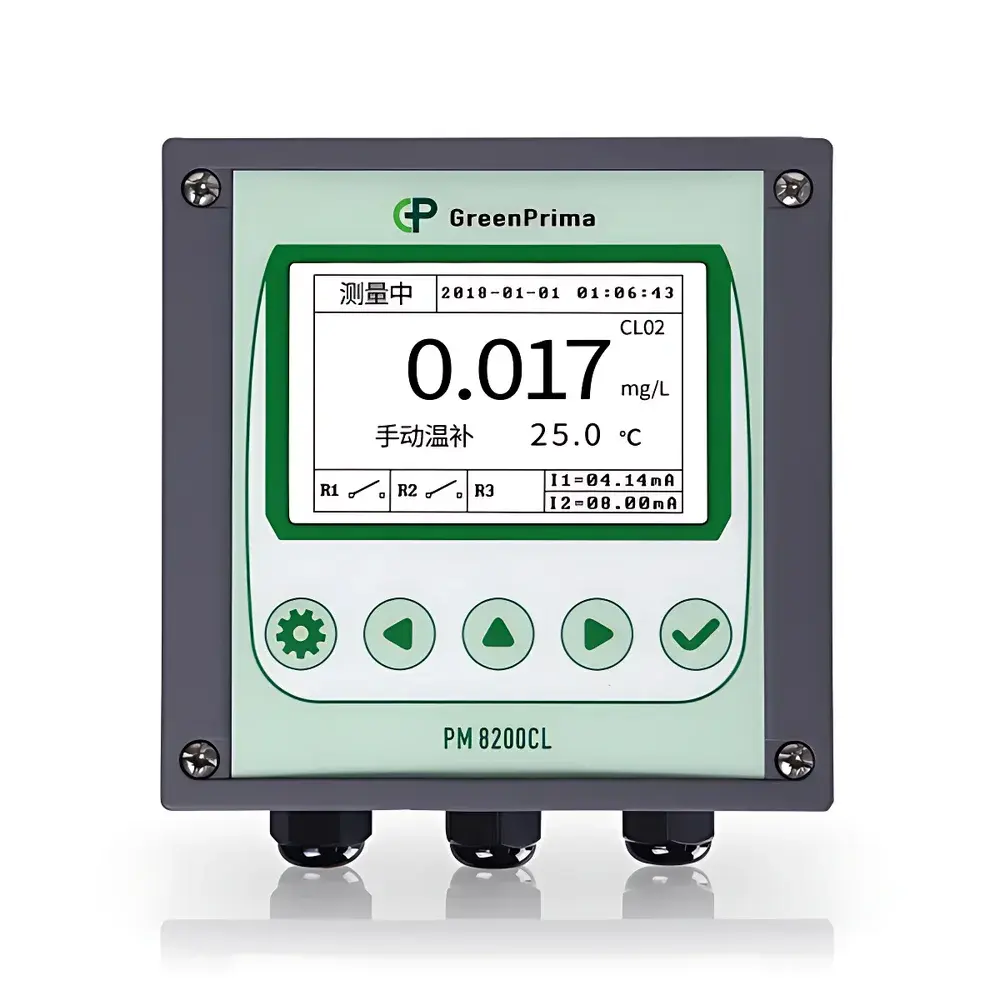
GreenPrima PM8200CL Online Residual Chlorine, Chlorine Dioxide & Ozone Analyzer
| Brand | GreenPrima |
|---|---|
| Origin | United Kingdom |
| Manufacturer Type | OEM Manufacturer |
| Product Category | Imported Instrument |
| Model | PM8200CL |
| Instrument Type | Online Analyzer |
| Measurement Principle | Amperometric Electrochemical Sensor (Constant Voltage Polarography) |
| Measured Parameters | Free Chlorine, Combined Chlorine, Chlorine Dioxide, Ozone |
| Range | 0–2.000 ppm and 0–20.00 ppm (dual-range auto-scaling) |
| Accuracy | ±0.001 ppm / ±0.01 ppm (depending on range) |
| Repeatability | ±0.001 ppm / ±0.01 ppm |
| Resolution | 0.001 ppm / 0.01 ppm |
| Detection Limit | 0.001 ppm / 0.01 ppm |
| Temperature Compensation | -10 to 130 °C (NTC10K or PT1000 selectable, manual/automatic) |
| Operating Temperature | 0–70.0 °C |
| Storage Temperature | -20 to 70.0 °C |
| Display | Backlit large-dot-matrix LCD with bilingual (English/Chinese) menu |
| Data Storage | 600,000 records |
| Power Supply | 90–260 VAC, 50/60 Hz or optional 24 VDC |
| Enclosure Rating | IP65 |
| Communication | RS485, MODBUS-RTU compliant |
| Analog Outputs | Two isolated 4–20 mA outputs (max. loop resistance 500 Ω, accuracy ±0.1% FS) |
| Cleaning Control Output | Adjustable cleaning interval (0.1–1000 h) and duration (1–1000 s) |
| Mounting Options | Wall-mount, pole-mount, panel-mount |
| Dimensions | 144 × 144 × 106 mm |
| Panel Cutout | 138 × 138 mm |
| Weight | 0.86 kg |
| Sensor Model | Bsens650 |
| Sensor Material | Glass body with dual-platinum ring electrode |
| Max. Pressure Rating | 5 bar |
| Cable Length | 3 m |
| Electrode Accuracy | ±2% FS |
Overview
The GreenPrima PM8200CL is a fully integrated online analyzer engineered for continuous, real-time monitoring of free chlorine, combined chlorine, chlorine dioxide, and ozone in aqueous systems. It operates on the principle of amperometric electrochemical sensing via constant-voltage polarography — a well-established method standardized under ASTM D1253, ISO 7393-2, and USP . In this configuration, a stable potential is applied between a working electrode (dual-platinum ring) and a reference electrode; oxidizing species such as Cl₂, ClO₂, and O₃ undergo reduction at the catalytic surface, generating a diffusion-controlled current proportional to their concentration. The system’s glass-bodied Bsens650 sensor eliminates membrane dependency and electrolyte replenishment, significantly reducing maintenance overhead while maintaining high reproducibility across variable flow and temperature conditions.
Key Features
- True membrane-free, reagentless operation — no consumable membranes, fill solutions, or colorimetric reagents required
- Dual-range auto-scaling measurement (0–2.000 ppm and 0–20.00 ppm) with resolution down to 0.001 ppm in low range
- Integrated temperature compensation using NTC10K or PT1000 sensors, supporting both manual and automatic modes
- Two isolated 4–20 mA analog outputs with full-scale accuracy of ±0.1%, configurable per parameter
- RS485 interface compliant with MODBUS-RTU protocol for seamless integration into SCADA, DCS, or PLC-based control architectures
- Programmable cleaning sequence with adjustable frequency (0.1–1000 hours) and duration (1–1000 seconds)
- IP65-rated enclosure suitable for indoor and sheltered outdoor installations in water treatment facilities
- Bilingual (English/Chinese) user interface with backlit dot-matrix LCD and intuitive navigation
- Onboard data logging capacity of 600,000 timestamped records, supporting trend analysis and regulatory reporting
Sample Compatibility & Compliance
The PM8200CL is validated for use in potable water distribution networks, municipal drinking water plants, swimming pool circulation systems, hospital wastewater disinfection units, pharmaceutical purified water loops (PW/WFI), and industrial cooling towers. Its sensor design meets material compatibility requirements per FDA 21 CFR Part 11 for electronic records and signatures when paired with compliant data management software. The analyzer supports GLP/GMP-aligned operational practices through audit-trail-capable configuration logs, calibration history storage, and user-access-level controls. It complies with EN 50178 for electrical safety in measuring equipment and conforms to electromagnetic compatibility standards IEC 61326-1 for industrial environments.
Software & Data Management
Data acquisition and configuration are managed via the front-panel interface or remotely through MODBUS-RTU polling. Logged measurements include timestamp, measured value, temperature reading, sensor status flags (e.g., signal drift, low-flow alert), and calibration metadata. Export is supported via USB or serial dump to CSV-compatible formats for integration with LIMS or enterprise analytics platforms. Optional PC-based configuration utility enables advanced setup of alarm thresholds, output scaling, and diagnostic diagnostics — all traceable with operator ID and time stamp to satisfy FDA 21 CFR Part 11 requirements for electronic records integrity.
Applications
- Real-time process control of chlorination and ozonation stages in municipal water treatment plants
- Monitoring residual disinfectant levels at distribution network endpoints (e.g., reservoirs, booster stations)
- Automated feedback control for chlorine dioxide generators in food processing and beverage production
- Compliance verification against WHO Guidelines for Drinking-water Quality and EU Directive 98/83/EC
- Disinfection validation in pharmaceutical clean utilities per USP and Annex 1
- Swimming pool and spa water quality assurance per CDC Model Aquatic Health Code (MAHC)
- Industrial closed-loop cooling water systems requiring continuous biocide concentration oversight
FAQ
Does the PM8200CL require routine membrane replacement or electrolyte refilling?
No — the Bsens650 sensor employs a solid-state, membrane-free electrochemical architecture with a dual-platinum ring electrode and integrated reference system, eliminating the need for consumable membranes or liquid electrolytes.
Can the instrument simultaneously measure free chlorine, chlorine dioxide, and ozone?
No — the PM8200CL measures one oxidant species per installation; sensor selection (Cl₂-, ClO₂-, or O₃-specific Bsens650 variants) must be specified at time of order based on application requirements.
Is temperature compensation automatic or manual?
Both options are supported: automatic compensation using integrated NTC10K or PT1000 probes, or manual entry of fixed temperature values during calibration.
What is the maximum allowable pressure at the BAF615 flow cell inlet?
The BAF615 flow-through cell is rated for continuous operation up to 5 bar (72.5 psi), with recommended operating pressure between 0.5–3.0 bar for optimal laminar flow and response stability.
How frequently should calibration be performed?
Initial calibration is recommended before commissioning; subsequent verification intervals depend on application criticality — typically every 7–30 days for regulatory compliance environments, supported by automated zero/span checks and drift alerts.







