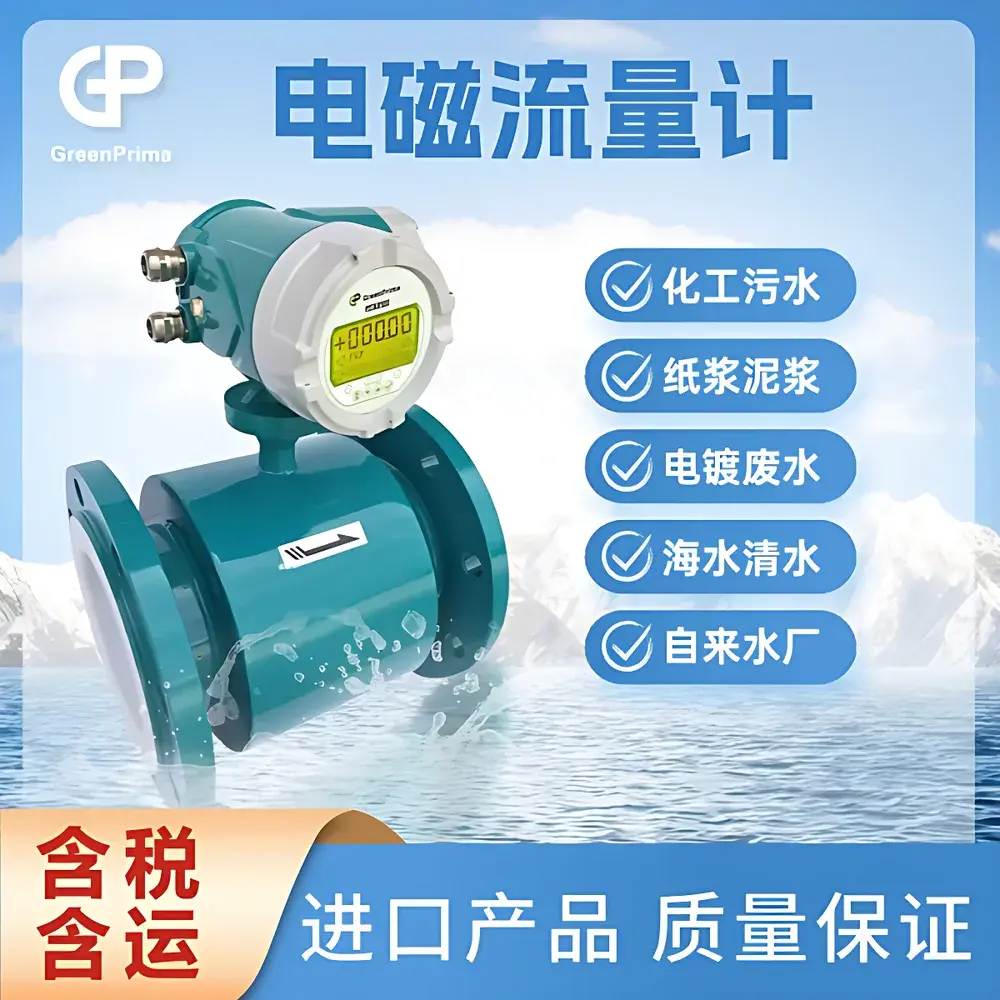
GreenPrima PST AB500 Electromagnetic Flow Meter for Chemical Wastewater
| Brand | GreenPrima |
|---|---|
| Origin | UK |
| Manufacturer Type | Manufacturer |
| Origin Category | Imported |
| Model | PST AB5 00 |
| Price | Upon Request |
| Measurement Principle | Electromagnetic Induction (Faraday’s Law) |
| Nominal Diameter Range | DN10–DN2200 |
| Accuracy | ≤±0.3% of reading |
| Repeatability | ±0.1% |
| Minimum Conductivity | >5 µS/cm |
| Flow Velocity Range | 0.1–15 m/s |
| Electrode Materials | 316L SS, Hastelloy B/C, Titanium, Tantalum, Platinum-Iridium, Ni, HC, HB |
| Lining Materials | PTFE, F46, Neoprene, Polyurethane |
| Process Temp. | –30°C to +250°C |
| Ambient Temp. | –30°C to +65°C |
| Enclosure Rating | IP65/IP67/IP68 |
| Output Signals | 4–20 mA, Pulse/Frequency, Dry Contact |
| Digital Protocols | MODBUS RTU (standard), HART, RS485, RS232, GPRS (optional) |
| Power Supply | 85–260 VAC or 11–40 VDC |
| Zero Adjustment | Empty Pipe Detection & Auto-Zero Function |
| Configuration | Integral or Remote Sensor-Transmitter Design |
Overview
The GreenPrima PST AB500 Electromagnetic Flow Meter is an industrial-grade online flow measurement solution engineered specifically for aggressive chemical wastewater streams in continuous process environments. Based on Faraday’s law of electromagnetic induction, the device measures volumetric flow rate of conductive liquids without mechanical obstruction—ensuring zero pressure drop and minimal maintenance. Its non-intrusive design eliminates moving parts within the flow path, making it inherently suitable for slurries, corrosive acids and alkalis (e.g., sulfuric acid, caustic soda), pulp suspensions, and abrasive mineral slurry applications common in petrochemical, pharmaceutical effluent treatment, and municipal wastewater reclamation plants. With a minimum fluid conductivity threshold of 5 µS/cm, the PST AB500 maintains stable calibration across wide variations in temperature, pressure, density, and viscosity—key performance advantages over mechanical or ultrasonic alternatives in chemically heterogeneous waste streams.
Key Features
- Full-bore electromagnetic sensing with no internal obstructions—reducing clogging risk and eliminating pressure loss.
- Dual-directional flow measurement capability with built-in flow direction detection and reversal compensation.
- Self-diagnostic firmware enabling real-time sensor health monitoring, electrode contamination detection, and excitation circuit validation.
- Modular construction supporting integral (compact) or remote (split-type) configurations for flexible installation in confined or hazardous areas.
- Wide operating temperature range: –30°C to +250°C for process media; –30°C to +65°C ambient—validated for steam-cleaned or thermally cycling pipelines.
- Configurable empty-pipe detection and auto-zero function to suppress false readings during intermittent flow or dry-line conditions.
- High-resolution backlit LCD with multilingual menu navigation (English default), supporting local operator interaction without external software.
- Comprehensive electrode and liner material matrix—including PTFE, F46, neoprene, polyurethane, and ceramic options—to match specific corrosion resistance requirements per ISO 15156 and NACE MR0175 standards.
Sample Compatibility & Compliance
The PST AB500 is validated for use with electrically conductive liquids exhibiting ≥5 µS/cm conductivity. It is routinely deployed in compliance with EN 61326-1 (EMC for industrial environments), IEC 61508 (SIL2-capable architecture), and ATEX/IECEx Zone 1 certification (when equipped with appropriate explosion-proof housings). For regulated industries, the meter supports audit-ready data logging when integrated with SCADA systems compliant with FDA 21 CFR Part 11 via optional HART or Modbus TCP gateways. All wetted materials conform to USP Class VI and FDA 21 CFR 177.2600 for incidental food contact where applicable. Calibration traceability follows ISO/IEC 17025-accredited procedures using master meters calibrated against NIST-traceable standards.
Software & Data Management
Configuration and diagnostics are performed locally via the onboard keypad and LCD interface or remotely via GreenPrima’s PC-based FlowConfig Suite (Windows-compatible). The device stores up to 32 event logs—including alarm timestamps, zero adjustments, and parameter changes—with time-stamped audit trails. Digital outputs support Modbus RTU (RS485, standard), HART 7 (4–20 mA superimposed), and optional RS232/GPRS telemetry modules for cloud-connected IIoT deployments. Firmware updates are delivered via microSD card or secure HTTPS endpoint, maintaining version control and change management integrity per GMP Annex 11 requirements.
Applications
- Real-time monitoring of influent/effluent flow in chemical plant wastewater treatment trains.
- Batch dosing control of caustic or acid neutralization agents in pH adjustment loops.
- Slurry transport verification in mining tailings pipelines and pulp & paper black liquor lines.
- Leak detection and mass balance reconciliation across multi-stream process units.
- Regulatory reporting compliance under EU Industrial Emissions Directive (IED) and US EPA NPDES permit conditions.
FAQ
What is the minimum conductivity required for reliable measurement?
The PST AB500 requires a minimum liquid conductivity of 5 µS/cm. Below this threshold, signal-to-noise ratio degrades significantly, affecting zero stability and linearity.
Can the meter operate in partially filled pipes?
No—it is designed exclusively for full-pipe operation. Partially filled conditions violate Faraday’s law assumptions and invalidate volumetric output.
Is the device compatible with SIL2 safety instrumented systems?
Yes, when configured with dual-channel excitation and certified firmware (TÜV-certified functional safety manual available upon request).
How is calibration verified in-situ?
Through built-in simulation mode and zero-check function; field verification may be performed using portable clamp-on ultrasonic reference meters per ISO 10790 guidelines.
Does the flow meter support intrinsically safe operation in Zone 0?
Not natively—the standard unit meets Zone 1 (Ex d/ia) requirements; Zone 0 deployment requires third-party IS barrier integration and system-level certification.
Related Products