
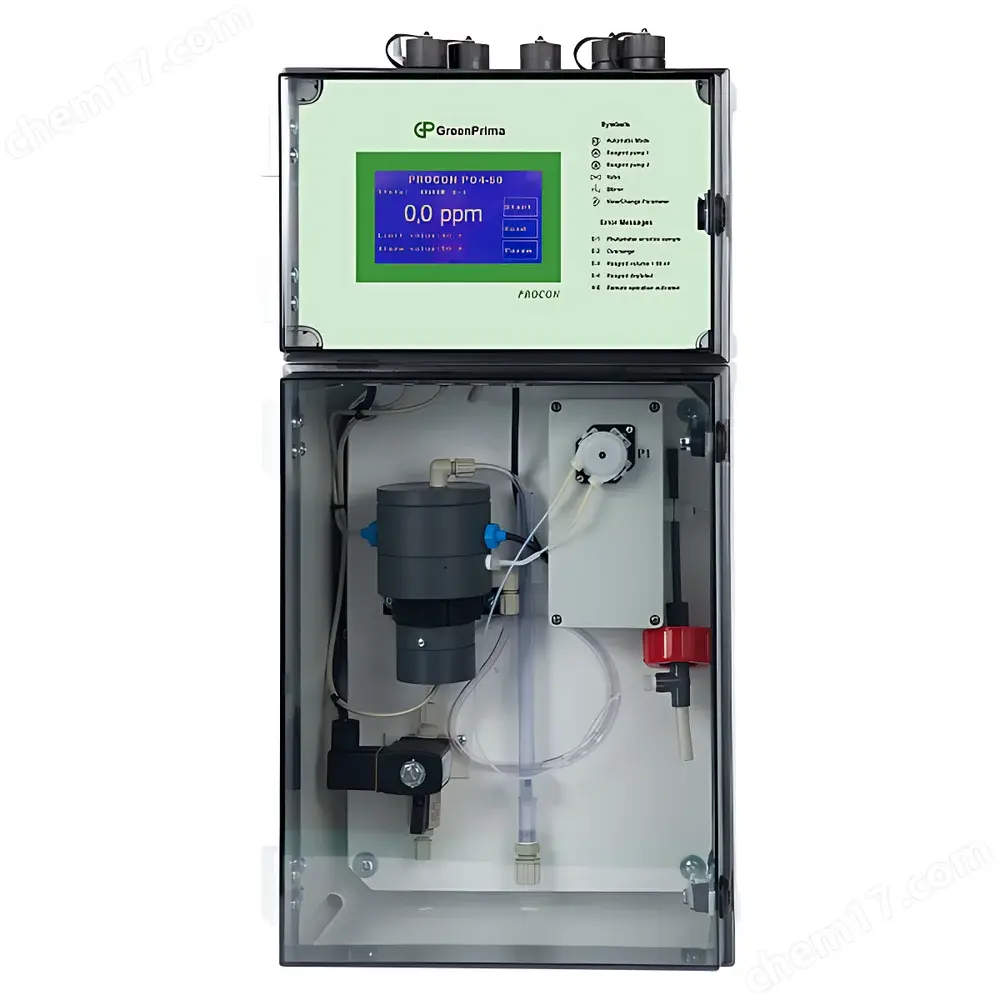
GreenPrima PROCON 6000 Online Silicate Analyzer
| Brand | GreenPrima |
|---|---|
| Origin | United Kingdom |
| Manufacturer Type | Original Equipment Manufacturer (OEM) |
| Product Category | Imported Instrument |
| Model | PROCON 6000 |
| Instrument Type | Online Analyzer |
| Measurement Principle | Photometric Determination of Soluble Silica via Molybdenum Blue Reduction Method |
| Measuring Range Options | 1–100 ppb, 4–999 ppb, 0.02–3 ppm SiO₂ |
| Resolution | 0.1 ppb / 1 ppb / 0.01 ppm |
| Accuracy | ±2% of full scale |
| Repeatability | ±0.5 ppb / ±4 ppb / ±0.02 ppm |
| Zero Stability | Automatic Drift Compensation |
| Analysis Cycle Time | 13 min (standard), adjustable from 1–99 min or externally triggered |
| Display | 240 × 128 pixel monochrome touchscreen LCD |
| Output Signals | Isolated 0/4–20 mA (max. load 500 Ω), programmable |
| Digital Interface | USB port for data export (optional) |
| Relay Outputs | 3× SPDT zero-potential relays (alarm, limit, analysis), rated 230 V AC / 3 A |
| Enclosure Rating | IP65 |
| Operating Temperature | 5–45 °C |
| Power Supply | 110–230 V AC, 50/60 Hz |
| Power Consumption | ~16 VA |
| Dimensions (H×W×D) | 640 × 315 × 190 mm |
| Weight | Approx. 22 kg |
Overview
The GreenPrima PROCON 6000 is a fully automated, online silicate analyzer engineered for continuous, high-precision monitoring of soluble silica (SiO₂) in ultrapure water systems. It employs the standardized photometric molybdenum blue reduction method—per ASTM D859 and ISO 10523—where orthosilicic acid reacts with ammonium molybdate under acidic conditions to form a heteropoly acid, subsequently reduced to a stable blue-colored complex (β-silicomolybdic acid). Absorbance is measured at 815 nm using a solid-state photodiode detector with temperature-stabilized optical path, ensuring long-term baseline integrity and minimal spectral interference. Designed for deployment in critical water loops—including boiler feedwater, turbine condensate, nuclear steam generators, and semiconductor process rinse water—the PROCON 6000 delivers trace-level quantification down to 0.1 ppb, supporting strict compliance with EP, USP , and IAPWS guidelines for silica control in high-pressure thermal cycles.
Key Features
- Fully autonomous operation with integrated microprocessor-controlled fluidics: automatic sample aspiration, line flushing, reagent dosing (molybdate + reducing agent), reaction timing, and photometric readout
- Three selectable measurement ranges optimized for different water quality regimes: low-range (1–100 ppb), mid-range (4–999 ppb), and high-range (0.02–3 ppm SiO₂)
- Self-calibrating zero point and dynamic drift compensation algorithm eliminates need for routine manual zeroing or calibration verification
- Intuitive 240 × 128 pixel resistive touchscreen interface with multilingual menu support (English, German, French, Spanish)
- Configurable analysis interval (1–99 minutes) and external trigger capability via dry-contact input for synchronization with plant PLCs or sampling events
- Programmable 0/4–20 mA analog outputs with user-defined scaling, fault signaling (e.g., sensor failure, low reagent), and HART-compatible configuration mode
- IP65-rated enclosure with modular front-access design for rapid maintenance and reagent cartridge replacement without tools
- Onboard data logging (up to 30 days at 1-min intervals) and optional USB mass storage export for audit-ready CSV files
Sample Compatibility & Compliance
The PROCON 6000 is validated for use with deionized, reverse osmosis, and mixed-bed polished water streams exhibiting conductivity <0.2 µS/cm and total organic carbon (TOC) <50 ppb. It complies with IEC 61326-1 (EMC for industrial environments), IEC 61000-4 series (surge, ESD, fast transient immunity), and meets CE marking requirements under the EU Machinery Directive 2006/42/EC. Its measurement protocol aligns with regulatory expectations for GLP/GMP water system monitoring per FDA 21 CFR Part 11 when paired with secure data management software (e.g., GreenPrima DataLink Suite with electronic signature and audit trail). All wetted parts—including peristaltic pump tubing, reaction chamber, and flow cells—are constructed from PFA, quartz, and 316L SS to prevent leaching or adsorption artifacts.
Software & Data Management
The analyzer operates on embedded firmware v4.2+ supporting local configuration via touchscreen or remote access through Modbus TCP (port 502) or ASCII serial protocol (RS-485). Optional GreenPrima DataLink Suite enables centralized fleet monitoring, trend visualization, alarm aggregation, and automated report generation (PDF/Excel). All critical events—including reagent depletion warnings, optical path fouling alerts, and out-of-spec measurements—are timestamped and stored with operator ID and action log. Audit trail functionality records parameter changes, calibration events, and user login/logout sessions—fully compliant with ALCOA+ data integrity principles and Annex 11 requirements.
Applications
- Power generation: Real-time silica surveillance in HP/LP turbine condensate, feedwater heaters, and once-through boiler makeup to prevent silica deposition on turbine blades and heat exchanger surfaces
- Pharmaceutical manufacturing: Continuous verification of purified water (PW) and water for injection (WFI) systems per USP and EU GMP Annex 1
- Semiconductor fabrication: Monitoring final rinse water in wafer cleaning lines where sub-ppb silica is required to avoid pattern collapse and particle adhesion
- Chemical and petrochemical plants: Control of ion exchange resin exhaustion and regeneration cycles based on silica breakthrough detection
- Nuclear utilities: Ensuring compliance with EPRI TR-102323 silica limits in secondary coolant loops to mitigate stress corrosion cracking risks
FAQ
What is the minimum detectable silica concentration?
The lower limit of quantitation (LLOQ) is 0.1 ppb SiO₂ in the 1–100 ppb range, verified per ICH Q2(R2) guidelines using standard addition methodology.
Does the analyzer require daily maintenance?
No routine daily intervention is required. Reagent cartridges are rated for 30 days of continuous operation at 13-minute cycle intervals; only quarterly optical window inspection and annual pump tube replacement are recommended.
Can it be integrated into a DCS or SCADA system?
Yes—via isolated 4–20 mA analog output, Modbus TCP Ethernet, or dry-contact relay signals. Configuration templates for Siemens Desigo, Honeywell Experion, and Emerson DeltaV are available upon request.
Is reagent consumption documented and traceable?
Yes—each reagent batch is assigned a unique barcode scanned during installation; usage volume, expiration date, and lot number are logged and exported with measurement data.
How is cross-contamination prevented between samples?
The system performs a full-line purge with deionized water before each analysis cycle, and all fluid paths are pressure-tested to ensure no carryover; flow cell geometry minimizes dead volume to <15 µL.
Related Products







