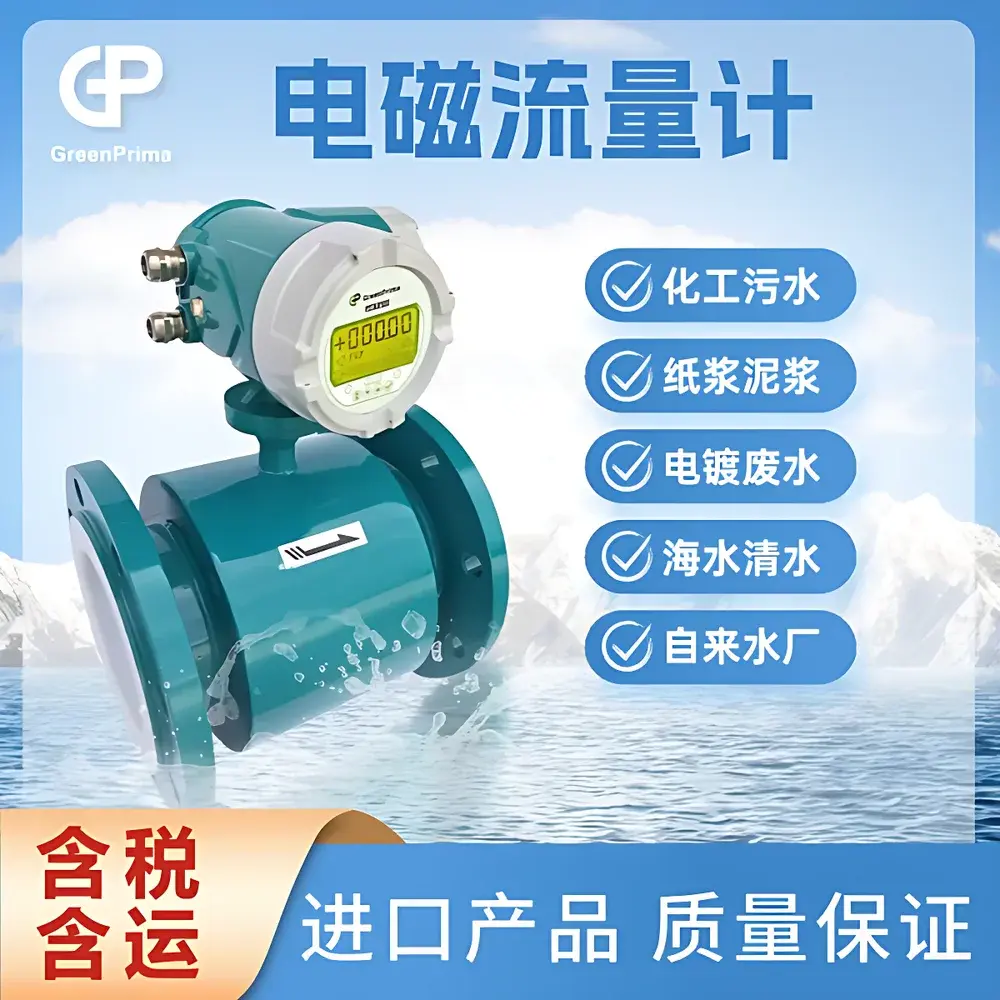
GreenPrima PSTA-B500 Electromagnetic Flow Meter for Chemical Wastewater Applications
| Brand | GreenPrima |
|---|---|
| Origin | United Kingdom |
| Manufacturer Type | Direct Manufacturer |
| Origin Category | Imported |
| Model | PSTA-B500 |
| Pricing | Available Upon Request |
| Nominal Diameter Range | DN10–DN2200 |
| Accuracy | ≤0.3% of reading |
| Repeatability | ±0.1% |
| Minimum Conductivity | >5 µS/cm |
| Flow Velocity Range | 0.1–15 m/s |
| Electrode Materials | 316L stainless steel, Hastelloy B/C, Titanium, Tantalum, Platinum-Iridium, Niobium, HC, HB |
| Lining Materials | PTFE, F46, Neoprene, Polyurethane |
| Process Temperature | –30°C to +250°C |
| Ambient Temperature | –30°C to +65°C |
| Enclosure Rating | IP65 / IP67 / IP68 |
| Power Supply | 85–260 VAC or 11–40 VDC |
| Output Signals | 4–20 mA, pulse/frequency, passive contact |
| Communication Protocols | MODBUS RTU (standard), HART, RS485, RS232, GPRS (optional) |
| Display | Backlit LCD with multilingual menu support |
| Installation Options | Integral or Remote (separated sensor and transmitter) |
| Empty Pipe Detection | Yes |
| Bidirectional Flow Measurement | Supported |
| Self-Diagnostic Functionality | Integrated |
Overview
The GreenPrima PSTA-B500 Electromagnetic Flow Meter is an industrial-grade online flow measurement solution engineered specifically for aggressive chemical wastewater streams in process-intensive environments. Operating on Faraday’s Law of Electromagnetic Induction, the PSTA-B500 measures volumetric flow rate by detecting the voltage induced across a conductive fluid moving perpendicularly through a magnetic field. Its non-intrusive measurement principle eliminates mechanical wear, pressure drop, and sensitivity to fluid density, viscosity, temperature, or pressure fluctuations—making it uniquely suited for highly variable, corrosive, and heterogeneous effluents common in chemical manufacturing, petrochemical refining, pharmaceutical wastewater treatment, and pulp & paper mill discharge monitoring.
Key Features
- Robust electromagnetic sensing architecture with zero-moving-parts measurement path—ensures long-term stability and minimal maintenance in abrasive or scaling wastewater conditions.
- Configurable electrode and liner material combinations—including Hastelloy C-276, titanium, tantalum, platinum-iridium, PTFE, F46, and polyurethane—to match specific chemical compatibility requirements per ISO 21809-3 and NACE MR0175/ISO 15156 standards.
- Integrated self-diagnostics including coil integrity verification, electrode contamination detection, empty-pipe recognition, and signal-to-noise ratio monitoring—supporting predictive maintenance and reducing unplanned downtime.
- Bidirectional flow measurement capability with high-resolution velocity sampling (up to 100 Hz), enabling accurate net flow calculation in recirculation loops or batch reactor drain-back scenarios.
- Wide operating temperature range (–30°C to +250°C process; –30°C to +65°C ambient) validated per IEC 60529 for IP65/IP67/IP68 enclosures—suitable for outdoor, washdown, and explosion-hazardous zones when paired with appropriate certifications (ATEX/IECEx optional).
- Low straight-run installation requirement (5D upstream / 2D downstream typical), minimizing footprint in retrofit applications where space-constrained piping layouts prevail.
Sample Compatibility & Compliance
The PSTA-B500 is certified for continuous operation with liquids exhibiting minimum electrical conductivity ≥5 µS/cm—covering strong acids (e.g., sulfuric, hydrochloric), caustic alkalis (e.g., sodium hydroxide), saline brines, slurry suspensions (e.g., limestone, activated carbon, lime mud), and fiber-laden effluents. It complies with EN 14181 (QAL1/QAL2 for continuous emission monitoring systems), meets electromagnetic compatibility requirements per EN 61326-1:2013, and supports audit-ready data integrity under FDA 21 CFR Part 11 when configured with secure MODBUS TCP or HART-enabled data logging. Optional GPRS telemetry enables remote transmission of flow totals, alarms, and diagnostic logs to centralized SCADA or MES platforms—facilitating real-time compliance reporting for ISO 14001 environmental management systems.
Software & Data Management
The integrated transmitter firmware includes configurable flow totalization (batch, daily, monthly), alarm thresholds (flow rate, empty pipe, sensor fault), and event logging with timestamped records stored onboard for ≥30 days. Standard MODBUS RTU over RS485 allows seamless integration into DCS/PLC networks (Siemens S7, Rockwell ControlLogix, Yokogawa CENTUM VP). Optional HART 7.5 protocol enables loop-powered configuration via handheld communicators or asset management software (e.g., Emerson DeltaV AMS, Honeywell Experion PKS). All communication interfaces support encrypted parameter read/write and user-access level control (operator/engineer/administrator), aligning with ISA/IEC 62443-3-3 cybersecurity guidelines.
Applications
- Real-time monitoring of influent and effluent streams in chemical plant wastewater treatment plants (WWTPs)
- Corrosive acid/base dosing control in neutralization reactors and scrubber systems
- Slurry flow measurement in catalyst recovery loops and spent caustic handling
- Batch volume verification during tank-to-tank transfers of hazardous waste streams
- Leak detection and balance calculations in multi-branch process drainage networks
- Regulatory reporting for EPA NPDES permits and EU Industrial Emissions Directive (IED) compliance
FAQ
What minimum conductivity is required for reliable measurement?
The PSTA-B500 requires a liquid conductivity ≥5 µS/cm. Below this threshold, signal-to-noise ratio degrades significantly—validation testing with representative process fluid is recommended prior to deployment.
Can the meter operate in partially filled pipes?
No. Electromagnetic flow meters require full pipe cross-section coverage for accurate velocity profile integration. For open-channel or gravity-fed applications, alternative technologies such as ultrasonic Doppler or area-velocity sensors are advised.
Is calibration traceable to national standards?
Yes. Factory calibration is performed using gravimetric master meters accredited to UKAS ISO/IEC 17025, with certificates issued per ISO 10792-1 and traceable to NPL (National Physical Laboratory, UK).
How does the device handle air entrainment or gas bubbles?
Transient gas pockets may cause momentary signal dropout or noise spikes. The firmware applies adaptive filtering and hold-last-valid-value logic to maintain continuity during brief interruptions—however, sustained two-phase flow is outside its design envelope.
What documentation is supplied for validation in regulated environments?
Each unit ships with IQ/OQ documentation templates, FAT/SAT test protocols, and a full traceability dossier including material certifications (EN 10204 3.1), RoHS/REACH declarations, and EMC test reports.
Related Products