
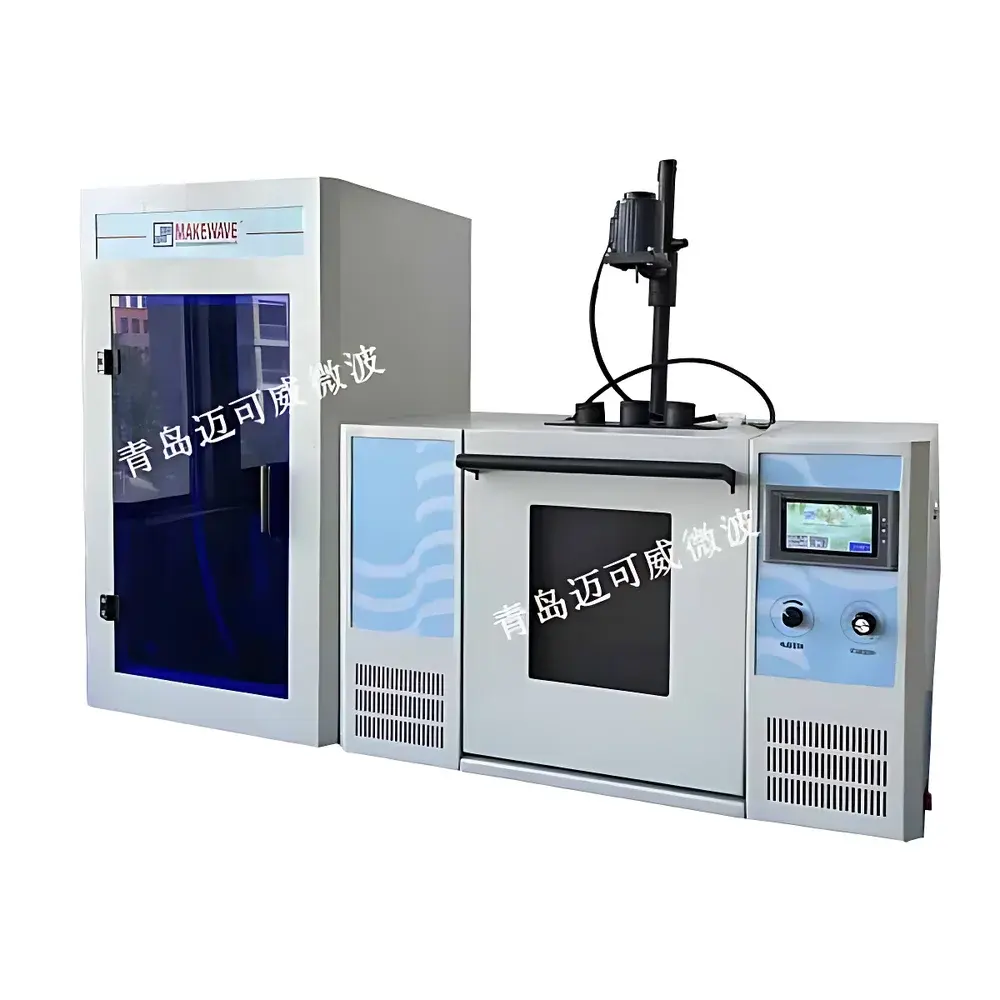
MakeWave MKG-H1C1A Microwave High-Pressure Continuous Flow Reactor
| Brand | MakeWave |
|---|---|
| Origin | Shandong, China |
| Manufacturer Type | Direct Manufacturer |
| Country of Origin | China |
| Model | MKG-H1C1A |
| Reactor Type | High-Pressure Continuous Flow Reactor |
| Vessel Capacity | 20 L |
| Construction Material | 304 Stainless Steel with 5-Layer PTFE Coating |
| Operating Pressure Range | 0–1 MPa (optional up to 2 MPa) |
| Operating Temperature Range | 0–170 °C (optional up to 200 °C) |
| Microwave Frequency | 2450 ± 50 MHz |
| Microwave Power Output | 0–800 W (continuous, non-pulsed, linearly adjustable) |
| Flow Rate Range | 0–50 mL/min |
| Reaction Tubing | Φ1 mm × 10 m PEEK/PTFE composite tubing |
| Vacuum Capability | 2 Pa |
| Safety Compliance | Microwave leakage < 5 mW/cm² (IEC 61000-4-3 compliant) |
| Dimensions (W×H×D) | 782 × 492 × 450 mm |
| Weight | 50 kg |
| Power Supply | 220 V AC / 50 Hz |
| Total Power Consumption | 1300 W |
Overview
The MakeWave MKG-H1C1A Microwave High-Pressure Continuous Flow Reactor is an engineered platform for precise, scalable, and reproducible chemical synthesis under controlled microwave irradiation and elevated pressure conditions. It operates on the principle of continuous-flow microwave-assisted chemistry, where liquid-phase reagents are pumped through a precisely dimensioned fluoropolymer reaction coil housed within a shielded, corrosion-resistant 20 L stainless steel cavity. Unlike batch-mode microwave reactors, this system enables real-time thermal and kinetic control during transit—minimizing hot-spot formation, improving heat transfer efficiency, and enhancing reaction selectivity and yield consistency. Designed for laboratory-to-pilot transition, the MKG-H1C1A supports seamless integration into process development workflows in pharmaceutical R&D, fine chemical synthesis, materials precursor preparation, and catalytic reaction screening. Its architecture complies with fundamental safety and electromagnetic compatibility requirements per IEC 61000-4-3 and meets ISO 9001 quality management standards for manufacturing traceability and process validation.
Key Features
- 20 L high-strength 304 stainless steel cavity with five-layer PTFE internal coating—engineered for long-term resistance to acidic, alkaline, and high-temperature process environments.
- Continuous-wave microwave generation at 2450 ± 50 MHz, delivering 0–800 W output with linear, non-pulsed power modulation for stable energy coupling and minimal thermal overshoot.
- Φ1 mm × 10 m chemically inert reaction tubing (PEEK/PTFE composite), supporting inline temperature and pressure monitoring at both inlet and outlet ports.
- Dual-loop closed-control system: independent PID regulation of microwave power, fluid temperature (0–170 °C, optional 200 °C), and system pressure (0–1 MPa, optional 2 MPa).
- Modular flow configuration: supports external recirculation mode (0–50 mL/min), integrated cooling loop at outlet, and optional 500 mL atmospheric-pressure batch module with magnetic stirring and reflux condensation.
- Integrated safety architecture including door-interlocked power cutoff, dual redundant pressure sensors with mechanical burst-disk relief, real-time microwave leakage monitoring (< 5 mW/cm²), and active cavity ventilation maintaining micro-negative pressure.
Sample Compatibility & Compliance
The MKG-H1C1A accommodates a broad range of liquid-phase chemistries—including polar and low-dielectric solvents, aqueous suspensions, and viscous organometallic precursors—without requiring solvent-specific tuning. Its corrosion-resistant cavity and inert tubing ensure compatibility with HCl, HNO₃, HF-containing media (under validated concentration limits), and aggressive oxidants such as peroxides or chlorinated reagents. The system conforms to general laboratory safety directives outlined in ISO/IEC 17025 for equipment qualification and supports documentation required for GLP-compliant study execution. While not inherently 21 CFR Part 11–compliant out-of-the-box, audit-ready data logs (timestamped temperature, pressure, power, and flow profiles) can be exported in CSV format for integration into validated electronic lab notebook (ELN) or LIMS environments.
Software & Data Management
Control is executed via a dedicated PLC-based interface with a 7-inch capacitive touchscreen HMI. All operational parameters—including multi-step ramp-hold temperature profiles, pressure ramping sequences, and dynamic power modulation—are programmable and stored in up to 100 user-defined protocols. Real-time graphical overlays display concurrent time-series curves for temperature, pressure, and microwave output. Data logging resolution is 1 Hz, with automatic timestamping and local SD-card storage. Export functionality supports direct USB transfer of raw datasets for post-acquisition analysis in MATLAB, Python (Pandas), or commercial kinetics modeling platforms. Optional video monitoring (via IP camera mounted behind quartz viewport) provides visual correlation between thermal events and observable phase changes or precipitate formation.
Applications
This reactor is routinely deployed in academic and industrial laboratories for: accelerated heterocyclic synthesis (e.g., Suzuki, Heck, and Buchwald–Hartwig couplings); nanoparticle nucleation and size-controlled growth (e.g., metal oxides, perovskites); continuous hydrothermal carbonization of biomass feedstocks; rapid extraction of phytochemicals from plant matrices; kinetic isotope effect (KIE) studies under steady-state thermal gradients; and development of continuous API crystallization processes. Its scalability—through parallelization or serial staging—enables direct translation of optimized residence-time distributions (RTDs) to pilot-scale continuous manufacturing units aligned with ICH Q5C and Q8(R2) guidance.
FAQ
What types of solvents are compatible with the MKG-H1C1A’s reaction tubing and cavity?
Standard operation supports water, alcohols, DMF, DMSO, acetonitrile, ethyl acetate, and dichloromethane. For HF or >60% sulfuric acid, consult technical documentation for exposure duration limits and recommended tubing replacement intervals.
Can the system operate under inert atmosphere conditions?
Yes—integrated gas purge ports (N₂ or Ar) allow headspace displacement prior to pressurization. Optional mass flow controller integration enables continuous inert gas sweep during operation.
Is remote monitoring or network connectivity supported?
The base unit includes RS485 Modbus RTU for integration into SCADA or building management systems. Ethernet/WiFi modules are available as factory-installed options for cloud-enabled telemetry and alarm notification.
How is calibration traceability maintained for temperature and pressure sensors?
Each sensor is supplied with individual NIST-traceable calibration certificates. Field verification procedures using reference thermocouples and dead-weight testers are documented in the user manual and align with ASTM E2877 practices.
Does the system support GMP documentation packages for regulated environments?
Upon request, MakeWave provides IQ/OQ protocol templates, FAT/SAT reports, and full component-level material certifications (EN 10204 3.1) to support equipment qualification under EU Annex 15 or FDA guidance.



