
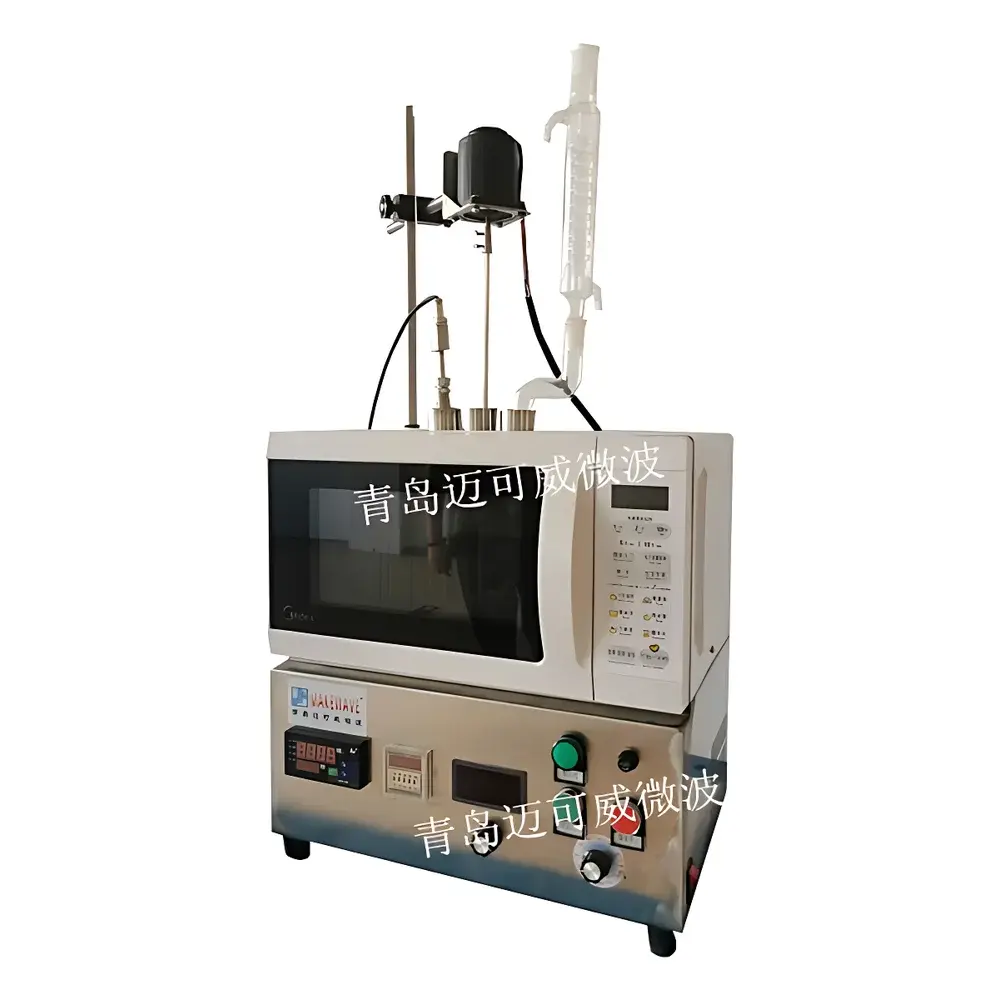
MakeWave MKJ-J1-3 Economical Laboratory Microwave Reactor
| Brand | MakeWave |
|---|---|
| Origin | Shandong, China |
| Manufacturer Type | Direct Manufacturer |
| Product Origin | Domestic (China) |
| Model | MKJ-J1-3 |
| Temperature Range | 0–300 °C |
| Pressure Operation | Ambient / Slight Positive Pressure |
| Microwave Power Output | 800 W (continuous, non-pulsed) |
| Magnetron Frequency | 2450 MHz |
| Stirring Method | Mechanical (PTFE anchor stirrer with adjustable-speed motor) |
| Reaction Volume | 0.5 L |
| Microwave Leakage | <5 mW/cm² |
| Power Supply | 220 V AC, 50 Hz |
| Overall Power Consumption | 1300 W |
| Cavity Volume | ~18 L |
| Dimensions (W×H×D) | 432 × 466 × 318 mm |
| Weight | 40 kg |
| Quality Certification | ISO 9001 |
Overview
The MakeWave MKJ-J1-3 Economical Laboratory Microwave Reactor is a purpose-engineered, open-atmosphere microwave platform designed for academic research, undergraduate and graduate teaching laboratories, and early-stage process development in synthetic chemistry, materials science, and thermal processing. Unlike high-pressure sealed microwave synthesis systems, the MKJ-J1-3 operates under ambient or slightly positive pressure conditions—eliminating complex pressure vessel engineering while retaining precise control over microwave energy delivery, temperature, and reaction kinetics. Its core architecture leverages a modified domestic microwave cavity (18 L internal volume) optimized for scientific reproducibility, featuring continuous non-pulsed 800 W microwave output at the industrial standard frequency of 2450 MHz. This enables uniform volumetric heating via dielectric loss mechanisms—ideal for solvent-based reactions, catalyst activation, polymerization initiation, dehydration, and thermal decomposition studies where pressure containment is not required. The system is not intended for high-pressure hydrothermal synthesis or explosive-sensitive chemistries; rather, it serves as a robust, cost-effective entry point into microwave-assisted reaction methodology.
Key Features
- Open-system design with ambient/low-pressure operation—no pressurized vessels, safety valves, or gas-tight seals required
- Continuous, non-pulsed 800 W microwave power output with analog regulation—enabling stable thermal ramping and steady-state irradiation
- Integrated mechanical stirring using a PTFE-coated anchor impeller driven by a variable-speed DC motor—compatible with corrosive media and viscous reaction mixtures
- Direct-insertion thermocouple temperature monitoring (0–300 °C range), calibrated for glass reactor compatibility and real-time feedback control
- Modular functional ports on the cavity wall: configurable for condenser attachment, inert gas inlet, sampling, or auxiliary sensor integration (e.g., IR pyrometer)
- Electromechanical control interface enabling independent programming of temperature setpoint, microwave power level, and reaction duration
- λ/4 choke-sealed door structure with dual interlock circuitry—ensuring automatic power cutoff upon door opening and microwave leakage <5 mW/cm² (exceeding GB 4706.21 and IEC 60335-2-90 limits)
- Transparent observation window for visual monitoring of reaction progress, reflux behavior, and stirrer function without interrupting irradiation
Sample Compatibility & Compliance
The MKJ-J1-3 supports standard 500 mL three-neck round-bottom flasks made of borosilicate glass (e.g., Pyrex® or equivalent), accommodating standard ground-glass joints (24/40). It is compatible with common organic solvents (ethanol, DMF, ethylene glycol), aqueous solutions, solid catalysts (e.g., Pd/C, Ni nanoparticles), and heterogeneous slurries. Due to its open configuration, volatile solvents require external condensation (e.g., water-cooled Liebig or Graham condenser) to prevent mass loss. The unit complies with ISO 9001:2015 quality management requirements for design, production, and documentation traceability. While not certified to UL/CSA or CE for standalone commercial deployment in regulated GMP environments, its electrical and RF safety performance meets national standards for laboratory-grade microwave equipment (GB 4706.21-2008, GB/T 18801-2015). For GLP-compliant workflows, users must implement supplementary audit trails via external data loggers or validated third-party software.
Software & Data Management
The MKJ-J1-3 employs a dedicated electromechanical controller—no embedded firmware or proprietary software stack. All operational parameters (temperature setpoint, power level, time) are adjusted manually via front-panel dials and switches. Real-time temperature is displayed on an analog/digital hybrid indicator. For digital data acquisition, users may integrate external thermocouple dataloggers (e.g., Omega OM-DAQPRO-5300 series) or USB-connected thermocouple interfaces compliant with IEEE 11073 or Modbus RTU protocols. The absence of onboard memory or network connectivity ensures electromagnetic isolation and simplifies validation in sensitive instrumentation labs. When paired with optional MakeWave MKX-H1C1-series upgrade modules, the system can support RS-485 communication, CSV export of time-temperature-power profiles, and 21 CFR Part 11–compliant electronic signatures via external LIMS integration.
Applications
- Organic synthesis: Suzuki, Heck, and Ullmann couplings under mild thermal conditions
- Nanomaterial preparation: rapid nucleation and growth of metal oxides (e.g., ZnO, TiO₂) and sulfides (e.g., CdS) in solution
- Polymer chemistry: ring-opening polymerization of lactides, polycondensation of polyesters
- Extraction and purification: microwave-assisted leaching of plant metabolites or metal ions from ores
- Thermal analysis training: comparative kinetic studies of decomposition pathways (TGA-like behavior without dedicated instrumentation)
- Educational demonstrations: illustrating dielectric heating principles, Arrhenius rate dependence, and energy efficiency vs. conventional oil-bath heating
FAQ
Can the MKJ-J1-3 be used for high-pressure reactions?
No. It is strictly an ambient-pressure or micro-positive-pressure system. Do not attempt to seal the reaction vessel or operate with pressure-rated components.
Is the microwave cavity shielded against RF interference with nearby analytical instruments?
Yes—the λ/4 choke door and grounded stainless-steel cavity provide >80 dB attenuation at 2450 MHz. However, maintain ≥1 m separation from sensitive RF receivers (e.g., NMR consoles, FTIR detectors).
What types of temperature sensors are supported besides the supplied thermocouple?
The unit accepts standard K-type thermocouples only. Infrared pyrometers may be mounted externally but require line-of-sight calibration and are not integrated into the control loop.
Does the system include cooling water connections for condenser use?
No. A separate benchtop recirculating chiller or tap-water adapter must be provided by the user for reflux condensation.
Can the MKJ-J1-3 be validated for ISO/IEC 17025 testing laboratories?
Yes—provided users perform full IQ/OQ/PQ documentation, including cavity mapping (ASTM E1558), temperature uniformity verification, and power output calibration per IEC 61217 Annex B. MakeWave supplies calibration certificates for thermocouples and power meters upon request.
Related Products



