
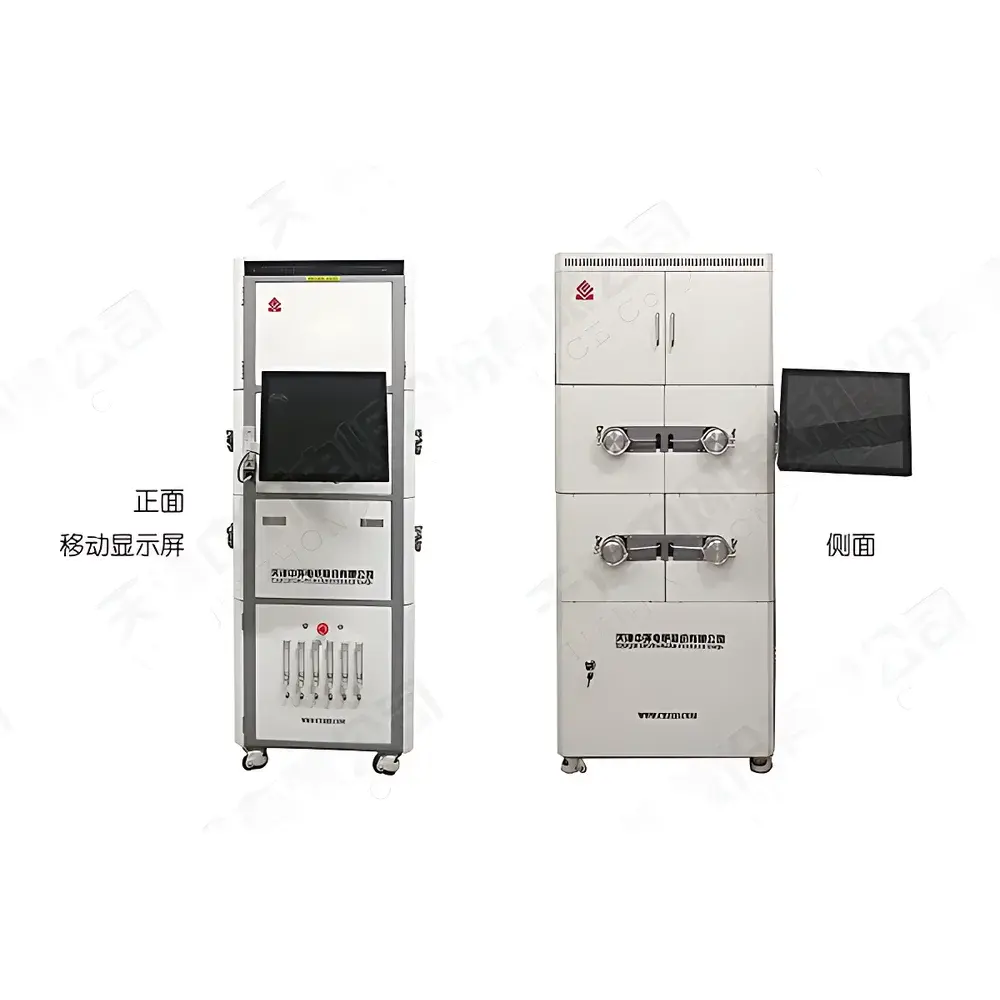
ZHONGHUAN FURNACE DTD-1200 Modular Multi-Channel Sintering System
| Brand | ZHONGHUAN FURNACE |
|---|---|
| Origin | Tianjin, China |
| Model | DTD-1200 Series |
| Max Temperature | 1200 °C |
| Heating Rate | 1–30 °C/min (average) |
| Temp Control Accuracy | ±1 °C |
| Power Rating | 8–15 kW |
| Voltage | 380 V AC |
| Furnace Types | Box-type and Tube-type configurations |
| Box Furnace Chamber Dimensions | 110 × 100 × 100 mm (1 L each) |
| Tube Furnace Heating Zone | 200 mm |
| Tube Furnace Isothermal Zone | 100 mm |
| Quartz Tube Size | Ø50/Ø3 × 650 mm |
| Gas Flow Control | 316L stainless steel double-ferrule fittings with glass rotameters (10–100 mL/min per line) |
| Number of Independent Channels | Configurable up to 12 box furnaces or 6 tube furnaces |
| Enclosure Design | Integrated monolithic chassis |
| Control Interface | Touchscreen with programmable PID temperature profiles |
Overview
The ZHONGHUAN FURNACE DTD-1200 Modular Multi-Channel Sintering System is an engineered platform for parallel thermal processing of advanced materials under controlled atmospheres. Designed around a modular architecture, it integrates independently operable box-type and tube-type furnace modules—each equipped with precision temperature regulation, programmable ramp/soak cycles, and dedicated gas delivery—within a unified structural frame. The system operates on the principle of resistive heating via high-resistivity alloy wire elements, enabling stable, uniform thermal fields across multiple chambers simultaneously. Its core function is to support comparative sintering studies, process optimization trials, and high-throughput thermal treatment of ceramics, battery cathode precursors, metal powders, and functional oxides—where reproducibility across replicate conditions is critical. Unlike single-chamber systems, the DTD-1200 eliminates sequential testing bottlenecks by allowing concurrent experiments at identical or varied setpoints, significantly accelerating R&D timelines in academic labs and industrial process development centers.
Key Features
- Modular configuration flexibility: Select from four standard variants—DTD-1200-4X-4K (4 box + 4 tube), DTD-1200-8X-2K (8 box + 2 tube), DTD-1200-6K (6 tube only), or DTD-1200-12X (12 box only)—to match experimental throughput requirements.
- Independent channel control: Each furnace module features its own touchscreen interface, programmable PID controller, and thermocouple feedback loop, ensuring isolation of thermal profiles and preventing cross-talk between runs.
- Precision atmosphere management: Up to six independent gas lines—configured with 316L stainless steel double-ferrule compression fittings and calibrated glass rotameters—deliver consistent flow rates (10–100 mL/min) for inert, reducing, or reactive environments.
- Thermal uniformity engineering: Box furnaces maintain ±1 °C control accuracy over 1 L chambers (110 × 100 × 100 mm); tube furnaces provide a 100 mm isothermal zone within a 200 mm heating length using Ø50/Ø3 × 650 mm quartz tubes.
- Robust mechanical integration: All variants share a common monolithic chassis (720 × 730 × 1690 mm) with reinforced insulation, front-access doors, and standardized mounting interfaces for future expansion or accessory integration (e.g., vacuum manifolds, mass flow controllers).
Sample Compatibility & Compliance
The DTD-1200 accommodates a broad range of sample forms—including pressed pellets, green tapes, powder beds, crucibles, and substrates mounted on ceramic boats or alumina setters—across both box and tube configurations. Box furnaces support batch processing of geometrically unconstrained specimens; tube furnaces enable dynamic gas-flow-through treatments ideal for volatile species removal or redox-sensitive reactions. The system complies with general electrical safety standards (IEC 61000-6-3, IEC 61000-6-4) and thermal equipment design principles aligned with ISO 13577-1 (industrial furnaces). While not pre-certified for GLP or GMP environments, its programmable temperature logging, user-accessible calibration offsets, and audit-ready parameter records support internal validation protocols required for ASTM C1161 (flexural strength of ceramics), ISO 2738 (sintered metal density), or USP (residual solvent analysis in pharmaceutical intermediates).
Software & Data Management
Each module’s embedded controller stores up to 32 multi-step temperature programs with dwell times, ramp rates, and alarm thresholds. Real-time temperature traces and setpoint deviations are displayed on the 7-inch resistive touchscreen and can be exported via USB to CSV format for post-processing in MATLAB, Python, or Excel. Optional RS485/Modbus RTU output enables integration into centralized lab data acquisition networks. Though no proprietary cloud platform is included, the system’s open communication protocol supports third-party SCADA systems compliant with OPC UA. For regulated environments, users may implement external electronic lab notebooks (ELNs) that capture timestamped operator IDs, program version numbers, and digital signatures—meeting traceability expectations under FDA 21 CFR Part 11 when paired with appropriate access controls and audit trail configuration.
Applications
- Comparative densification studies of oxide ceramics (e.g., Al₂O₃, ZrO₂) across varying heating schedules and dwell times.
- Multi-parameter optimization of solid-state battery cathode synthesis (LiCoO₂, NMC, LiFePO₄), including oxygen partial pressure and ramp rate effects on crystallinity.
- Controlled carbonization of polymer-derived ceramics under nitrogen or argon flow.
- Thermal stability screening of MOFs and covalent organic frameworks (COFs) under inert or low-pO₂ conditions.
- Batch annealing of thin-film electrodes and printed electronics substrates requiring uniform thermal history across dozens of samples.
- Accelerated aging tests for catalyst supports and thermoelectric materials where parallel exposure to identical thermal cycles reduces statistical uncertainty.
FAQ
Can individual furnace modules operate at different temperatures simultaneously?
Yes—each box or tube module has independent heating circuits and PID controllers, enabling concurrent operation at distinct setpoints, ramp rates, and soak durations.
Is vacuum capability available as a factory option?
Vacuum integration is not standard but can be implemented externally using compatible flanged vacuum manifolds and diffusion pumps; the quartz tubes and furnace ports accept standard KF-25 or CF-35 fittings.
What maintenance intervals are recommended for heating elements and insulation?
Under normal operation at ≤1100 °C, heating elements typically exceed 5,000 hours of service life; ceramic fiber insulation should be inspected annually for compression or cracking, especially near door seals and thermocouple ports.
Are thermocouple calibration certificates provided with shipment?
Standard units ship with factory-calibrated Type K thermocouples traceable to NIST standards; full calibration reports (including as-found/as-left data) are available upon request at additional cost.
Does the system support remote monitoring via Ethernet or Wi-Fi?
The base configuration includes only local touchscreen and USB export; Ethernet connectivity requires optional RS485-to-Ethernet gateway hardware and custom network configuration by the end user.



