
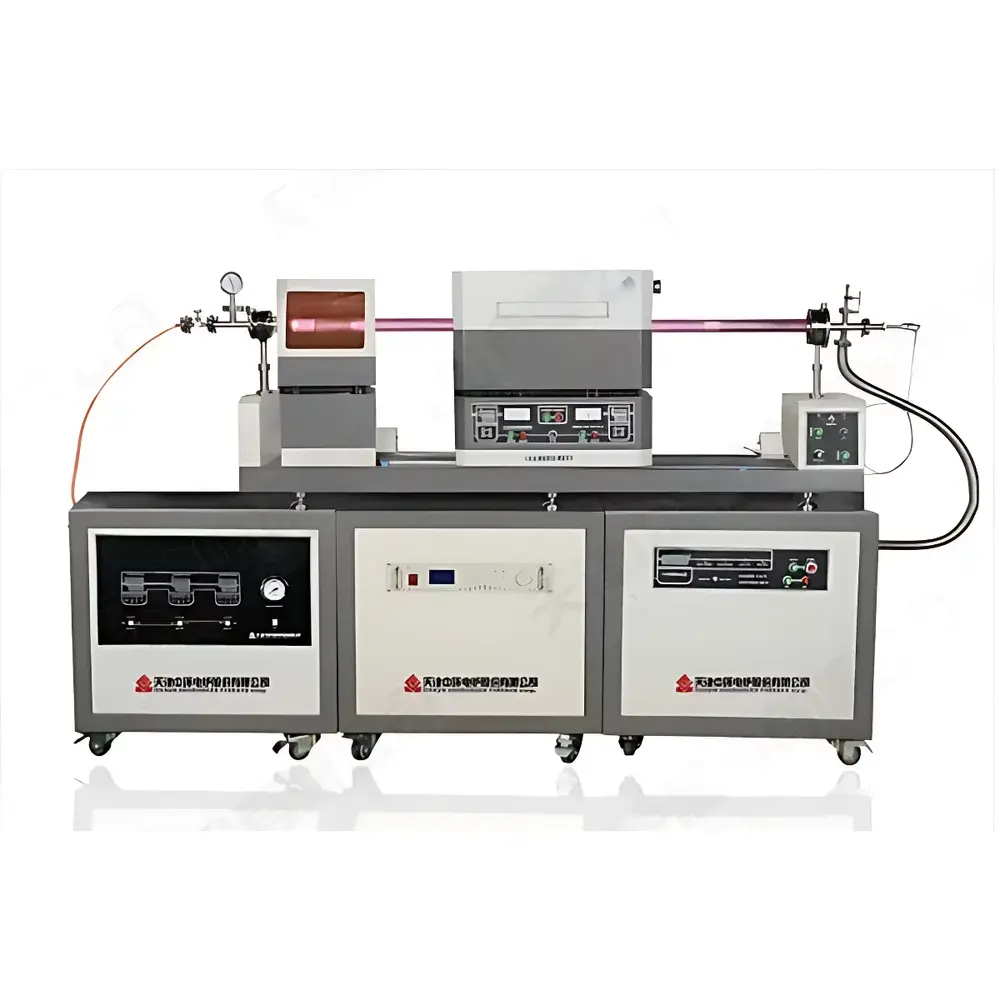
ZHONGHUAN FURNACE 1200°C Sliding Dual-Zone / Multi-Zone Plasma-Enhanced Chemical Vapor Deposition System
| Brand | ZHONGHUAN FURNACE |
|---|---|
| Origin | Tianjin, China |
| Model | 1200°C Sliding Dual-Zone / Multi-Zone PECVD System |
| Maximum Temperature | 1200°C |
| Temperature Control Accuracy | ±1°C |
| Rated Power | 3.2 kW |
| Internal Chamber Dimensions | 340 × 580 × 555 mm |
| Heating Method | 50-Stage Programmable Temperature Controller (Domestic) |
| Instrument Type | Tube Furnace |
| Vacuum Configuration | Optional Medium- or High-Vacuum System |
Overview
The ZHONGHUAN FURNACE 1200°C Sliding Dual-Zone / Multi-Zone Plasma-Enhanced Chemical Vapor Deposition (PECVD) System is a precision-engineered platform for low-temperature thin-film synthesis under controlled reactive atmospheres. Unlike conventional thermal CVD, this system utilizes radiofrequency (RF) plasma excitation (typically 13.56 MHz) to dissociate precursor gases—such as silane (SiH₄), ammonia (NH₃), or methane (CH₄)—into highly reactive radicals and ions at substrate temperatures significantly below their thermal decomposition thresholds. This enables high-quality film growth—including silicon nitride (SiNₓ), silicon dioxide (SiO₂), amorphous hydrogenated silicon (a-Si:H), and carbon-based coatings—on temperature-sensitive substrates such as polymer films, flexible electronics, or pre-fabricated semiconductor devices. The sliding dual-zone architecture allows independent thermal profiling across two spatially separated furnace zones, facilitating precise thermal gradient control during deposition and post-deposition annealing—all within a single integrated quartz tube chamber.
Key Features
- Sliding dual-zone configuration with independently programmable heating zones, enabling synchronized or differential thermal ramping (e.g., precursor vaporization zone + reaction/deposition zone)
- Integrated 13.56 MHz RF plasma generator with impedance-matching network for stable plasma ignition and sustained discharge under pressures ranging from 10⁻² to 10² Pa
- 50-segment programmable temperature controller with ±1°C accuracy and repeatability better than ±0.5°C over full 1200°C range
- Multi-channel mass flow controller (MFC) system supporting up to four independent gas lines (e.g., SiH₄, NH₃, H₂, Ar), each with digital setpoint control and real-time flow monitoring
- Modular vacuum interface compatible with optional medium-vacuum (10⁻¹–10⁻³ Pa, rotary vane + turbomolecular pump) or high-vacuum (≤5×10⁻⁵ Pa, cryo- or ion-pumped) configurations
- Robust stainless-steel frame with water-cooled RF feedthroughs, quartz tube (OD 60–100 mm, customizable), and front-loading horizontal design for rapid sample insertion and process iteration
Sample Compatibility & Compliance
The system accommodates standard 1–4 inch diameter wafers, ceramic substrates, metal foils, and custom-shaped samples up to 555 mm in length. Quartz sample boats and alumina setters are included for uniform thermal distribution. All electrical components comply with IEC 61000-6-3 (EMC emission standards) and IEC 61000-6-2 (immunity). The RF subsystem meets CISPR 11 Class B limits for industrial RF equipment. While not certified to UL or CE for standalone sale in the EU/US, the system is engineered to support GLP-compliant process documentation when paired with validated data acquisition software. Vacuum components conform to ISO 2862 (vacuum flange dimensions) and ASTM E575 (vacuum leak testing methodology).
Software & Data Management
Temperature profiles, gas flow rates, RF power output, and vacuum pressure are logged via RS485/USB-connected data acquisition modules. Optional LabVIEW-based control software provides synchronized parameter logging at 1 Hz resolution, alarm-triggered event capture, and export to CSV or HDF5 formats. Audit trails—including user login timestamps, parameter change history, and system error logs—are maintained for traceability. When configured with FDA 21 CFR Part 11-compliant add-ons (e.g., electronic signatures, role-based access), the system supports regulated R&D environments requiring documented evidence of process consistency.
Applications
- Deposition of passivation layers (SiNₓ, SiO₂) on silicon photovoltaic cells and perovskite solar modules
- Growth of dielectric gate stacks for flexible thin-film transistors (TFTs) on polyimide substrates
- Surface functionalization of biomedical implants using plasma-polymerized coatings
- Low-temperature synthesis of graphene and transition metal dichalcogenides (TMDs) via catalytic CVD precursors
- Process development for MEMS packaging, where thermal budget constraints prohibit conventional furnace annealing
FAQ
What vacuum level is required for typical PECVD processes?
Most SiNₓ and a-Si:H depositions operate optimally between 0.1–10 Pa. The system supports both medium-vacuum (10⁻¹–10⁻³ Pa) and high-vacuum (≤5×10⁻⁵ Pa) configurations depending on precursor reactivity and film purity requirements.
Can the dual-zone furnace operate with opposing thermal gradients?
Yes—the sliding mechanism allows physical separation of zones, and independent PID loops permit simultaneous heating and cooling profiles (e.g., 800°C upstream, 300°C downstream) to control precursor pyrolysis and surface reaction kinetics separately.
Is quartz tube replacement supported in-field?
Standard OD 60 mm and 80 mm quartz tubes are field-replaceable using ISO-KF 60/80 flanges; spare tubes and O-rings are available as consumables.
Does the RF power supply include automatic matching?
Yes—the integrated 13.56 MHz RF generator includes a motorized auto-matching network with real-time reflected power monitoring and arc suppression circuitry.
What safety interlocks are implemented?
Interlocks include door-open RF cutoff, overtemperature shutdown (>1220°C), coolant flow failure detection (for RF head), and vacuum-pressure-dependent RF enable/disable logic.



