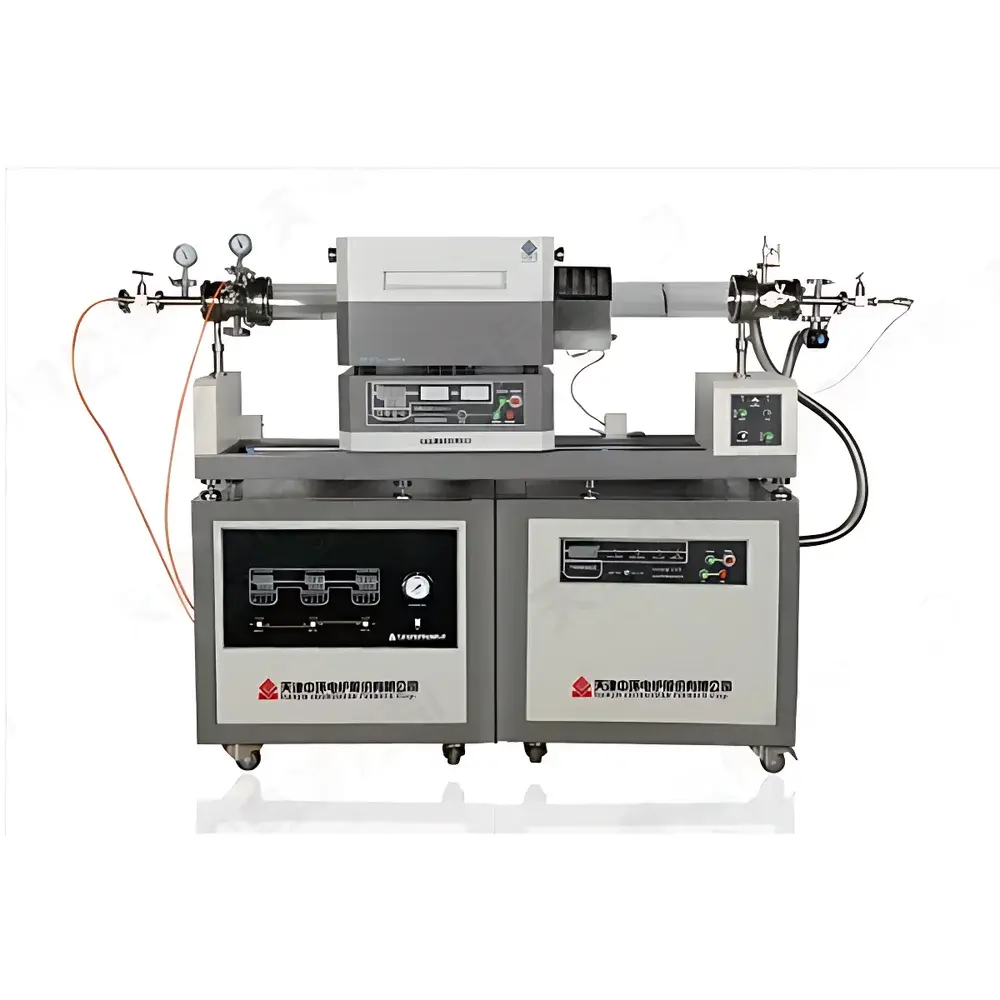
Zhonghuan Furnace CVD-12II6SH-3Z / CVD-12III9SH-3Z Dual-Tube Sliding Single-/Multi-Zone Chemical Vapor Deposition System (1200 °C)
| Brand | Zhonghuan Furnace |
|---|---|
| Origin | Tianjin, China |
| Model | CVD-12II6SH-3Z (Dual-Zone) / CVD-12III9SH-3Z (Triple-Zone) |
| Max Temperature | 1200 °C |
| Heating Zone Length | 610 mm / 940 mm |
| Uniform Temperature Zone | 400 mm / 700 mm |
| Quartz Tube ID/OD | Φ80 mm / Φ100 mm |
| Rated Power | 4.8 kW / 7.2 kW |
| Voltage | 220 V / 380 V (3-phase) |
| Sliding Stroke | 485 mm / 650 mm |
| Sliding Mode | Manual or Motorized (Temperature-Programmed Auto-Translation) |
| Temperature Control | 50-Stage Programmable PID Controller, ±1 °C Accuracy |
| Gas Channels | Up to 3 Mass Flow Controlled Lines (0–500 sccm, N₂-calibrated, ±1% F.S.) |
| Vacuum System Options | Medium Vacuum (1×10⁻¹–1×10⁻³ Pa) or High Vacuum (1×10⁻³–1×10⁻¹ Pa |
| Sealing | Dual-Knurled KF Flanges with Multi-Ring Dynamic Seal Architecture |
| Cooling | Integrated Forced-Air Quenching System for Rapid Post-Process Thermal Extraction |
Overview
The Zhonghuan Furnace CVD-12II6SH-3Z and CVD-12III9SH-3Z are engineered dual-tube sliding-type chemical vapor deposition systems designed specifically for controlled thin-film synthesis on flexible metallic substrates—particularly ultrathin metal foils used in next-generation energy devices such as solid-state batteries, flexible supercapacitors, and roll-to-roll transparent conductive electrodes. Unlike conventional stationary tube CVD reactors, this system integrates a precisely actuated furnace translation mechanism that enables rapid thermal ramping and programmable quenching by physically moving the heated zone relative to the sample. The dual-quartz-tube configuration establishes a concentric annular reaction chamber between inner and outer tubes, allowing independent control of precursor gas flow paths, reaction atmosphere composition, and cooling gas injection—critical for achieving stoichiometric control, minimizing parasitic reactions, and suppressing substrate oxidation during high-temperature growth.
Key Features
- Sliding Thermal Zone Architecture: Motorized or manual furnace translation (485 mm / 650 mm stroke) synchronized with temperature program completion, enabling precise dwell-time control at target temperature followed by rapid air-cooled extraction—reducing thermal budget and mitigating interdiffusion in multilayer foil architectures.
- Dual-Tube Reaction Geometry: Inner quartz tube (Φ80 mm) accommodates substrate carriers; outer tube (Φ100 mm) forms an annular channel for reactive gas introduction or inert purge. Independent vacuum and gas routing to each tube via dual KF-flanged, multi-ring sealed interfaces ensures process modularity and cross-contamination prevention.
- Fuzzy PID Temperature Control: 50-segment programmable controller with ±1 °C stability across the uniform zone (400 mm / 700 mm), low thermal inertia design, and overshoot suppression—optimized for reproducible nucleation kinetics in graphene, transition metal dichalcogenides (TMDs), and metal oxide thin films.
- Modular Gas Delivery: Configurable up to three mass flow-controlled lines (0–500 sccm, N₂-calibrated, ±1% F.S., <4 s response), compatible with corrosive precursors (e.g., Mo(CO)₆, W(CO)₆, H₂S) and carrier gases (Ar, N₂, H₂). Quick-connect KF waveguide manifolds reduce assembly time and leak risk.
- Vacuum Flexibility: Optional medium-vacuum (rotary vane + turbo-molecular pump, 1×10⁻³–1×10⁻¹ Pa) or high-vacuum configuration (1600 L/s molecular pump, base pressure ≤5×10⁻⁶ Pa) with auto-threshold pressure regulation and overpressure protection to safeguard pump integrity during accidental air ingress.
Sample Compatibility & Compliance
This CVD platform is validated for use with metallic foils (Cu, Ni, stainless steel, Ti, Al) ranging from 25 µm to 200 µm thickness, accommodating standard 1″–2″ wafer-sized carriers or custom jig-mounted roll segments. The dual-tube sealing architecture—featuring triple O-ring grooves and radial compression compensation—maintains leak rates <1×10⁻⁸ mbar·L/s even with quartz tube OD tolerances up to ±0.5 mm, satisfying ISO 10110 optical component handling standards for reproducible vacuum integrity. All electrical components comply with IEC 61000-6-4 (EMC emission) and IEC 61000-6-2 (immunity) requirements. Optional documentation packages support GLP/GMP-aligned lab audits, including calibration certificates traceable to NIST standards for thermocouples and mass flow controllers.
Software & Data Management
The integrated temperature controller supports RS485/Modbus RTU communication for third-party SCADA integration (e.g., LabVIEW, Python-based automation frameworks). Process logs—including setpoint profiles, actual thermocouple readings, gas flow timestamps, and vacuum pressure traces—are exported in CSV format with UTC timestamps and metadata tagging (operator ID, batch number, recipe version). For regulated environments, optional 21 CFR Part 11-compliant firmware add-ons provide electronic signature capability, audit trail logging, and role-based access control—enabling full data lineage tracking from recipe execution to final film characterization.
Applications
- Growth of large-area monolayer graphene on Cu foil for flexible transparent electrodes
- Synthesis of WS₂ and MoS₂ heterostructures on Ni foils for bendable photodetectors
- Atomic-layer-controlled SnO₂ or TiO₂ coatings on stainless-steel current collectors for Li-ion battery anodes
- Thermal ALD-like sequential precursor dosing using pulsed sliding motion for conformal metal nitride barrier layers
- Rapid thermal annealing (RTA)-assisted post-deposition crystallization of amorphous metal oxides under controlled reducing atmospheres
FAQ
Can this system be used for sulfurization or selenization processes?
Yes—the dual-tube design allows H₂S or H₂Se to be introduced into the annular gap while maintaining inert gas flow through the inner tube, minimizing precursor decomposition upstream and enabling stoichiometric chalcogenide film formation.
Is remote monitoring supported out-of-the-box?
Standard configuration includes Modbus-enabled temperature and vacuum readouts; Ethernet-to-Modbus gateways or OPC UA middleware can be added for cloud-based dashboard integration.
What maintenance intervals are recommended for the molecular pump in high-vacuum mode?
Per manufacturer guidelines, oil changes every 3,000 operating hours and bearing inspection every 6,000 hours—extended life achieved via pressure-regulated operation and automatic venting on power loss.
Does the sliding mechanism support programmable dwell-and-move sequences within a single run?
Yes—custom motion profiles (e.g., “hold at 1000 °C for 5 min, slide 100 mm at 5 mm/min, hold again”) can be embedded directly into the 50-stage temperature program via auxiliary output triggers.
Are replacement quartz tubes available with custom dimensions or doping?
Zhonghuan Furnace offers OEM-specified fused silica tubes (e.g., low-OH, IR-transmissive, or Al-doped variants) with lead times of 4–6 weeks upon drawing approval.