
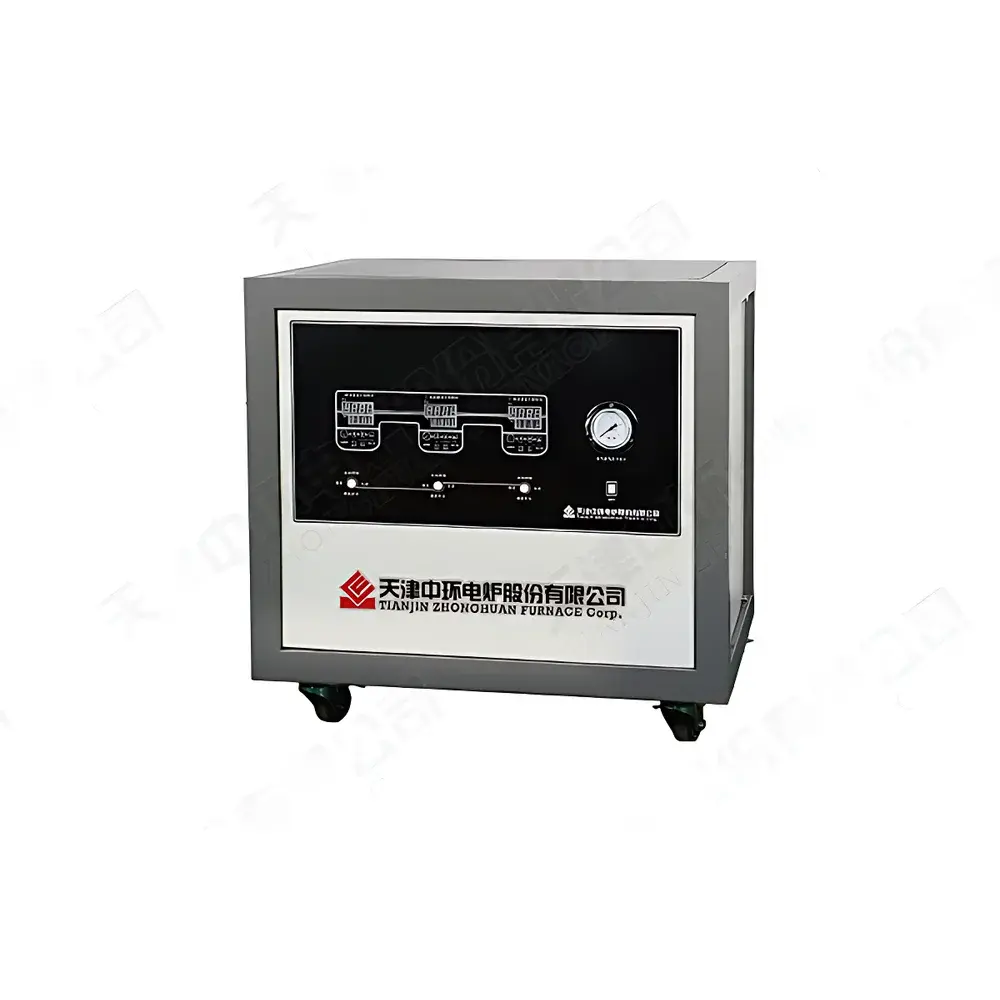
Zhonghuan Furnace MFC-System Series Mass Flow Control System
| Brand | Zhonghuan Furnace |
|---|---|
| Origin | Tianjin, China |
| Model | MFC-System Series |
| Interface Options | Swagelok double ferrule, Bariou (barbed), KF-16 |
| Control Principle | Thermal mass flow measurement with closed-loop PID regulation |
| Display | Digital LED flow meter with 0.1% FS accuracy |
| Response Time | ≤1 s (t₉₀) |
| Gas Compatibility | N₂, Ar, O₂, H₂, CO, CO₂, synthetic air, and other non-corrosive gases |
| Pressure Rating | Up to 1.0 MPa (gauge) |
| Operating Temperature | 5–45 °C |
| Compliance | CE-marked, RoHS-compliant, compatible with ISO/IEC 17025 laboratory environments |
Overview
The Zhonghuan Furnace MFC-System Series Mass Flow Control System is an engineered solution for precise, repeatable, and traceable gas dosing in high-temperature thermal processing environments. Built upon thermal-based mass flow sensing technology—specifically constant-temperature anemometry—the system directly measures gas mass flow rate (in standard cubic centimeters per minute, sccm, or standard liters per minute, slm) independent of pressure and temperature fluctuations. This eliminates the need for downstream compensation and ensures metrological consistency across variable process conditions. Designed for integration into vacuum and controlled-atmosphere furnaces—including tube and box-type configurations—the system supports both single-gas and multi-gas applications where stoichiometric control, purge sequencing, or reactive gas introduction is critical. Its architecture adheres to fundamental principles of fluid dynamics and thermal transport, enabling stable operation under dynamic load changes typical in ramp-hold-sintering cycles.
Key Features
- Triple-interface mechanical compatibility: Standardized Swagelok double-ferrule fittings for leak-tight metal-to-metal sealing, barbed (Bariou) connectors for flexible tubing integration, and KF-16 quick-release flanges for vacuum-side coupling—enabling seamless adaptation to diverse gas delivery infrastructures.
- Integrated digital flow instrumentation: High-resolution LED display with real-time mass flow readout (0.1% full-scale accuracy), programmable setpoint input, and analog (0–5 V / 4–20 mA) and digital (RS-485 Modbus RTU) I/O for external PLC or SCADA synchronization.
- Closed-loop PID control architecture: Delivers rapid dynamic response (t₉₀ ≤ 1 second) and long-term stability (<±0.2% FS drift over 1,000 hours), minimizing overshoot during gas ramping and ensuring reproducible atmosphere composition across thermal cycles.
- Process safety subsystems: Integrated check valves prevent backflow under differential pressure conditions; optional gas mixing manifold (stainless steel 316L) provides homogeneous pre-mixing upstream of the furnace chamber, mitigating localized concentration gradients and eliminating uncontrolled gas egress points.
- Modular scalability: Base unit supports up to four independently controlled gas channels; expansion modules enable configuration of 6-, 8-, or custom N-channel systems with synchronized start/stop timing and interlocked purge protocols.
Sample Compatibility & Compliance
The MFC-System Series is validated for use with inert (N₂, Ar, He), oxidizing (O₂, air), reducing (H₂, CO), and neutral (CO₂, N₂O) process gases—provided they are free of particulates, condensables, and corrosive contaminants (e.g., Cl₂, NH₃, HF). All wetted materials conform to ASTM A269/A270 standards for seamless austenitic stainless steel tubing. The system meets CE Directive 2014/30/EU (EMC) and 2014/35/EU (LVD), and complies with RoHS 2011/65/EU restrictions on hazardous substances. When deployed in GLP- or GMP-regulated laboratories, audit trails—enabled via optional data logging firmware—support compliance with FDA 21 CFR Part 11 requirements for electronic records and signatures.
Software & Data Management
The system operates natively without proprietary software but supports third-party integration through open Modbus RTU protocol. Optional Zhonghuan Furnace DataBridge™ firmware (v2.3+) adds timestamped CSV export, alarm event logging (e.g., flow deviation >±2%, valve timeout), and configurable pass/fail thresholds aligned with ISO 8573-1 compressed air purity classes. All configuration parameters—including gas-specific calibration coefficients (K-factors), flow range scaling, and PID tuning constants—are stored in non-volatile memory with write-protection to maintain integrity during power interruption.
Applications
- Controlled-atmosphere sintering of advanced ceramics (e.g., SiC, Al₂O₃) requiring precise O₂ partial pressure modulation.
- Inert purging and hydrogen reduction annealing of magnetic alloys (e.g., Fe-Si, Ni-Fe) with <10 ppm residual oxygen specification.
- Multi-step carburizing/nitriding cycles in metallurgical heat treatment, where sequential CH₄/NH₃/N₂ dosing must follow time-resolved stoichiometric profiles.
- Research-scale CVD precursor delivery in thin-film synthesis, leveraging fast-response capability for pulsed gas injection schemes.
- Calibration verification of reference mass flow meters per ISO 14111 and ISO 11583 methodologies using gravimetric or bubble-flow reference standards.
FAQ
What gas calibration standards are supported?
The system ships pre-calibrated for N₂; optional factory calibration certificates (traceable to NIST SRM 1961) are available for Ar, O₂, H₂, CO, CO₂, and synthetic air.
Can the system operate under vacuum conditions?
Yes—when equipped with KF-16 vacuum-rated fittings and configured with upstream pressure stabilization, it maintains specified accuracy down to 1 × 10⁻³ mbar absolute inlet pressure.
Is remote monitoring possible without additional hardware?
Yes—via RS-485 Modbus RTU interface using standard industrial gateways; no proprietary dongles or USB adapters required.
How is long-term drift compensated?
Zero-point auto-compensation occurs during idle periods; users may also initiate manual zero calibration using certified zero gas (99.999% N₂) per ISO 6142 guidelines.
Does the system support fail-safe shutdown logic?
Yes—digital outputs can be wired to furnace safety relays to trigger thermal hold or emergency venting if flow deviates beyond user-defined tolerance bands for >5 seconds.



