
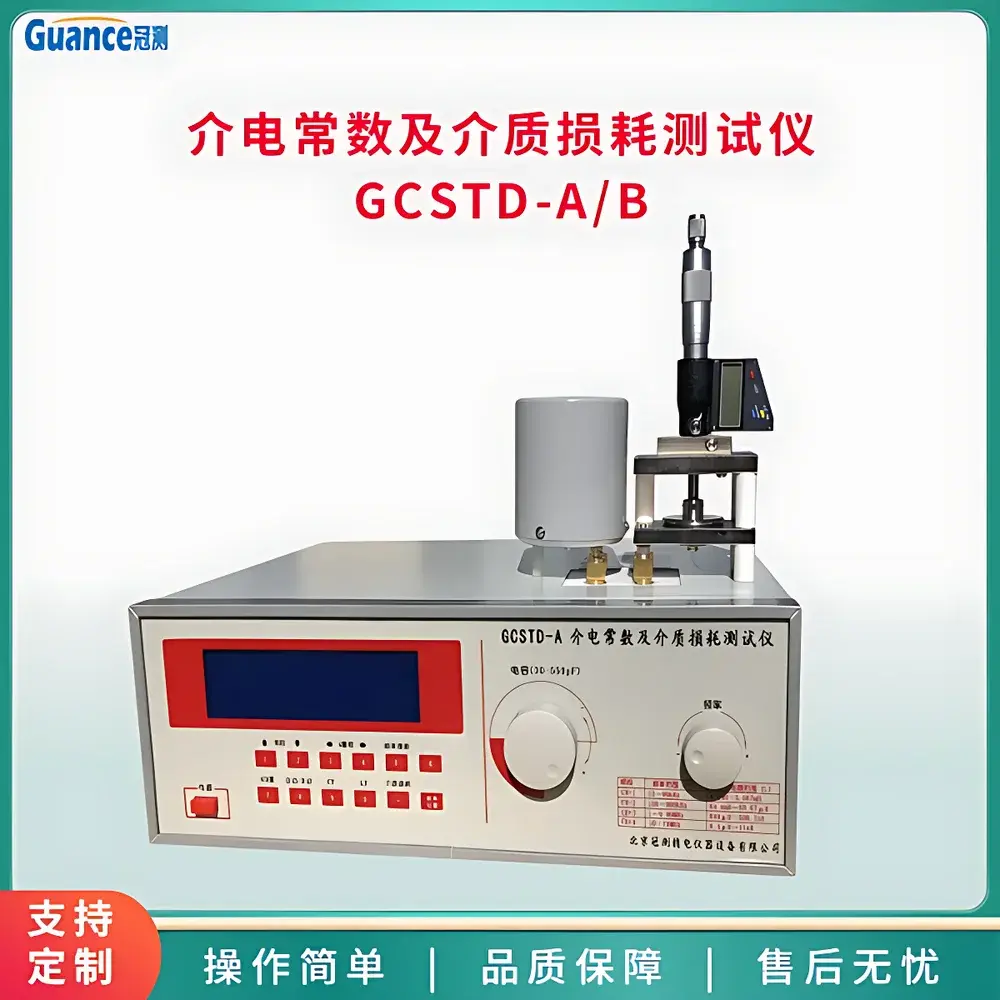
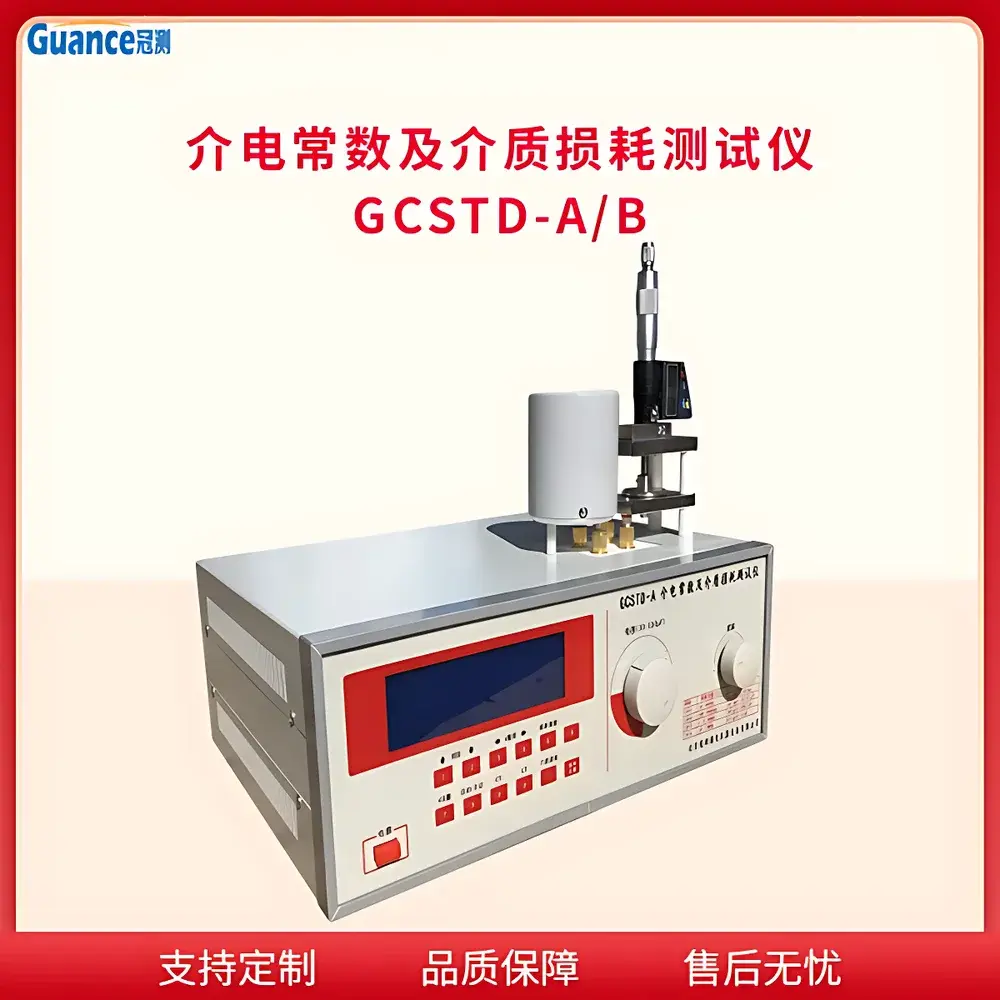
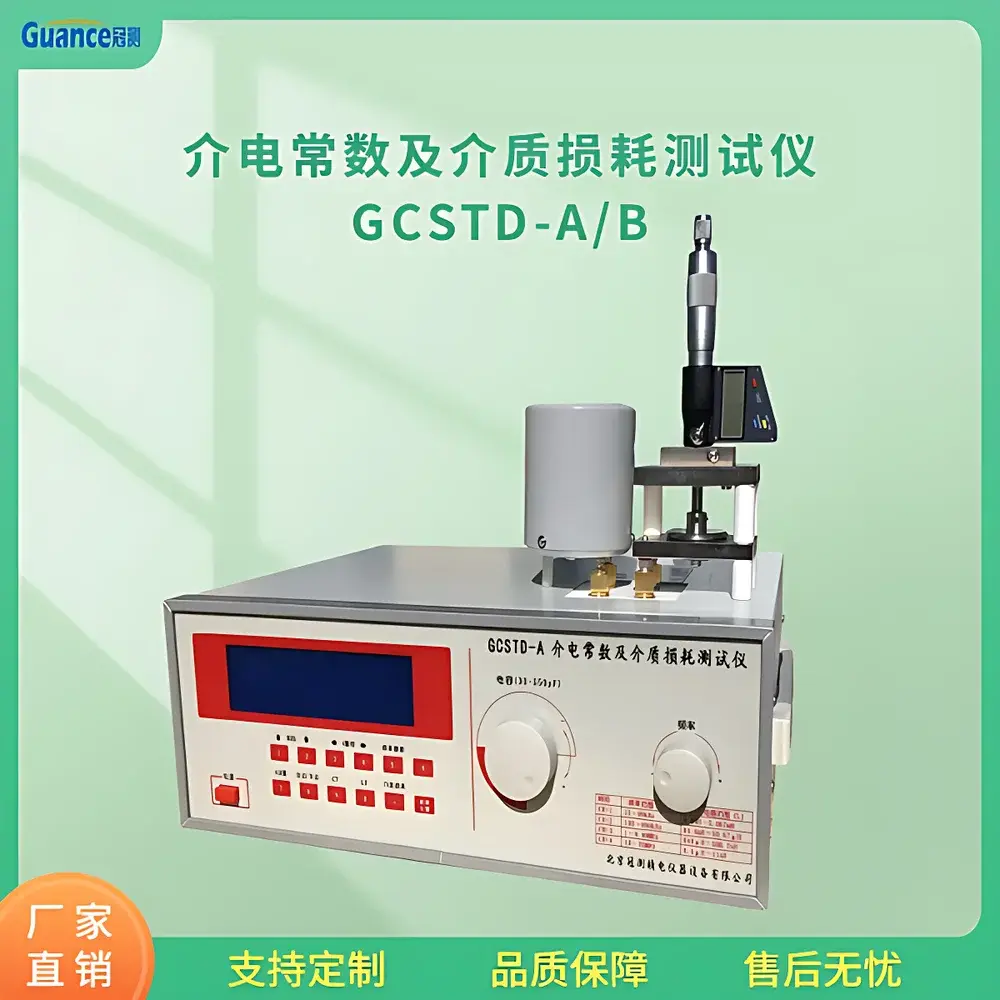
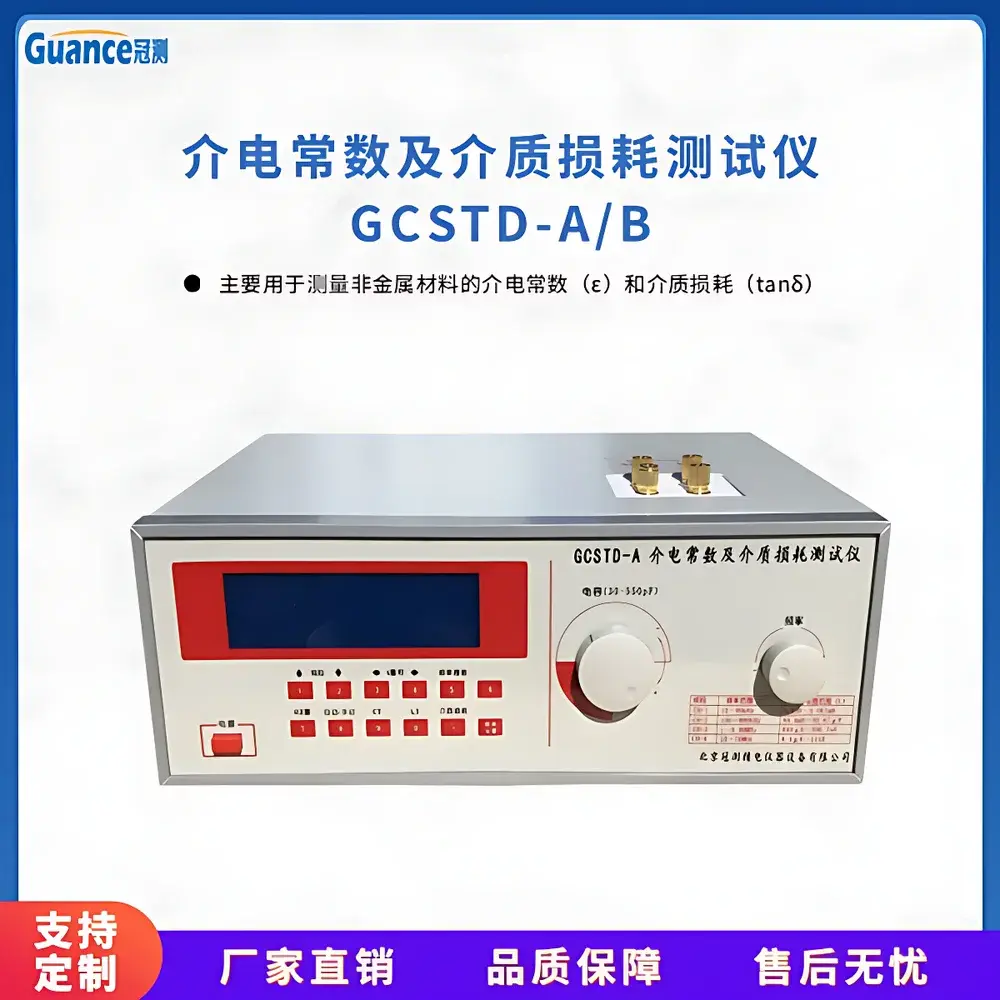
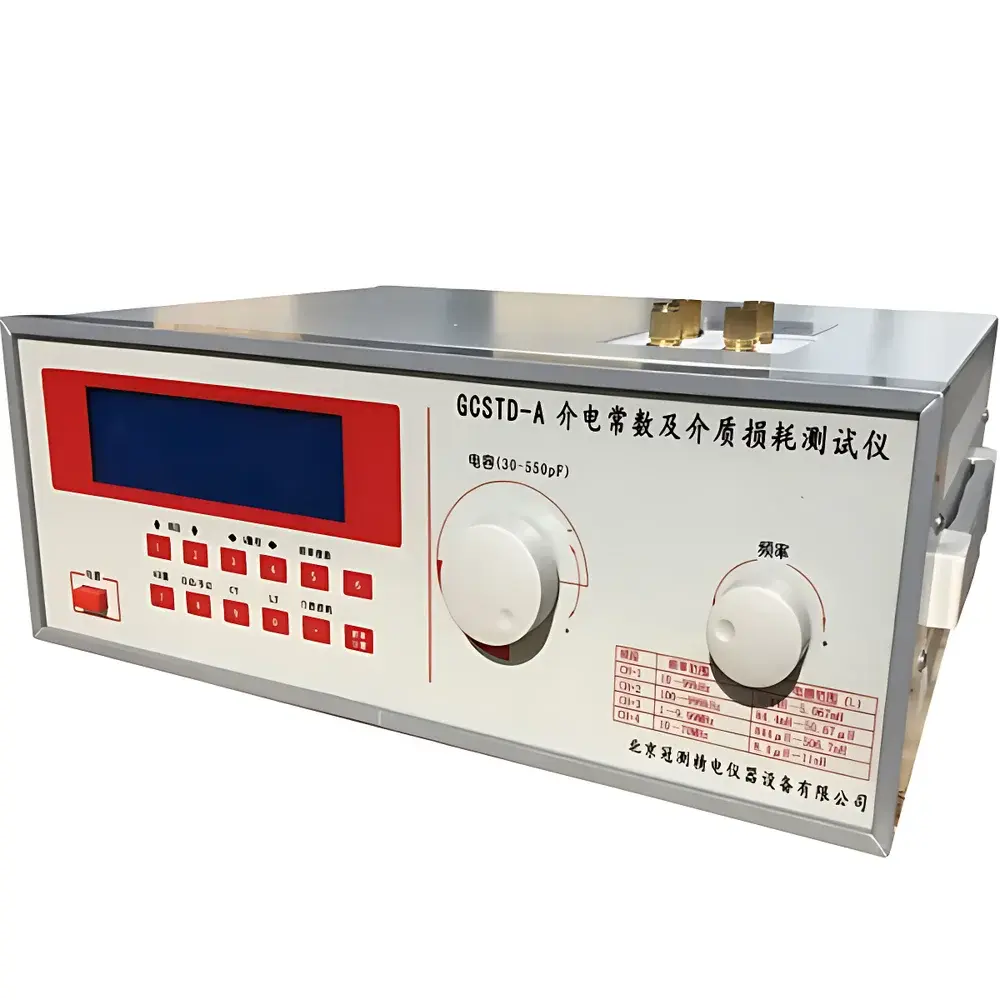
Guance Instruments GCSTD-AB High-Frequency Dielectric Constant and Loss Tangent Analyzer
| Brand | Guance Instruments |
|---|---|
| Origin | Beijing, China |
| Manufacturer Type | Authorized Distributor |
| Country of Origin | China |
| Model | GCSTD-AB |
| Price | USD 670 (FOB) |
| Measurement Principle | High-Frequency Resonance Method (Q-meter Based) |
| Frequency Range | Configurable Across Three Models (GCSTD-A / B / C) |
| Test Parameters | Relative Permittivity (εᵣ), Dissipation Factor (tanδ), Q-factor, Capacitance (C), Inductance (L), Series/Parallel Resistance (Rₛ/Rₚ), Characteristic Impedance (Z₀) |
| Sample Types | Solid (disc, Φ38 mm, thickness 0.5–15 mm), Liquid (cell: Φ48 mm × 7 mm depth), Powder (with liquid cell adapter) |
| Compliance | GB/T 1409–2006, GB/T 5654–2007, GB/T 21216–2007, GB/T 1693–2007, GB/T 5594.4–1985, ASTM D150, IEC 60250 |
| Operating Environment | 0–40 °C, RH < 80 %, 220 V ±10 %, 50 Hz ±5 % |
| Power Consumption | ≤25 W |
| Net Weight | 7 kg |
| Dimensions (L×W×H) | 380 × 280 × 132 mm |
Overview
The Guance Instruments GCSTD-AB is a precision high-frequency dielectric characterization system engineered for the quantitative determination of relative permittivity (εᵣ) and dissipation factor (tanδ) in non-metallic insulating materials. It operates on the well-established resonance method—specifically, a digitally stabilized Q-meter architecture—wherein the test sample forms part of a high-Q parallel or series resonant circuit. By precisely measuring the shift in resonant frequency and the change in circuit Q-value induced by the sample’s dielectric properties, the instrument calculates εᵣ and tanδ with traceable accuracy across a broad frequency range (10 kHz to 70 MHz, model-dependent). This principle enables direct, non-destructive evaluation of polarization mechanisms and energy loss pathways in ceramics, polymers, composites, rubber, and liquid dielectrics—critical parameters for capacitor design, insulation system qualification, and advanced material development.
Key Features
- Digital frequency-locking control with automatic resonance point search and dynamic Q-range switching, eliminating manual tuning drift and enhancing measurement repeatability.
- Integrated microcontroller-based architecture ensures stable signal amplitude regulation, low-residual-inductance tuning circuits, and minimized parasitic capacitance—key for high-accuracy εᵣ and tanδ at elevated frequencies.
- Multi-configurable electrode interface supporting standardized solid discs (Φ38 mm, thickness 0.5–15 mm), liquid cells (Φ48 mm × 7 mm), and powder-compatible configurations via optional adapters.
- Nine calibrated reference inductors included for cross-verification and extended impedance coverage—enabling consistent calibration across diverse sample geometries and permittivity ranges.
- Compliance-ready firmware architecture supports audit trails and parameter logging, aligning with GLP-aligned laboratory documentation practices for R&D and QC environments.
Sample Compatibility & Compliance
The GCSTD-AB accommodates rigid solids (e.g., alumina, silicon nitride, epoxy composites), viscous liquids (transformer oils, silicone fluids), and granular powders (filled ceramics, battery separator materials) when used with appropriate electrode fixtures. All measurement protocols adhere strictly to internationally recognized standards: GB/T 1409–2006 (equivalent to IEC 60250) for AC dielectric response; GB/T 5654–2007 and GB/T 21216–2007 for liquid dielectric characterization; GB/T 1693–2007 for vulcanized rubber; and GB/T 5594.4–1985 for electronic ceramic substrates. The system’s traceable calibration methodology satisfies requirements for ISO/IEC 17025-compliant testing laboratories performing material qualification under ASTM D150 and IEC 60250 frameworks.
Software & Data Management
While the GCSTD-AB operates as a standalone benchtop instrument with digital LCD readout, its measurement logic embeds structured data formatting compatible with external PC acquisition via RS-232 (optional interface module). Raw outputs include εᵣ, tanδ, Q, L, C, and R values at each tested frequency point. Users may export time-stamped datasets for post-processing in MATLAB, Python (SciPy), or Excel. Firmware supports user-defined test sequences, pass/fail thresholds, and configurable averaging—facilitating routine QC checks. Audit-relevant metadata (operator ID, ambient T/RH, calibration date) can be appended manually or via integrated environmental sensor input (optional upgrade).
Applications
- Quality assurance of high-permittivity ceramic capacitors and low-loss RF substrates during manufacturing process control.
- R&D evaluation of polymer nanocomposites for 5G antenna encapsulation, where εᵣ stability vs. frequency and temperature is critical.
- Insulation integrity assessment of transformer oils per IEC 60429 and GB/T 5654–2007, correlating tanδ trends with oxidation state and moisture content.
- Dielectric spectroscopy of piezoelectric ceramics (e.g., PZT, BaTiO₃) across audio-to-RF bands to identify domain wall relaxation peaks.
- Validation of microwave-absorbing materials for EMI shielding applications, using εᵣ′ and εᵣ″ dispersion analysis.
FAQ
What frequency range does the GCSTD-AB support?
The GCSTD-AB model is optimized for measurements from 10 kHz up to 70 MHz. Frequency selection is fixed per unit; users must specify required band (A/B/C) at order entry.
Can it measure thin films or coatings?
No—it requires bulk samples meeting minimum thickness (0.5 mm for solids) and uniform geometry to ensure field homogeneity and avoid fringing effects.
Is calibration certificate included?
Yes—a factory calibration report traceable to national metrology institutes (NIM, China) is supplied with each unit, including uncertainty budgets per GB/T 27025.
Does it comply with FDA 21 CFR Part 11?
As a hardware-based analyzer without electronic signature or user-role management, it does not meet full Part 11 requirements—but raw data exports support integration into validated LIMS or ELN systems that do.
What maintenance is required?
Annual verification against NIST-traceable standards is recommended; no routine consumables or recalibration kits are needed beyond periodic electrode cleaning and contact inspection.
Related Products



