
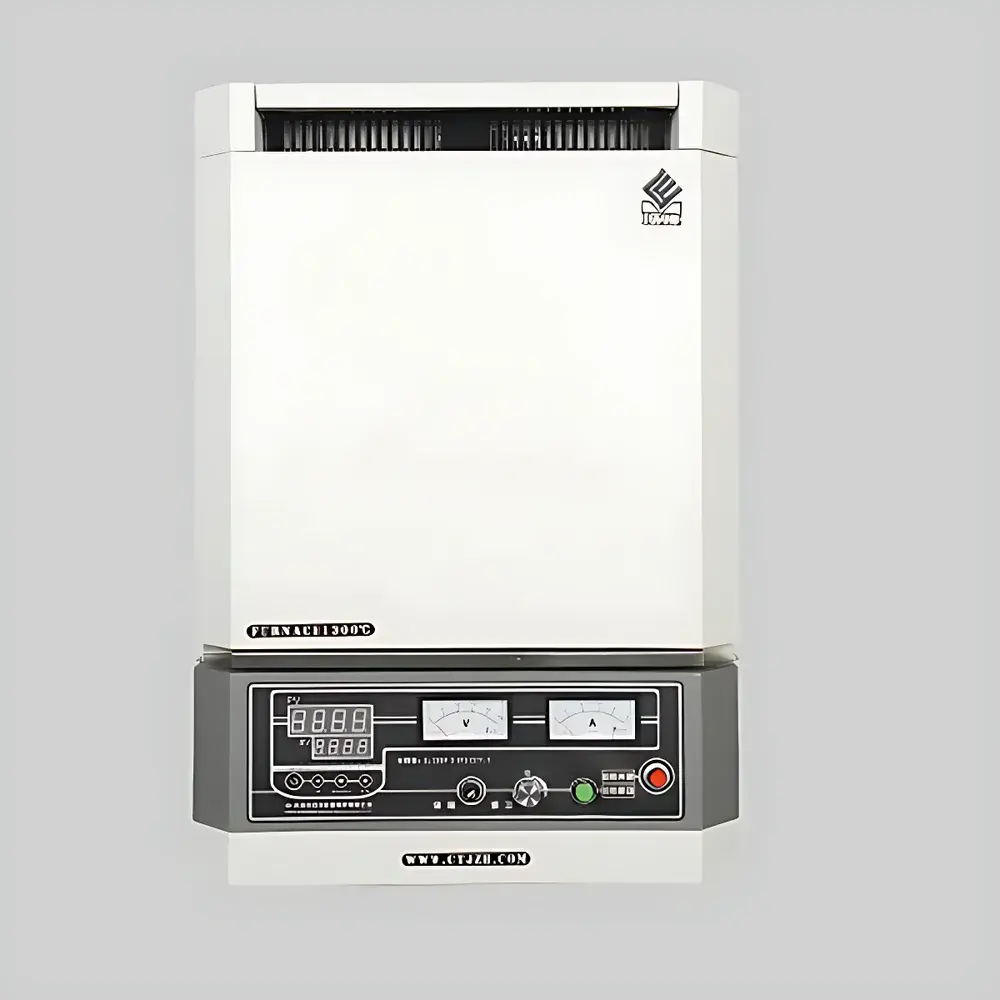
ZHX-03173 Desktop High-Temperature Muffle Furnace (1700 °C) by Zhonghuan Furnace
| Brand | Zhonghuan Furnace |
|---|---|
| Origin | Tianjin, China |
| Model | ZHX-03173 |
| Instrument Type | Box-Type Muffle Furnace |
| Max Temperature | 1700 °C |
| Temperature Control Accuracy | ±1 °C |
| Rated Power | 4 kW |
| Heating Element | Silicon-Molybdenum (MoSi₂) Rods |
| Internal Chamber Dimensions | 150 × 140 × 140 mm |
| Chamber Volume | 3 L |
| Voltage | 220 V AC, Single-Phase |
| Weight | 140 kg |
| External Dimensions | 667 × 629 × 1023 mm |
Overview
The ZHX-03173 Desktop High-Temperature Muffle Furnace is an engineered laboratory-grade box-type resistance furnace designed for precise thermal processing up to 1700 °C. It operates on the principle of resistive heating via high-temperature silicon-molybdenum (MoSi₂) rods, which provide stable, uniform heat distribution across the insulated chamber. The furnace employs advanced thermal insulation using high-purity alumina-silica ceramic fiber modules—reducing thermal mass and enabling rapid heating while achieving >40% energy savings compared to conventional refractory brick-lined furnaces. Its compact desktop footprint (667 × 629 × 1023 mm) and 3 L usable chamber volume make it suitable for small-batch sintering, ashing, calcination, and heat treatment in academic research labs, materials science departments, and quality control environments where space efficiency and reproducible high-temperature performance are critical.
Key Features
- High-stability MoSi₂ heating elements rated to 1800 °C surface temperature, ensuring long service life and consistent thermal output at 1700 °C operating conditions.
- Intelligent dual-mode temperature control system supporting both PID regulation and adaptive auto-tuning; configurable for either fixed-setpoint operation or multi-segment programmable ramp-soak profiles (up to 30 segments with domestic controller; 40 segments with optional imported module).
- Integrated safety architecture: automatic power cutoff upon door opening, independent over-temperature cut-off (with audible/visual alarm), and ground-fault leakage protection compliant with IEC 61000-4-5 surge immunity standards.
- Active surface-cooling system: thermal sensor-triggered axial fan activates when external casing temperature exceeds 50 °C, maintaining safe operator contact temperatures during extended high-temperature runs.
- Current-limiting and soft-start circuitry mitigates inrush current during startup and transient load changes—protecting both the heating elements and user-supplied electrical infrastructure.
- RS-485 serial interface standard-equipped for integration into centralized lab management systems; supports Modbus RTU protocol for remote monitoring, real-time data logging, historical trend analysis, and automated report generation across networks of up to 200 units.
Sample Compatibility & Compliance
The ZHX-03173 accommodates crucibles and sample holders made from high-purity alumina, zirconia, graphite, or molybdenum—compatible with inert, oxidizing, and weakly reducing atmospheres (when used with optional gas inlet kits). Its uniform ±1 °C temperature stability across the 150 × 140 × 140 mm working zone meets ASTM E1142 (Standard Practice for Calibration of High-Temperature Furnaces) and ISO 8573-1 cleanliness class requirements for thermal processing validation. The furnace design adheres to CE electromagnetic compatibility directives (2014/30/EU) and low-voltage safety regulations (2014/35/EU). For GLP/GMP-regulated environments, optional audit-trail-enabled software modules support 21 CFR Part 11-compliant electronic records and signature workflows.
Software & Data Management
The furnace interfaces with proprietary PC-based control software (Windows-compatible) that enables full remote supervision—including real-time temperature curve visualization, multi-furnace synchronization, event-driven alarm notifications, and exportable CSV/PDF reports conforming to ISO/IEC 17025 documentation requirements. All temperature setpoints, ramp rates, hold durations, and system status logs are timestamped and digitally signed. Optional touchscreen HMI (7-inch color LCD) provides intuitive Chinese-language navigation with dynamic display modes: numeric setpoint view, analog bar graph, live/recorded trend curves, and tabular alarm history—eliminating dependency on external computers for routine operation.
Applications
This furnace serves core thermal processes in ceramics R&D (e.g., sintering of SiC, AlN, and ZrO₂ composites), metallurgical analysis (ash content determination per ISO 1171), catalyst activation, electrode material annealing, and pre-firing of dental porcelain. It is routinely employed in university laboratories for solid-state reaction kinetics studies, in battery material development for cathode precursor calcination, and in ISO 17025-accredited testing labs for calibration of thermocouples and reference materials against NIST-traceable standards. Its ±1 °C precision and <5 °C/min controllability above 1200 °C enable reliable replication of thermal cycles specified in ASTM C1171 (refractory shrinkage testing) and USP heavy metals assay protocols.
FAQ
What atmosphere options are supported inside the chamber?
The standard configuration is air atmosphere; optional quartz or stainless-steel gas inlet ports allow controlled introduction of N₂, Ar, or forming gas (5% H₂/95% N₂) for protective or reactive thermal treatments.
Is the furnace compatible with Type S or Type B thermocouples?
Yes—it accepts standard platinum-rhodium thermocouples (Type S up to 1600 °C, Type B up to 1800 °C) with cold-junction compensation and linearization per IEC 60584-1.
Can the controller store multiple heating programs for different material types?
Yes—the programmable controller retains up to 10 user-defined profiles in non-volatile memory, each editable for ramp rate, soak time, and cooling strategy.
Does the unit include a calibration certificate?
A factory calibration report (traceable to national metrology institutes) is provided; on-site UKAS or DAkkS-accredited calibration services are available as an add-on option.
What maintenance is required for the MoSi₂ heating elements?
No periodic replacement is needed under normal operation; however, visual inspection every 200 h at >1500 °C is recommended to detect oxidation-induced embrittlement or sagging—elements should be replaced if resistance increases by >15% from initial value.



