
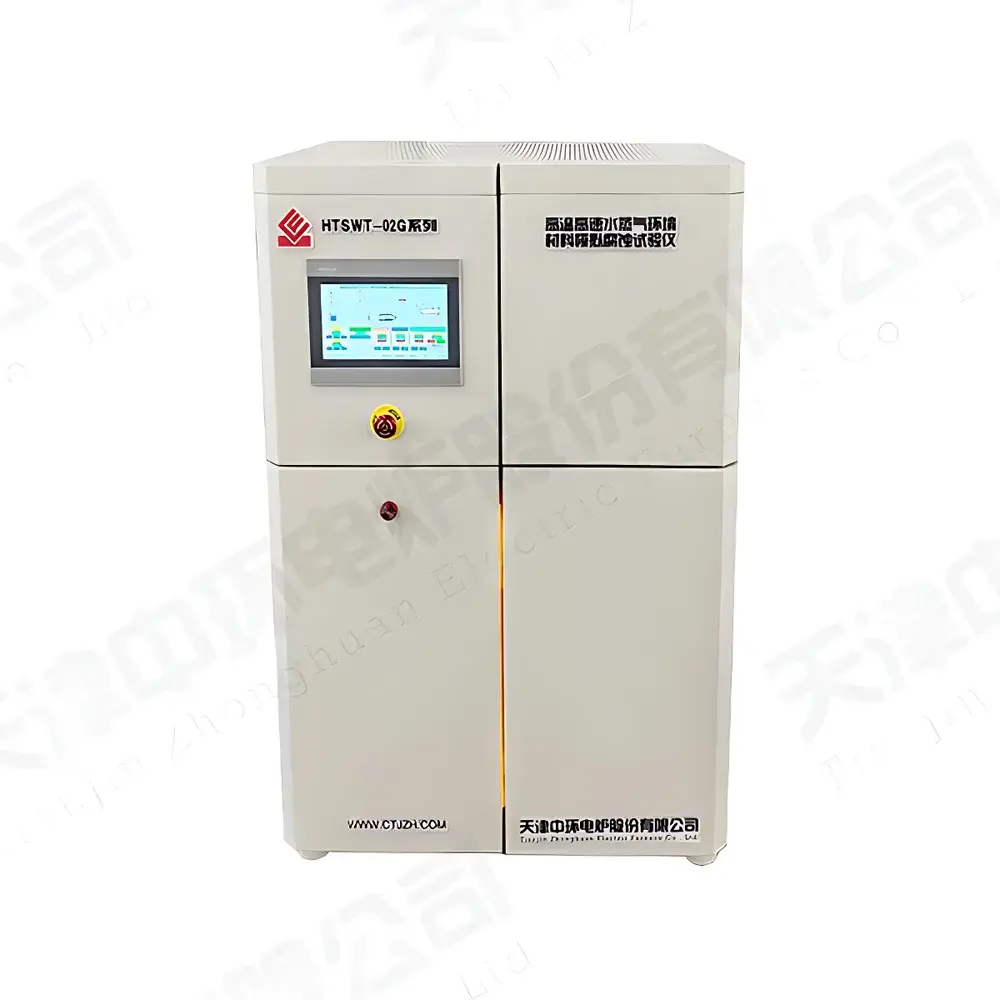
Zhonghuan Furnace HTSWT-02G High-Temperature High-Velocity Steam Corrosion Simulation Test System
| Brand | Zhonghuan Furnace |
|---|---|
| Origin | Tianjin, China |
| Model | HTSWT-02G |
| Max Operating Temperature | 1600 °C |
| Reaction Chamber Diameter | Φ50 mm / Φ70 mm (optional) |
| Effective Chamber Length | 100 mm |
| Sample Dimensions | 30 × 20 × 4 mm |
| Sample Mounting Angle | 30°–45° (adjustable) |
| Heating Element | Silicon Molybdenum Rod |
| Heater Tube Material | Alumina |
| Steam Generation Range | 5–100% RH (or arbitrary humidified gas mixture) |
| Evaporator Temp Limit | ≤150 °C |
| Trace Gas Line Heat Tracing | ≤120 °C |
| Max Steam Flow Rate | 30 L/min |
| Max Steam Velocity | 160 m/s |
| Carrier Gas Control | Mass Flow Controller (up to 5 L/min) |
| Pressure | Ambient (atmospheric) |
| Voltage | 220 V AC |
| Power Rating | 5.5 kW |
| Control Interface | 10.4″ Integrated Touchscreen with PLC-Based Multi-Module Architecture |
| Temperature Program | 50-Step Ramp/Soak Profile |
| Temperature Stability | ±1 °C |
| Data Logging | Real-Time Trend Curves & Exportable Reports (CSV/PDF) |
Overview
The Zhonghuan Furnace HTSWT-02G High-Temperature High-Velocity Steam Corrosion Simulation Test System is an engineered platform for accelerated evaluation of material degradation mechanisms under thermodynamically aggressive steam-rich environments—specifically replicating the combined thermal, oxidative, and hydrolytic stresses encountered in gas turbine hot-section components, ceramic matrix composites (CMCs), environmental barrier coatings (EBCs), and ultra-high-temperature ceramics (UHTCs). Unlike conventional static oxidation furnaces, this system integrates controlled steam generation, precise carrier gas mixing, high-velocity steam delivery, and isothermal reaction chamber design to reproduce realistic water vapor partial pressure (pH₂O), mass flux, and convective heat transfer conditions found in operational turbine passages. The core measurement principle relies on gravimetric monitoring of mass change (via optional integrated microbalance integration) coupled with post-test microstructural analysis (e.g., SEM-EDS, XRD, TEM) to quantify oxide scale growth kinetics, spallation resistance, phase evolution, and interfacial reaction layer formation.
Key Features
- Modular steam generation architecture: Precision liquid dosing pump + heated evaporator (≤150 °C) + pre-mixing zone ensures reproducible, homogeneous humidified gas streams across 5–100% relative humidity or custom H2O/N2, H2O/Ar, or H2O/O2 blends.
- High-velocity steam delivery: Optimized nozzle geometry and insulated trace-heated piping (≤120 °C) enable stable steam velocities up to 160 m/s at the sample surface—critical for simulating boundary-layer shear stress and volatile species transport in rotating machinery.
- Alumina-tube reaction chamber (Φ50 mm or Φ70 mm internal diameter, 100 mm active length) with SiMo heating elements supports continuous operation up to 1600 °C under atmospheric pressure, ensuring minimal thermal gradient distortion during long-duration cyclic exposure (e.g., 100–1000 h).
- Adjustable sample mounting angle (30°–45°) allows investigation of directional erosion effects and impingement corrosion behavior relevant to turbine vane leading edges and combustor liners.
- Integrated 10.4″ industrial touchscreen interface with PLC-based control logic enables full automation of multi-segment temperature profiles (50-step ramp/soak), synchronized steam flow modulation, and real-time logging of T, p, flow rate, and humidity—compliant with GLP documentation requirements.
- Exportable trend data (CSV/PDF) and audit-trail-capable event logging support regulatory reporting frameworks including ISO 9001, ASTM G185 (standard practice for evaluating EBC performance), and internal QA/QC protocols for aerospace materials qualification.
Sample Compatibility & Compliance
The HTSWT-02G accommodates standardized coupon geometries (30 × 20 × 4 mm) fabricated from structural ceramics (e.g., SiC, Si3N4), oxide ceramics (Y2O3-stabilized ZrO2, mullite), CMCs (SiC/SiC, C/SiC), refractory metal alloys (Nb-silicides, Mo-Si-B), and coated systems (YSZ/EBC bilayers, rare-earth silicate topcoats). All wetted components—including evaporator, mixing manifold, and reaction tube—are constructed from high-purity alumina or quartz to prevent catalytic interference or metallic contamination. The system operates exclusively at ambient pressure, eliminating high-pressure safety certification requirements while maintaining fidelity to turbine exhaust conditions where pH₂O dominates chemical potential gradients. It conforms to ASTM C1368 (oxidation testing of ceramics), ISO 20567-2 (coating corrosion resistance), and supports method development aligned with NASA TM–2019–220367 (steam corrosion testing of EBCs).
Software & Data Management
Embedded firmware provides deterministic control over all process variables via a deterministic real-time PLC kernel. The HMI features intuitive navigation through parameter setup, program editing, live graphing (multi-channel overlay), and report generation. All setpoints, actual values, alarms, and timestamped operator actions are stored locally with configurable retention (≥30 days) and exportable to external NAS or LIMS via USB or Ethernet. Optional OPC UA server integration enables seamless data federation into enterprise MES platforms. Audit trail functionality records user login/logout events, parameter modifications, and emergency stops—meeting FDA 21 CFR Part 11 electronic record/electronic signature (ERES) readiness criteria when deployed in regulated R&D environments.
Applications
- Quantitative assessment of environmental barrier coating (EBC) lifetime under simulated turbine exhaust conditions (1200–1400 °C, pH₂O = 10–30 kPa, vsteam > 50 m/s).
- Mechanistic studies of volatile hydroxide formation (e.g., Si(OH)4, MoO2(OH)2) and protective scale densification kinetics in SiC-based CMCs.
- Validation of thermodynamic models predicting phase stability of rare-earth disilicates (e.g., Yb2Si2O7) under transient thermal cycling with steam ingress.
- Correlation of microstructural evolution (TEM cross-sections) with gravimetric mass change to decouple parabolic oxidation from linear hydrolysis-dominated degradation.
- Screening of dopant effects (e.g., Al, Y, Hf) on alumina-forming alloy oxidation resistance under high-velocity steam impingement.
FAQ
What carrier gases are compatible with the HTSWT-02G system?
Nitrogen, argon, oxygen, and synthetic air may be used as carrier gases; all require appropriate mass flow controllers calibrated for the selected gas species.
Can the system operate under vacuum or elevated pressure?
No—it is designed strictly for atmospheric-pressure operation to maintain compatibility with standard ceramic reaction tubes and simplify safety validation.
Is the reaction chamber accessible during operation?
No; the chamber is sealed and actively heated. Sample insertion/removal requires full cooldown to <100 °C and system purge per safety protocol.
Does the system include a built-in microbalance?
Not standard; however, the flange configuration supports third-party microbalance integration (e.g., SETARAM TG-DTA or Netzsch STA) with custom vacuum feedthroughs and thermal shielding.
How is steam concentration verified and calibrated?
Relative humidity is validated using NIST-traceable chilled-mirror hygrometers installed downstream of the mixing zone; calibration intervals follow ISO/IEC 17025 guidelines.
Related Products





