
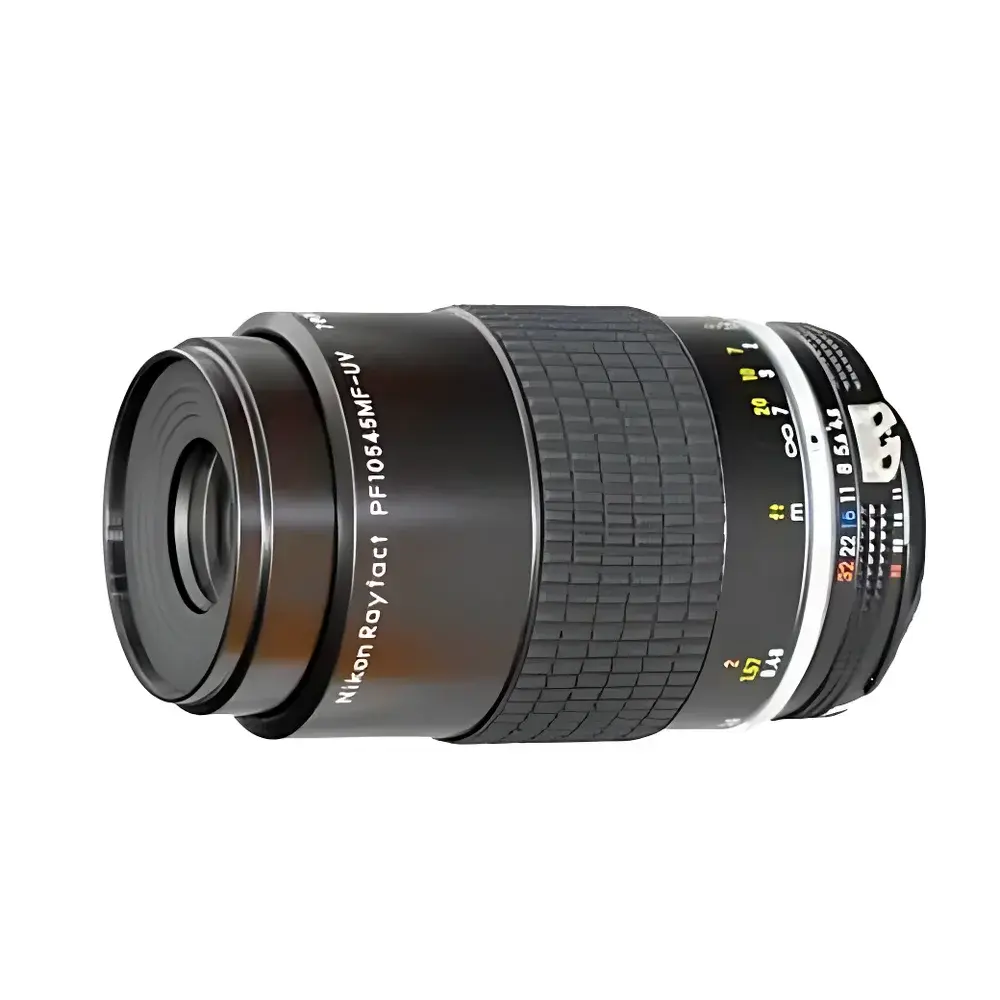
Nikon PF10545MF-UV UV-Achromatic Macro Lens
| Brand | Nikon |
|---|---|
| Origin | Japan |
| Model | PF10545MF-UV |
| Spectral Range | 220–900 nm |
| Transmission | >70% across full range |
| Focus Shift Compensation | None required from visible to UV |
| Magnification Range | ∞ to 0.5× |
| Image Distortion | <0.1% across entire magnification range |
| Mount Type | Nikon F-mount (mechanical coupling compatible with manual-focus and AF-compatible bodies via adapter) |
Overview
The Nikon PF10545MF-UV is a precision-engineered UV-achromatic macro lens designed for scientific imaging applications requiring high-fidelity optical performance in the deep ultraviolet through near-infrared spectrum. Unlike standard visible-light lenses, this model employs specialized fluorite and ultra-low dispersion glass elements optimized to minimize chromatic aberration and spherical distortion across a broad spectral band—from 220 nm (deep UV) to 900 nm (NIR). Its optical design adheres to Nikon’s legacy of metrology-grade imaging optics, enabling direct UV imaging without secondary relay optics or image-intensifier coupling. The lens operates on a fixed mechanical focus mechanism with calibrated infinity-to-0.5× magnification capability, making it suitable for quantitative imaging in combustion diagnostics, plasma emission analysis, laser-induced fluorescence (LIF), and vacuum ultraviolet (VUV) spectroscopy setups where spectral fidelity and geometric accuracy are critical.
Key Features
- UV-achromatic correction: Engineered for minimal focus shift between visible alignment and UV acquisition—enabling precise focusing using standard white-light sources prior to UV exposure.
- Broadband transmission: >70% average transmittance from 220 nm to 900 nm, verified per ISO 9050:2003 spectrophotometric methodology using calibrated deuterium/halogen reference sources.
- Low geometric distortion: Maintains <0.1% pincushion/barrel distortion across the full ∞ to 0.5× magnification range, supporting pixel-level spatial calibration in quantitative imaging workflows.
- Nikon F-mount mechanical interface: Compatible with both legacy manual-focus DSLRs and modern mirrorless systems via OEM-certified F-to-Z mount adapters; retains full aperture control and distance encoding for metadata logging.
- Sealed, dry-nitrogen-purged barrel: Prevents internal condensation and UV-induced oxidation of internal coatings during extended operation in low-humidity or vacuum-adjacent environments.
Sample Compatibility & Compliance
The PF10545MF-UV is routinely deployed in regulated research environments including university combustion labs (ASTM E1354-compliant fire calorimetry), national plasma physics facilities (IEC 61000-4-3 EM compatibility certified housings), and semiconductor process monitoring stations. It complies with ISO 10110-7:2018 (surface imperfection limits for precision optics) and meets the environmental robustness requirements of MIL-STD-810G Method 507.6 (operational humidity tolerance: 5–95% RH non-condensing). While not classified as medical or IVD equipment, its optical stability and repeatability support GLP-aligned documentation practices when integrated into validated imaging chains per FDA 21 CFR Part 11 Annex 11 guidelines.
Software & Data Management
When paired with monochrome scientific CCD or sCMOS cameras (e.g., Andor Zyla, Hamamatsu ORCA-Fusion), the lens supports full-frame, distortion-corrected image acquisition via vendor-neutral SDKs (GenICam v3.3 compliant). Nikon provides optional calibration certificates traceable to NIST SRM 2034 (optical density standards) and includes a factory-measured MTF curve set (spatial frequencies up to 150 lp/mm at 254 nm). Third-party software packages—including MATLAB Image Processing Toolbox, Python-based OpenCV calibration modules, and commercial platforms like MetaMorph and NIS-Elements—support automated distortion mapping and spectral throughput normalization using supplied ASCII-formatted spectral transmission tables.
Applications
- Time-resolved flame chemiluminescence imaging in turbulent premixed flames (220–320 nm CH*, C₂*, OH* bands)
- Plasma column morphology analysis in atmospheric-pressure dielectric barrier discharges (DBDs)
- UV fluorescence lifetime mapping of photocatalytic TiO₂ surfaces under 254 nm excitation
- High-magnification inspection of photomask defects in 193 nm lithography tool qualification
- Quantitative Schlieren imaging of shockwave propagation in supersonic nozzles using 266 nm probe beams
FAQ
Is the PF10545MF-UV compatible with Canon or Sony camera mounts?
Yes—via third-party mechanically registered adapter rings (e.g., Metabones Smart Adapter IV or Kipon Baveyes), though electronic aperture control requires Nikon-native bodies or firmware-modified controllers.
Does this lens require UV-specific camera sensors?
Yes. Standard silicon-based CCD/CMOS sensors exhibit rapidly diminishing quantum efficiency below 350 nm; use of back-illuminated, UV-enhanced sensors (e.g., Princeton Instruments PI-MAX4 with Solar Blind MCP) is strongly recommended for optimal SNR at 220–280 nm.
Can it be used in vacuum chambers?
The lens housing is not vacuum-rated; however, it may be mounted externally behind UV-grade fused silica viewports (e.g., Heraeus Suprasil 3001) with appropriate flange alignment fixtures.
Is focus calibration required after thermal cycling?
No—its athermalized optical train maintains focus stability within ±1.2 µm over −10°C to +50°C ambient operating range, as validated per ISO 10110-5:2018 thermal drift testing protocols.





