
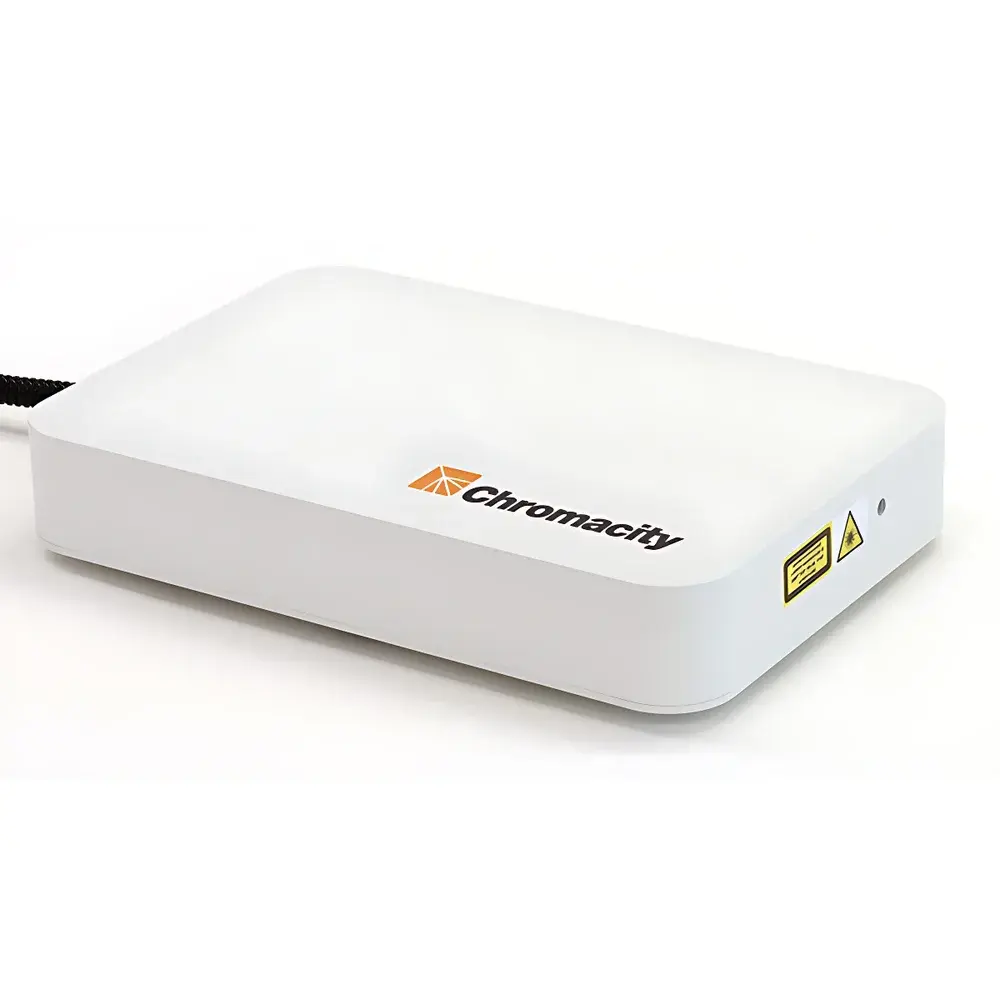
SPARK-1040 High-Power Femtosecond Laser System
| Origin | UK |
|---|---|
| Manufacturer Type | Authorized Distributor |
| Origin Category | Imported |
| Model | SPARK-1040 |
| Output Power | 0.5–3 W |
| Wavelength | 1040 nm |
| Pulse Duration | 170 fs – 2.5 ps |
| Spectral Bandwidth | 20–40 nm |
| Repetition Rate | 100 MHz (standard), optional 80–200 MHz with lock-to-clock synchronization |
| Amplitude Noise | <140 Hz RMS (measured over 50 hours) |
| Beam Quality | M² < 1.1 |
| Polarization | Linear |
| Beam Divergence | <2 mrad |
| Beam Diameter (1/e²) | 0.5 mm (standard), optional 0.5–2 mm |
| Interface | Ethernet |
| Laser Head Dimensions | 404 × 249 × 65 mm |
| Controller Dimensions | 483 × 285 × 86 mm |
| Laser Head Weight | 7.5 kg |
| Controller Weight | 2 kg |
| Power Supply | 110–240 V AC, 50–60 Hz, 80 W max |
Overview
The SPARK-1040 High-Power Femtosecond Laser System is a turnkey, industrial-grade ytterbium-doped fiber-based ultrafast laser engineered for precision nonlinear optical applications requiring stable, high-brightness 1040 nm radiation. Operating on the principle of mode-locked fiber oscillator-amplifier architecture, it delivers transform-limited pulses with durations tunable from 170 fs to 2.5 ps—enabling optimal temporal coherence and peak power control across diverse experimental configurations. With average output power scalable from 500 mW to 3 W at 100 MHz repetition rate (with low amplitude noise <140 Hz RMS over 50-hour continuous operation), the SPARK-1040 meets stringent stability requirements for quantitative imaging, pump-probe spectroscopy, and metrology-grade optical parametric amplification. Its near-diffraction-limited beam quality (M² < 1.1), linear polarization, and minimal divergence (<2 mrad) ensure efficient coupling into single-mode fibers, bulk nonlinear crystals, and scanning microscope objectives—making it a robust core source for multi-photon microscopy, OCT, and THz generation platforms.
Key Features
- Stable, maintenance-free ytterbium-fiber oscillator-amplifier architecture with integrated dispersion compensation
- Factory-calibrated pulse duration tuning (170 fs – 2.5 ps) via adjustable intra-cavity grating compressor
- Low-noise electronic locking interface supporting external clock synchronization (80–200 MHz range)
- High spatial coherence: M² 25 dB, beam pointing stability <5 µrad/°C
- Industrial-grade thermal management enabling 24/7 operation with <0.5% power drift over 8-hour thermal soak
- Ethernet-based remote control compliant with SCPI command set; supports LabVIEW, Python, and MATLAB drivers
- Modular design: laser head and controller physically separated for flexible integration into OEM systems or cleanroom environments
Sample Compatibility & Compliance
The SPARK-1040 is compatible with standard fused silica, BBO, LBO, and BiBO nonlinear crystals used in OPO pumping, SHG, and supercontinuum generation. Its 1040 nm central wavelength falls within the high-transmission window of water and biological tissue—critical for deep-tissue multiphoton excitation and label-free SHG imaging. The system complies with IEC 60825-1:2014 Class 4 laser safety standards, incorporates interlock-ready TTL ports for integration with shutter systems and safety enclosures, and meets CE marking requirements for electromagnetic compatibility (EN 55011, EN 61000-6-3/4). While not inherently GLP/GMP-certified, its deterministic performance metrics—including traceable power calibration (NIST-traceable photodiode), factory-recorded RMS noise profiles, and firmware audit logs—support validation under ISO/IEC 17025-accredited laboratory protocols.
Software & Data Management
The SPARK-1040 is operated via a web-hosted GUI accessible through any modern browser over Ethernet, eliminating proprietary software installation. Real-time monitoring includes pulse energy (calculated from average power and rep rate), internal temperature diagnostics, pump diode current/voltage telemetry, and lock-status indicators. All operational parameters are timestamped and exportable as CSV or HDF5 files. Firmware supports firmware-over-the-air (FOTA) updates with SHA-256 signature verification. For regulated environments, optional audit trail logging (aligned with FDA 21 CFR Part 11 principles) records user actions, parameter changes, and system events with immutable timestamps—facilitating compliance during QA/QC audits in photonics R&D labs and medical device development facilities.
Applications
- Two-photon and second-harmonic generation (SHG) microscopy of thick tissue sections and live organoids
- Pump source for synchronously pumped optical parametric oscillators (OPOs) generating tunable mid-IR output (1.4–4 µm)
- Supercontinuum generation in highly nonlinear photonic crystal fibers for broadband OCT and spectroscopic applications
- Time-resolved pump-probe studies of carrier dynamics in perovskites, 2D materials, and quantum dots
- 3D laser lithography and two-photon polymerization using acrylate and epoxy-based resins
- Terahertz time-domain spectroscopy (THz-TDS) via optical rectification in ZnTe or GaP crystals
- Seed source for Yb:YAG or Yb:CaF₂ amplifier systems requiring high-fidelity temporal contrast and low CEP noise
FAQ
Is the SPARK-1040 compatible with third-party pulse compressors or spectral shapers?
Yes—the laser features a collimated free-space output with standardized SM1-threaded mounting and a calibrated dispersion pre-compensation profile, enabling seamless integration with commercial acousto-optic programmable dispersive filters (AOPDFs) and chirped-mirror compressors.
Can the repetition rate be externally triggered or synchronized to a master clock?
Standard configuration supports passive lock-to-clock operation at 100 MHz; optional hardware upgrade enables active phase-locked loop (PLL) synchronization across 80–200 MHz with sub-100 fs jitter relative to external 10 MHz reference.
What maintenance is required during routine operation?
No scheduled maintenance is required—fiber-integrated design eliminates alignment sensitivity and consumables; only periodic verification of output power stability and beam pointing using calibrated photodiodes and quadrant detectors is recommended per ISO 11146.
Does the system support OEM integration into custom optical benches or medical devices?
Yes—laser head and controller are mechanically and electrically decoupled, with industry-standard DIN-rail mounting options, 24 V DC auxiliary power outputs, and TTL-compatible status signals for embedded system handshaking.
Is spectral bandwidth tunability available as a factory option?
Spectral bandwidth is fixed by cavity design but can be broadened post-emission using nonlinear compression techniques; optional fiber-based spectral filtering modules (e.g., bandpass tunable filters with 0.5 nm resolution) are available for application-specific line narrowing.





