
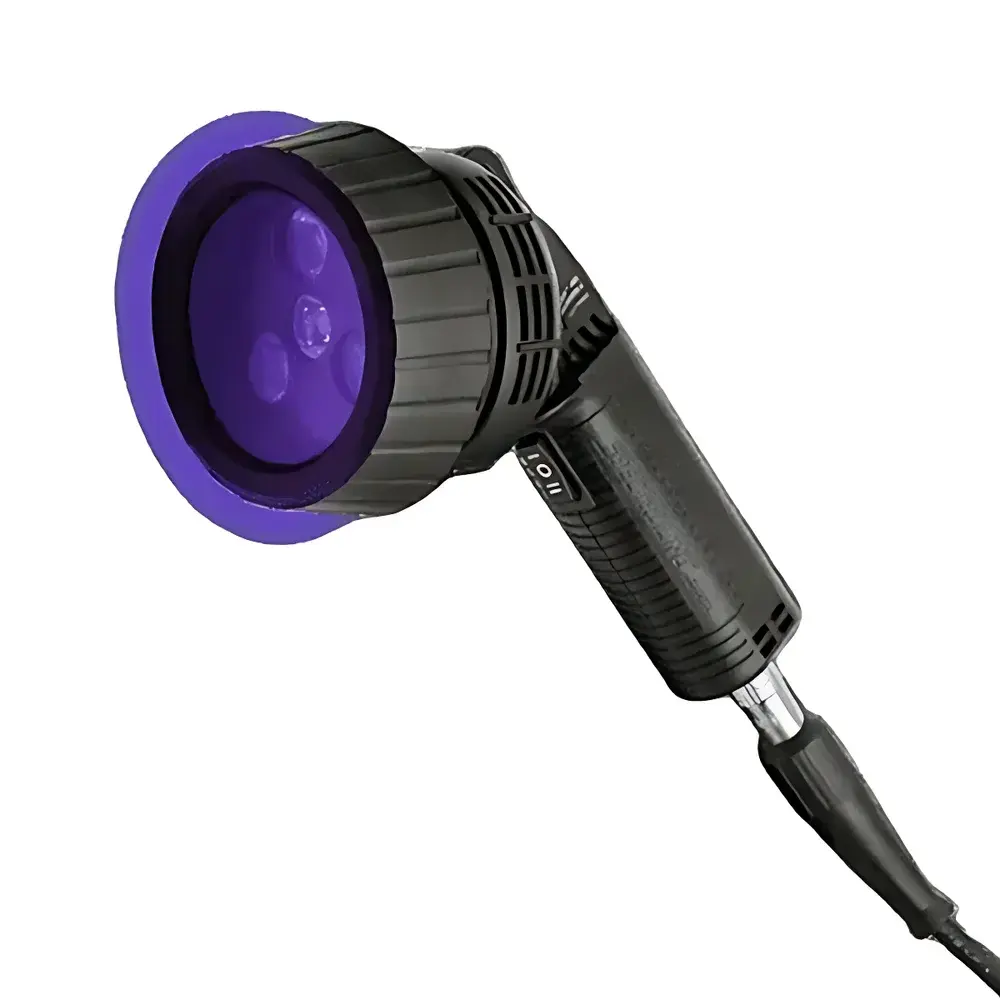
Spectro-UV Tritan & Classic Series Handheld Fan-Cooled UV-A Lamps
| Brand | Spectro-UV |
|---|---|
| Origin | USA |
| Model Series | Tritan Series, Classic Series |
| UV-A Wavelength | 365 nm (peak), 360–370 nm range |
| FWHM | ≤15 nm (Tritan), ≤20 nm (Classic) |
| UV-A Intensity at 38 cm | 5,700–8,000 µW/cm² |
| Beam Diameter at 38 cm | 15–19 cm Ø |
| Visible Light Emission | ≤20 lux |
| IP Rating | IP68 (Classic), IP54 (Tritan) |
| Power Options | AC adapter, rechargeable Li-ion battery (up to 9 h runtime) |
| Thermal Protection | Auto-shutdown at critical temperature |
| Compliance | ASTM E3022-18, ISO 3059:2012, RRES 90061:2014, AITM6-1001 Issue 15, Rolls-Royce PRC-001 |
Overview
Spectro-UV’s handheld fan-cooled UV-A lamps are engineered for precision, reliability, and regulatory compliance in mission-critical inspection environments. Designed around a narrowband 365 nm UV-A emission profile—peaking at 365 nm with full-width half-maximum (FWHM) ≤15 nm (Tritan) or ≤20 nm (Classic)—these lamps deliver high-intensity, spectrally stable irradiation essential for fluorescent penetrant inspection (FPI), magnetic particle inspection (MPI), and other non-destructive testing (NDT) workflows. The integrated thermal management system—including active fan cooling and thermally triggered shutdown—ensures sustained output stability during extended operation, mitigating intensity drift caused by LED junction heating. Unlike passive-cooled alternatives, this architecture maintains nominal UV-A irradiance over time, directly supporting repeatability requirements defined in ASTM E3022-18 and ISO 3059:2012.
Key Features
- Active thermal regulation via brushless DC fan and real-time temperature monitoring, enabling continuous-duty operation without intensity degradation
- Compliance-grade optical performance: spectral peak at 365 ± 5 nm, FWHM ≤15 nm (Tritan), ≤20 nm (Classic), and UV-A irradiance ≥5,700 µW/cm² at 38 cm per ASTM E3022-18
- Dual-power architecture: AC-powered models for benchtop or fixed-station use; Li-ion battery variants (e.g., CLA-100ZX, CLA-150X) offering up to 9 hours of uninterrupted field operation
- Ruggedized mechanical design: IP68 ingress protection (Classic series), chemical-resistant housing, and drop-tested construction per MIL-STD-810G
- Low visible light emission (<20 lux at working distance), minimizing operator eye fatigue and ensuring optimal fluorescence contrast under darkroom conditions
- Modular accessories: interchangeable LED protective shields, swappable power cords, and optional wireless charging cradles (Classic series)
Sample Compatibility & Compliance
These UV-A lamps are validated for use with standard fluorescent penetrants and magnetic particles compliant with AMS 2644, ISO 3452-2, and ASTM E1417. Their spectral output meets the stringent photometric and radiometric criteria specified in aerospace NDT standards—including Airbus AITM6-1001 Issue 15, Rolls-Royce RRES 90061:2014, and Pratt & Whitney PW-0160. Each unit undergoes individual photometric calibration and is supplied with a traceable Certificate of Conformance referencing NIST-traceable reference detectors. The low-current ripple (<6% for battery operation, <5% for AC) and stable forward voltage ensure consistent excitation of fluorescent dyes across batch-to-batch inspections—a prerequisite for GLP/GMP-aligned quality systems.
Software & Data Management
While these are standalone optical instruments with no embedded firmware or connectivity, Spectro-UV provides comprehensive documentation packages aligned with FDA 21 CFR Part 11 readiness: each lamp ships with a Device Master Record (DMR)-aligned user manual, calibration certificate, and test report verifying conformance to ASTM E3022-18 Annex A1. For laboratories operating under ISO/IEC 17025 or AS9100, Spectro-UV supports audit-ready record retention through standardized log templates for daily intensity verification (using NIST-traceable UV-A meters), battery cycle tracking, and thermal event logging. No proprietary software is required; all validation protocols integrate seamlessly with existing LIMS or QMS platforms.
Applications
- Aerospace NDT: Fluorescent penetrant and wet magnetic particle inspection of turbine blades, airframe welds, and composite structures per Boeing D6-17487 and Airbus AITM6-1001
- Automotive manufacturing: Surface crack detection on castings, forgings, and additive-manufactured components
- Power generation: In-service inspection of nuclear reactor coolant piping and steam turbine rotors
- Forensic science: Latent fingerprint development and trace evidence visualization using cyanoacrylate fuming and alternate light sources
- Life sciences: UV crosslinking validation in nucleic acid blotting and photoactivation studies where narrowband 365 nm exposure is required
FAQ
Do these lamps meet ASTM E3022-18 requirements for aerospace NDT?
Yes—each model is independently verified for spectral output, irradiance uniformity, visible light leakage, and thermal stability per ASTM E3022-18 Annex A1.
What is the recommended recalibration interval?
Annual photometric recalibration is advised when used in regulated environments; Spectro-UV provides certified recalibration services with NIST-traceable documentation.
Can the Classic series be used underwater?
The IP68 rating permits temporary submersion up to 1.5 m for 30 minutes; however, UV-A transmission through water significantly attenuates irradiance—surface inspection only is recommended.
Is battery runtime affected by ambient temperature?
Yes—Li-ion capacity decreases below 10°C; operation between 15–35°C ensures rated runtime. Cold-weather operation requires pre-warming and reduced duty cycles.
Are replacement LEDs user-serviceable?
No—LED modules are factory-calibrated and sealed. Field replacement requires return-to-factory service to maintain spectral and intensity certification.





