
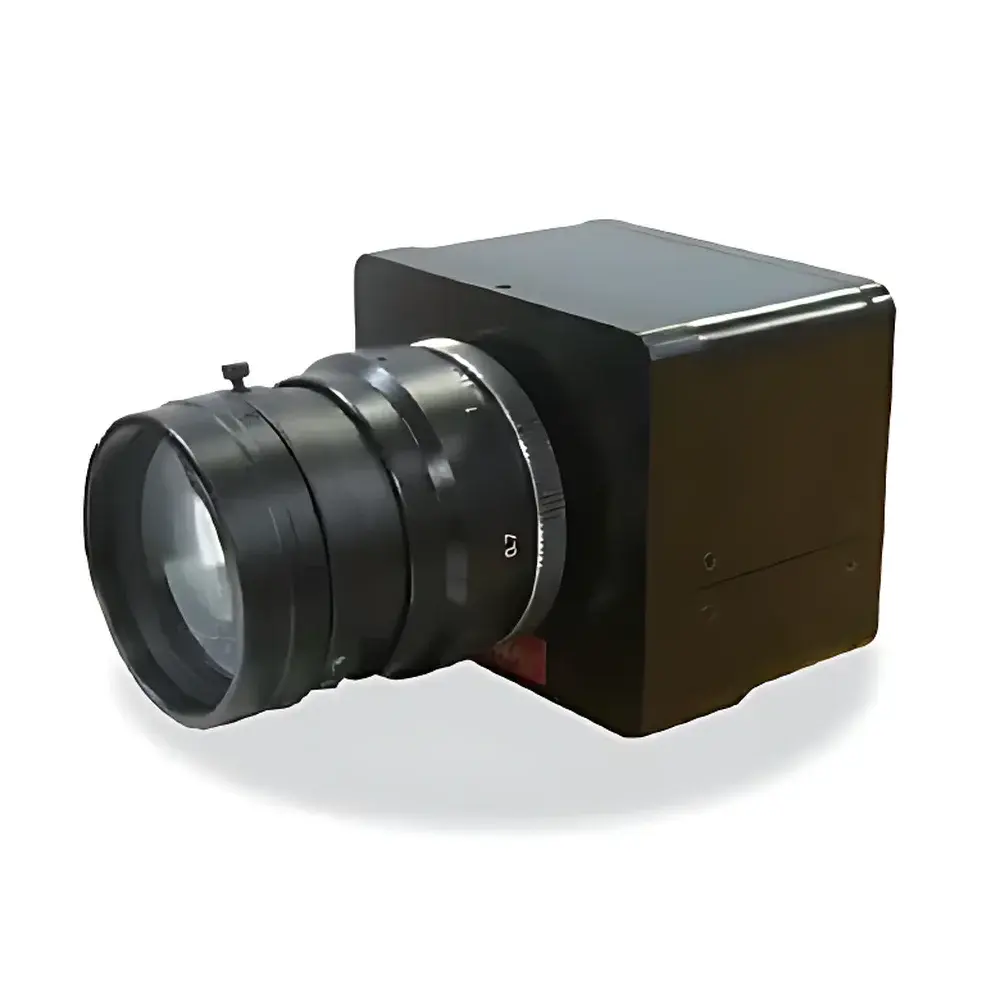
Artray ARTCAM-130XQE-WOM Near-Infrared CMOS Camera
| Brand | Artray |
|---|---|
| Origin | Japan |
| Model | ARTCAM-130XQE-WOM |
| Spectral Response Range | 400–1200 nm |
| Resolution | 1280 × 1024 |
| Pixel Size | 10 µm × 10 µm |
| Shutter Type | Rolling Shutter |
| Frame Rate | 28 fps |
| Interface | USB 2.0 |
Overview
The Artray ARTCAM-130XQE-WOM is a high-sensitivity near-infrared (NIR) CMOS camera engineered for scientific and industrial imaging applications requiring extended silicon-based spectral response. Unlike conventional InGaAs-based NIR cameras, this model leverages a specially optimized back-illuminated CMOS sensor with enhanced quantum efficiency in the 900–1200 nm range—achieving detectable responsivity up to 1200 nm while maintaining significantly lower dark current and read noise than typical InGaAs alternatives. Its optical architecture is based on silicon photodiode technology with deep-depletion and anti-reflection coating enhancements, enabling high signal-to-noise ratio (SNR) imaging under low-light NIR conditions. Designed for integration into automated inspection systems, photoluminescence mapping setups, and semiconductor failure analysis workflows, the ARTCAM-130XQE-WOM delivers quantitative imaging performance without cryogenic cooling—reducing system complexity and operational overhead.
Key Features
- Extended spectral sensitivity from 400 nm (visible) to 1200 nm (NIR), covering key emission bands of silicon-based materials including photoluminescence at ~1150 nm.
- 1280 × 1024 active pixel array with uniform 10 µm square pixels, supporting high-resolution spatial profiling of micro-scale defects and carrier recombination zones.
- Rolling shutter operation with global reset capability, enabling synchronized triggering for time-resolved luminescence capture and pulsed excitation experiments.
- Native USB 2.0 interface providing plug-and-play compatibility with Windows and Linux host systems; no frame grabber required.
- Low-noise analog front-end and 12-bit ADC output ensure dynamic range >60 dB, suitable for both high-intensity reflectance imaging and weak-emission photoluminescence detection.
- Compact, fanless aluminum housing rated for continuous operation in controlled laboratory and cleanroom environments (ISO Class 5 compatible).
Sample Compatibility & Compliance
The ARTCAM-130XQE-WOM is routinely deployed in non-destructive evaluation of silicon wafers, PERC solar cells, and III-V heterostructures where sub-bandgap photon emission reveals minority carrier lifetime distribution and defect localization. Its spectral range aligns with ASTM F2793–21 (Standard Practice for Photoluminescence Imaging of Silicon Wafers) and supports compliance with internal quality control protocols used in PV manufacturing per IEC 61215-2 and IEC 62788-5-1. While not certified for medical or aerospace-grade qualification, the camera meets CE marking requirements for electromagnetic compatibility (EN 61326-1) and safety (EN 61010-1). Data acquisition workflows can be configured to satisfy basic GLP documentation needs, including timestamped metadata embedding and user-defined ROI annotation.
Software & Data Management
Artray provides a native SDK (C/C++, Python bindings) and GUI application (ARTView) supporting real-time preview, exposure/gain adjustment, histogram analysis, and multi-frame averaging. All acquired images are saved in lossless TIFF format with embedded EXIF tags containing exposure time, gain setting, sensor temperature (monitored via on-chip thermal diode), and calibration checksums. The SDK enables integration with MATLAB, LabVIEW, and Python-based analysis pipelines (e.g., NumPy/SciPy, OpenCV). For regulated environments, optional firmware update v2.3+ introduces audit-trail logging of parameter changes and user session timestamps—supporting traceability requirements aligned with FDA 21 CFR Part 11 Annex 11 principles when paired with validated host software.
Applications
- Photoluminescence (PL) and electroluminescence (EL) imaging of crystalline silicon solar cells for defect identification and efficiency grading.
- In-line wafer inspection during front-end semiconductor fabrication, especially for detecting metal contamination and dislocation clusters.
- NIR fluorescence microscopy of quantum dot-labeled biological samples where autofluorescence interference is minimized beyond 900 nm.
- Thermal emission monitoring of electronic components operating under bias, leveraging intrinsic blackbody radiation in the 1000–1200 nm window.
- Optical characterization of thin-film coatings and transparent conductive oxides using NIR reflectance and transmittance mapping.
FAQ
Does the ARTCAM-130XQE-WOM require external cooling?
No—it operates at ambient temperatures with passive thermal management; dark current remains below 0.05 e⁻/pixel/s at 25°C.
Is the sensor sensitive to 1300 nm light?
No—peak quantum efficiency drops sharply above 1200 nm; usable response is limited to ≤1200 nm per datasheet specifications.
Can it be synchronized with external laser pulses?
Yes—hardware trigger input (TTL-compatible) supports external synchronization with jitter <1 µs.
What is the maximum sustained frame rate at full resolution?
28 fps over USB 2.0; binning modes (e.g., 2×2) enable higher effective frame rates with reduced spatial resolution.
Is radiometric calibration provided with the camera?
A factory-measured relative responsivity curve (400–1200 nm) is included; NIST-traceable absolute calibration is available as an optional service.



