
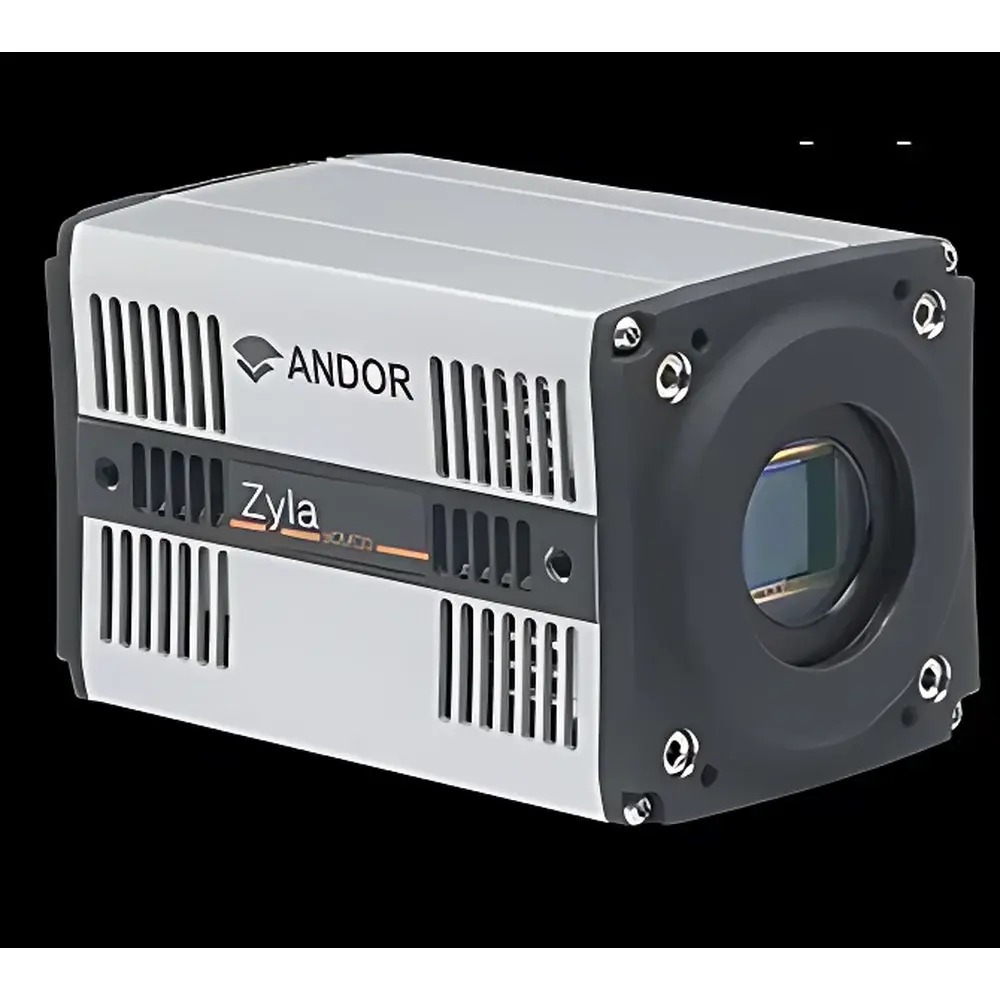
Andor Zyla 4.2 PLUS Scientific sCMOS Camera
| Brand | Andor |
|---|---|
| Origin | United Kingdom |
| Model | Zyla 4.2 PLUS |
| Sensor Type | Back-illuminated sCMOS |
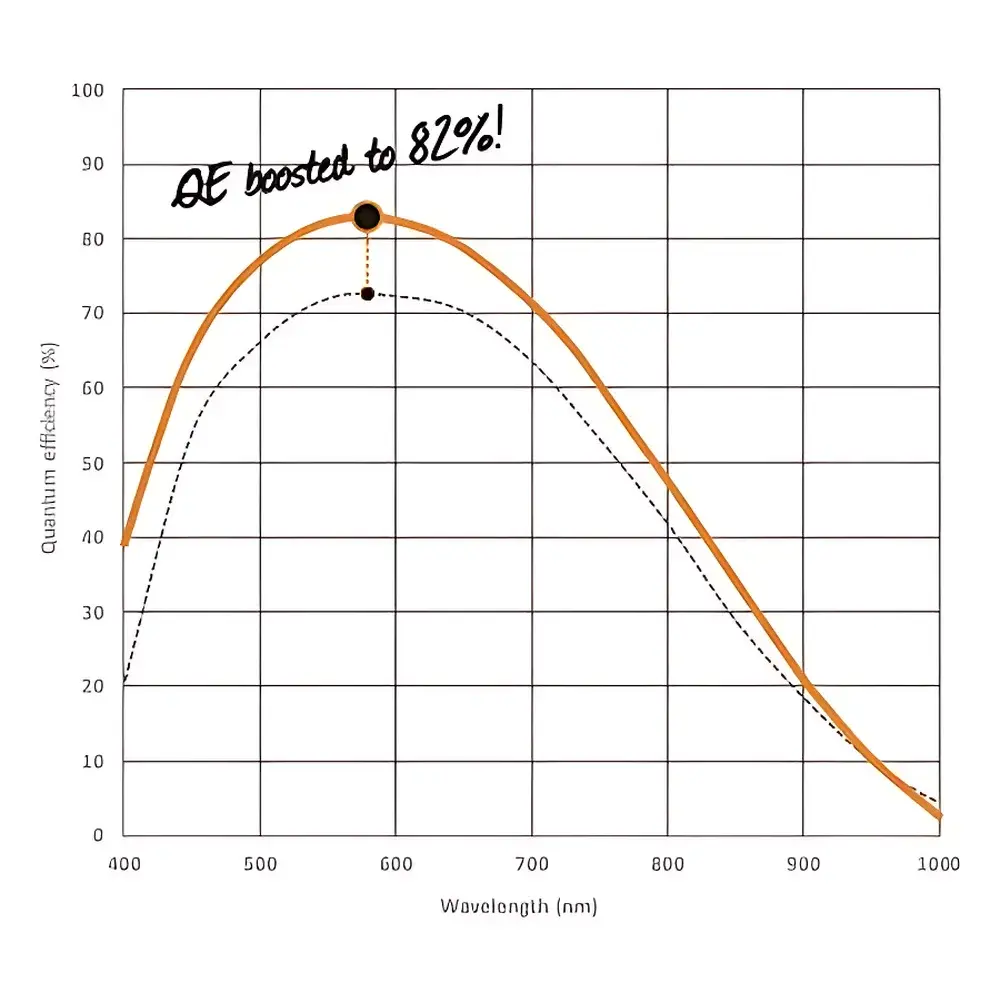
| Quantum Efficiency (QE) | Up to 82% @ 560 nm |
| Read Noise | < 0.9 e⁻ (rms) |
| Dynamic Range | 33,000:1 |
| Pixel Size | 6.5 µm |
| Resolution | 2048 × 2048 (4.2 MP) or 2560 × 2160 (5.5 MP) options |
| Full-Frame Frame Rate | 53 fps via USB 3.0 (optimized mode), up to 100 fps in cropped modes |
| Shutter Modes | Global and Rolling |
| Cooling | Thermoelectric (TE) to 0 °C @ 35 °C ambient |
| Specialized Acquisition Modes | Laser Sheet Microscopy, Line-Scan Confocal, Fluorescence Correlation Spectroscopy (FCS) with ROI-based rates up to 26,041 fps |
| Compliance | CE, RoHS, FDA 21 CFR Part 11-ready software support |
Overview
The Andor Zyla 4.2 PLUS is a high-performance scientific sCMOS camera engineered for quantitative, low-light imaging applications in life sciences, biophysics, and advanced microscopy. Built upon a back-illuminated sCMOS sensor architecture, it delivers industry-leading quantum efficiency (up to 82% at 560 nm), sub-electron read noise (99.8% across full well capacity). The camera operates via high-bandwidth USB 3.0 interface, supporting real-time streaming at 53 fps at full resolution — a 77% speed improvement over prior-generation sCMOS platforms — while maintaining full bit-depth integrity and on-chip intelligent noise suppression.
Key Features
- Back-illuminated sCMOS sensor with peak QE of 82% — optimized for fluorescence excitation/emission spectra
- Read noise < 0.9 e⁻ (rms) at maximum frame rate — enabling single-photon-level detection sensitivity
- Global and rolling shutter operation — supports time-resolved imaging, synchronization with pulsed lasers, and artifact-free motion capture
- Thermoelectric cooling to 0 °C (at 35 °C ambient) — ensures stable dark current performance during extended acquisitions
- Compact, lightweight housing (≤ 250 g) with minimal mechanical vibration — ideal for OEM integration into confocal, light-sheet, and super-resolution systems
- Dual-resolution variants: 2048 × 2048 (4.2 MP) and 2560 × 2160 (5.5 MP), both with 6.5 µm pixels — balancing field-of-view and spatial sampling requirements
- On-board real-time false-noise filtering and pixel defect correction — reduces post-processing overhead and improves data reproducibility
Sample Compatibility & Compliance
The Zyla 4.2 PLUS is compatible with standard C-mount and F-mount optical interfaces, facilitating direct coupling to inverted and upright microscopes, spectrographs, and custom optical benches. Its spectral response (350–1100 nm) aligns with ISO 11146-compliant laser beam profiling, ASTM E2823-19 for fluorescence imaging validation, and USP guidelines for quantitative bioimaging instrumentation. When operated with Andor’s Solis or SDK-based acquisition software, the system supports audit-trail logging, electronic signatures, and secure user access controls — fulfilling core requirements of FDA 21 CFR Part 11 for regulated environments. All firmware and driver binaries are digitally signed and undergo periodic GLP/GMP-aligned verification per Andor’s internal quality management system (ISO 9001:2015 certified).
Software & Data Management
Control and acquisition are managed through Andor’s Solis v5.x platform or programmable SDKs (C++, Python, MATLAB, LabVIEW). Solis provides real-time histogram analysis, multi-channel time-lapse registration, and export to TIFF, HDF5, and OME-TIFF formats compliant with the Open Microscopy Environment specification. The SDK enables deterministic trigger timing, hardware-synchronized multi-camera operation, and integration into automated workflows governed by NI TestStand or custom LIMS architectures. Metadata embedding includes exposure parameters, temperature logs, sensor calibration coefficients, and timestamped shutter events — ensuring traceability for publication-grade datasets and regulatory submissions.
Applications
- Light-sheet fluorescence microscopy (LSFM) — leveraging global shutter and high-speed ROI readout for volumetric imaging of cleared tissues and live embryos
- Fluorescence correlation spectroscopy (FCS) — achieving 26,041 fps in 2048 × 8 ROI mode to resolve nanosecond-scale diffusion kinetics
- Live-cell calcium and voltage imaging — combining low phototoxicity, high temporal resolution, and quantitative linearity for kinetic modeling
- Single-molecule localization microscopy (SMLM) — supporting PALM/STORM via precise photon counting and drift correction compatibility
- Ion channel electrophysiology imaging — synchronized acquisition with patch-clamp rigs using TTL-triggered exposure control
- OEM integration into diagnostic analyzers and industrial inspection systems requiring validated, maintenance-free imaging cores
FAQ
What is the difference between the Zyla 4.2 PLUS and earlier Zyla models?
The Zyla 4.2 PLUS features a next-generation back-illuminated sCMOS sensor with enhanced microlens design, delivering +10% higher QE than previous gold-standard sCMOS sensors, lower read noise (99.8%) across the full dynamic range.
Does the camera support hardware triggering and synchronization?
Yes — it offers TTL-compatible input/output trigger ports with sub-microsecond jitter, supporting external laser pulsing, stage scanning, and multi-modal instrument coordination.
Is the Zyla 4.2 PLUS suitable for regulated pharmaceutical research?
When used with Solis software configured for 21 CFR Part 11 compliance (audit trail, role-based access, electronic signatures), it meets essential data integrity requirements for GLP and early-stage GMP workflows.
Can the camera be integrated into custom optical systems?
Its compact form factor (100 × 100 × 65 mm), C-mount interface, TE cooling, and SDK-based control make it widely adopted in OEM microscope, endoscope, and analytical instrument designs.
What file formats are supported for raw image export?
TIFF (16-bit and 32-bit float), HDF5, and OME-TIFF — all preserving embedded metadata required for FAIR (Findable, Accessible, Interoperable, Reusable) data principles.





