
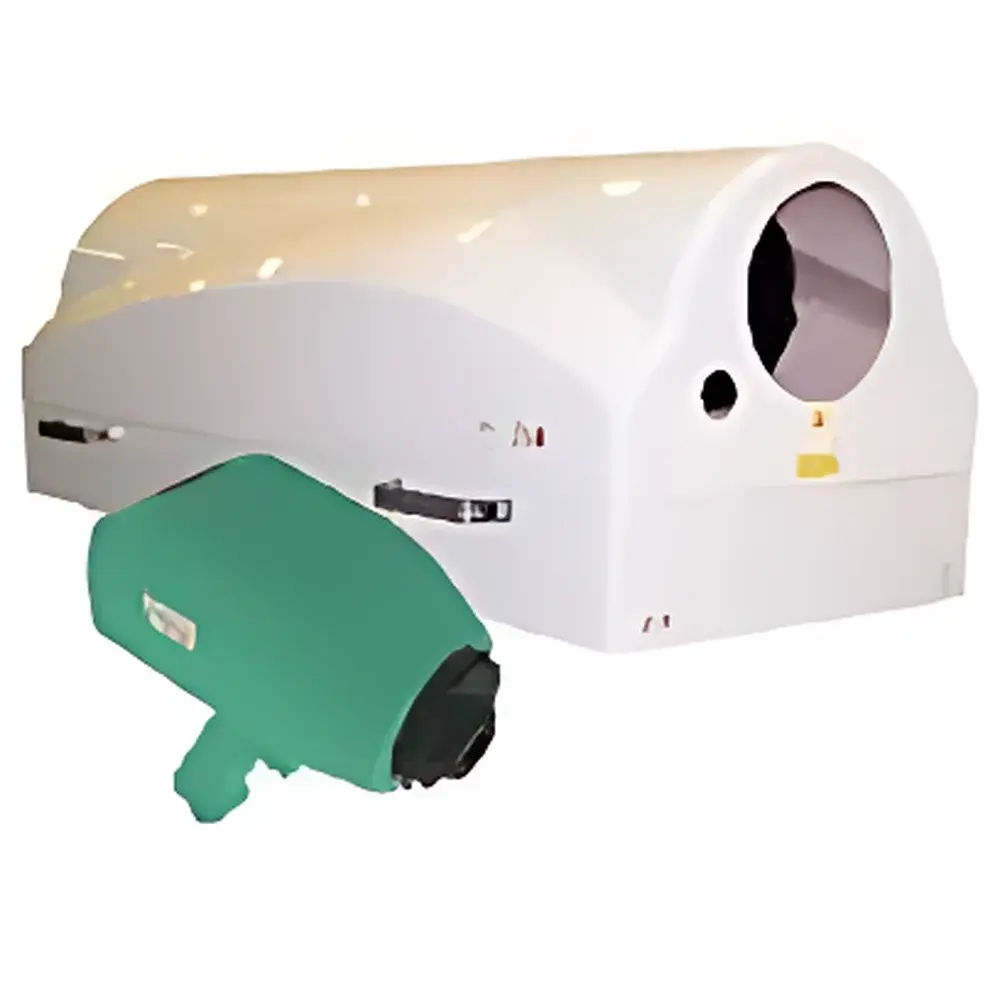
RemoteLIBS by IVEA — Pulsed Nd:YAG Modular Online Laser-Induced Breakdown Spectroscopy System
| Brand | IVEA |
|---|---|
| Origin | France |
| Instrument Type | Online LIBS System |
| Laser Source | Pulsed Nd:YAG (266 nm / 355 nm / 532 nm options) |
| Operating Distance | 3–10 m (customizable) |
| Probe Options | FarLIBS (telescopic coupling) or OfiLIBS (fiber-optic coupling) |
| Optical Architecture | Integrated collimation, focusing, and light collection path |
| Spectrometer Options | Echelle spectrometer + ICCD or Czerny-Turner spectrometer + ICCD |
| Motion Control | Motorized XYZ sample positioning stage |
| Integration | Modular, field-deployable design |
| Compliance | Designed for industrial process monitoring and hazardous environment deployment |
Overview
The RemoteLIBS system by IVEA is a purpose-engineered online Laser-Induced Breakdown Spectroscopy (LIBS) platform designed for elemental analysis of materials located at standoff distances ranging from 3 to 10 meters. Unlike conventional benchtop LIBS instruments requiring direct sample access, RemoteLIBS employs a pulsed Nd:YAG laser source coupled with either telescopic (FarLIBS) or fiber-optic (OfiLIBS) delivery to generate microplasmas on remote targets. The emitted atomic and ionic line spectra are collected via the same optical path and directed to a high-sensitivity spectrometer—either an echelle configuration for broad spectral coverage with high resolution or a Czerny-Turner design optimized for signal-to-noise ratio in specific elemental bands. Detection is performed using an intensified charge-coupled device (ICCD) with nanosecond-level gating, enabling precise temporal discrimination of plasma emission against ambient background. This architecture supports quantitative and semi-quantitative multi-element analysis without physical contact, making it suitable for applications where safety, accessibility, or thermal constraints prohibit proximity-based measurement.
Key Features
- Standoff operation at 3–10 m distance, configurable per site-specific requirements including extended-range optical alignment and atmospheric compensation
- Dual probe modularity: FarLIBS probe for free-space telescopic coupling; OfiLIBS probe for flexible fiber-optic integration into confined or shielded environments
- Triple-wavelength Nd:YAG laser source (266 nm, 355 nm, 532 nm) enabling optimization of ablation efficiency and plasma excitation across diverse material classes (metals, ceramics, polymers, soils)
- Fully integrated optical train with coaxial focusing and collection optics, minimizing alignment drift and maximizing photon throughput
- Motorized XYZ translation stage with software-controlled positioning, supporting raster scanning and automated multi-point analysis
- Modular spectrometer interface accommodating either echelle or Czerny-Turner configurations, each paired with a gated ICCD detector for time-resolved spectral acquisition
Sample Compatibility & Compliance
RemoteLIBS is validated for direct analysis of solid, layered, and heterogeneous surfaces—including metallic alloys, refractory linings, nuclear containment structures, reactor vessel windows, and pipeline exteriors. It requires no sample preparation and operates under ambient atmospheric conditions, though optional purge gas interfaces support inert or controlled-atmosphere measurements. The system adheres to functional safety principles relevant to industrial deployment: optical enclosure interlocks, Class IV laser housing compliance per IEC 60825-1, and electromagnetic compatibility (EMC) certification per EN 61326-1. While not a regulated medical device, its data acquisition architecture supports audit-ready logging in accordance with GLP and ISO/IEC 17025 documentation practices. For regulated industries, raw spectral data export formats (e.g., HDF5, ASCII) are compatible with third-party chemometric validation pipelines compliant with ASTM E2926 and ISO 11843 standards.
Software & Data Management
The system is operated via IVEA’s proprietary RemoteLIBS Control Suite, a Windows-based application providing real-time plasma imaging, spectral acquisition, and elemental quantification workflows. Software modules include automated wavelength calibration using internal Ne/Ar reference lines, self-absorption correction algorithms, and multivariate regression models trained on NIST SRM-certified reference materials. All acquisition parameters—including laser energy, gate delay, integration time, and spatial coordinates—are timestamped and stored with metadata in a relational SQLite database. Export options include CSV, MATLAB .mat, and standardized JCAMP-DX files for interoperability with LIMS and enterprise analytics platforms. Audit trail functionality records user actions, parameter changes, and instrument status events—supporting FDA 21 CFR Part 11 compliance when deployed with network authentication and electronic signature modules.
Applications
- Nuclear facility monitoring: Real-time analysis of radioactive containment surfaces, fuel cladding, and spent fuel pool components without entry into high-dose zones
- Industrial process control: In-situ composition verification of molten metal streams, refractory wear in blast furnaces, and slag layer stratification
- Infrastructure integrity assessment: Rapid elemental mapping of corrosion products, coating degradation, and concrete alkali-silica reaction indicators on bridges, tunnels, and offshore platforms
- Hazardous material screening: Identification of heavy metals (Pb, Cd, As), halogens (Cl, F), and toxic additives in legacy building materials, waste drums, and contaminated soil matrices
- Aerospace component inspection: Non-contact verification of thermal barrier coating stoichiometry (e.g., YSZ Zr/Y ratio) and oxidation layer thickness on turbine blades
FAQ
What is the minimum detectable concentration for common elements using RemoteLIBS?
Detection limits vary by element, matrix, and operating configuration—typically ranging from 10–100 ppm for major metallic elements (Fe, Al, Cu) and 100–500 ppm for trace elements (Cr, Ni, Mn) under optimal standoff conditions. Calibration against site-specific reference samples is recommended for quantitative accuracy.
Can RemoteLIBS operate in high-temperature environments?
The probe head and optical path are rated for ambient temperatures up to 50 °C; however, passive cooling jackets and radiation shields enable operation near surfaces up to 800 °C when combined with appropriate standoff distance and beam attenuation strategies.
Is fiber-optic transmission limited to specific wavelengths?
Yes—the OfiLIBS probe uses UV-grade fused silica fibers optimized for transmission at 266 nm and 355 nm; 532 nm operation is supported but may incur higher nonlinear losses at peak pulse energies.
How is spectral calibration maintained during long-term deployment?
The system performs automatic wavelength calibration before each acquisition sequence using integrated miniature gas discharge lamps (Ne/Ar), with drift correction applied in real time via pixel-mapping algorithms.
Does RemoteLIBS support automated classification of unknown materials?
Yes—via optional Chemometric Engine module, which applies PCA-LDA or PLS-DA models trained on spectral libraries to assign materials to predefined categories (e.g., stainless steel grades, polymer types, geological formations).



