
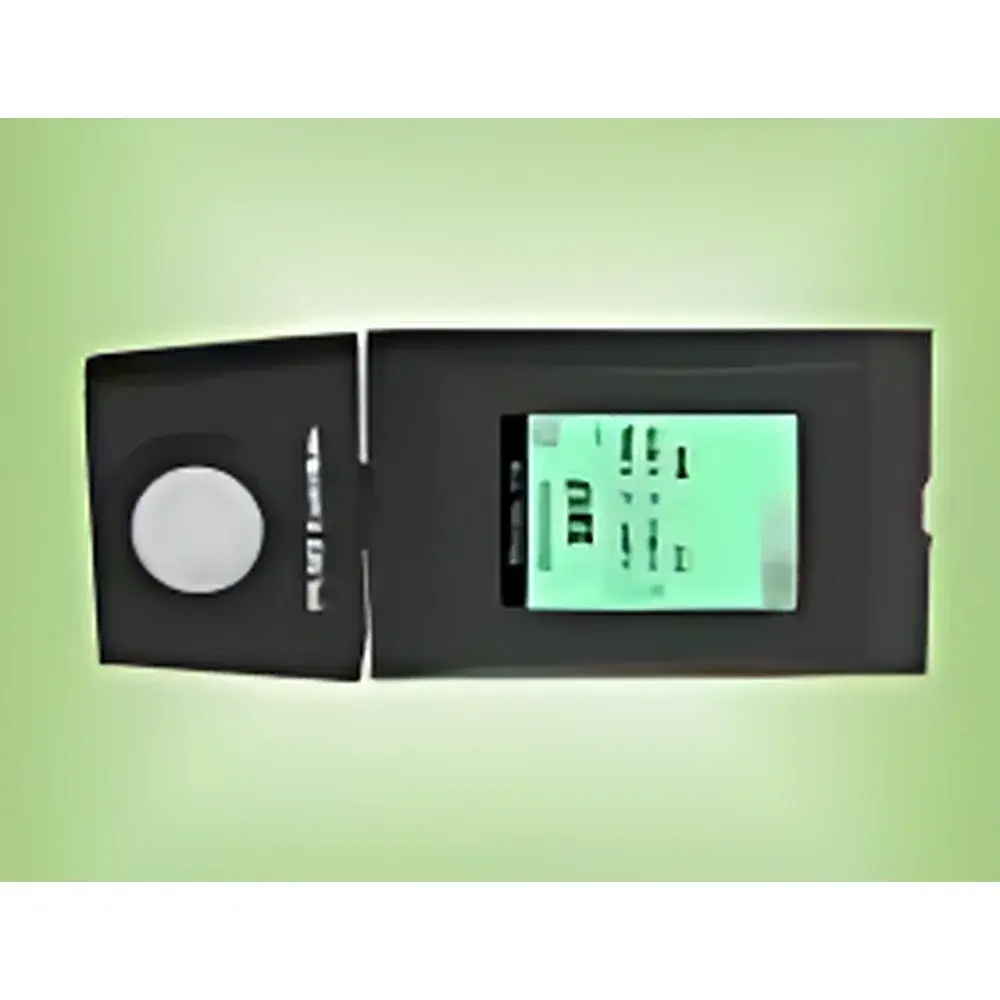
Photo Research PR-521 Handheld Photometer
| Brand | Photo Research |
|---|---|
| Origin | USA |
| Model | PR-521 |
| Type | Automatic |
| Illuminance Range | 0.01–999,999 lx |
| Luminance Range | 0.001–999,999 cd/m² |
| Chromaticity Accuracy | ±0.002 in CIE 1931 xy |
| Correlated Color Temperature (CCT) Range | 1000–100,000 K |
| Display | Backlit capacitive touchscreen |
| Data Storage | SD card (up to 52,000 measurements) |
| Interface | USB 2.0 |
| Battery | Rechargeable Li-ion, 6 hours continuous operation |
| Compliance | NIST-traceable calibration, ISO/CIE-compliant photometric geometry |
Overview
The Photo Research PR-521 Handheld Photometer is a precision-engineered optical measurement instrument designed for field-deployable and laboratory-grade photometric characterization of light sources, displays, architectural lighting, and luminous surfaces. Based on CIE-standardized V(λ) spectral response correction and calibrated silicon photodiode detection, the PR-521 delivers traceable, repeatable measurements of illuminance (lx), luminance (cd/m²), chromaticity coordinates (CIE 1931 x,y and u′,v′), and correlated color temperature (CCT). Its compact, ergonomic form factor integrates high-fidelity optics with real-time signal processing—enabling rapid, single-point or spatially averaged assessments without requiring external power or PC tethering. The device conforms to photometric measurement geometries defined in CIE Publication 127, IES LM-79, and ISO/CIE 11664-1, ensuring data compatibility with international lighting standards and regulatory reporting frameworks.
Key Features
- Backlit capacitive touchscreen interface with intuitive icon-driven navigation and real-time graphical display of spectral weighting, measurement history, and statistical overlays.
- Integrated NIST-traceable calibration certificate stored onboard; user-accessible calibration verification mode supports periodic performance validation against reference standards.
- USB 2.0 interface enables firmware updates, direct data export to Windows/macOS systems, and remote control via PR’s proprietary Photometric Control Software (PCS v4.2+).
- Removable industrial-grade SD card (class 10, up to 32 GB) supports unattended logging of up to 52,000 timestamped measurements with metadata (operator ID, location tag, ambient temperature, battery level).
- Rechargeable lithium-ion battery system provides ≥6 hours of continuous operation at 25°C; low-power sleep mode extends standby time to 72 hours with auto-wakeup on button press or USB connection.
- Ruggedized magnesium alloy housing rated IP54 for dust and splash resistance; operating temperature range: 0–40°C; relative humidity: 20–80% non-condensing.
Sample Compatibility & Compliance
The PR-521 accommodates diverse measurement configurations including point-source luminaires, OLED/LCD panels, automotive interior lighting, roadway signage, and architectural façade elements. Its cosine-corrected diffuser ensures accurate angular response per CIE 127:2007 requirements, while the 1° field-of-view optical system minimizes spatial averaging errors on non-uniform surfaces. All factory calibrations are performed under controlled environmental conditions and documented per ISO/IEC 17025:2017 requirements. The instrument supports audit-ready data integrity through embedded time-stamping, operator authentication prompts, and optional GLP/GMP-compliant report generation (via PCS software with 21 CFR Part 11 electronic signature module).
Software & Data Management
Photometric Control Software (PCS) provides comprehensive post-processing capabilities including spectral reconstruction from tristimulus values, binning analysis for LED batch consistency, CCT deviation mapping, and compliance reporting against ENERGY STAR, DLC, and IEC 62471 photobiological safety thresholds. Raw measurement files (.pr5) retain full sensor-level metadata and support third-party integration via XML schema export. Data encryption (AES-128) and role-based access control ensure secure handling in regulated environments. Firmware updates preserve historical calibration coefficients and maintain backward compatibility with legacy .pr3 datasets.
Applications
- LED manufacturing QA/QC: luminous flux verification, binning by chromaticity shift, and thermal derating analysis across drive current sweeps.
- Display metrology: uniformity mapping of smartphone/tablet screens, HDR tone-mapping validation, and viewing-angle-dependent color shift quantification.
- Architectural lighting design: in-situ illuminance grid surveys, daylight harvesting system commissioning, and glare index (UGR) pre-validation.
- Automotive lighting certification: headlamp beam pattern photometry, interior ambient lighting homogeneity assessment, and adaptive driving beam (ADB) dynamic testing.
- Regulatory testing labs: accredited measurements for UL 1598, EN 60598, and IEC 61000-3-2 harmonic distortion correlation studies.
FAQ
Is the PR-521 compatible with third-party spectroradiometers for cross-validation?
Yes—the PR-521 supports manual spectral mismatch correction factors (SMCF) input for alignment with specific reference spectroradiometers, as recommended in CIE TN 007:2022.
Does the device meet FDA or ISO 13485 requirements for medical device lighting verification?
While not certified as a medical device itself, the PR-521’s measurement uncertainty budget, calibration traceability, and audit trail features align with ISO 13485 Annex A requirements for supporting equipment used in Class IIa/IIb lighting validation protocols.
Can measurement units be customized per project (e.g., foot-candles, nits, Duv)?
Yes—unit selection is configurable per measurement session, including lux/ft-cd, cd/m²/nit, CIE 1931 xy/u′v′, Duv, and ΔEu′v′ tolerancing.
How frequently should recalibration be performed?
Photo Research recommends annual recalibration under normal use; however, internal diagnostic routines and drift monitoring allow extension to 18 months when supported by documented intermediate verification using a stable reference source.
Is there an API for integrating PR-521 data into MES or LIMS platforms?
Yes—PCS includes a RESTful HTTP API with JSON payload support, enabling direct ingestion into LabVantage, Thermo Fisher SampleManager, and custom SQL-based LIMS deployments.




