
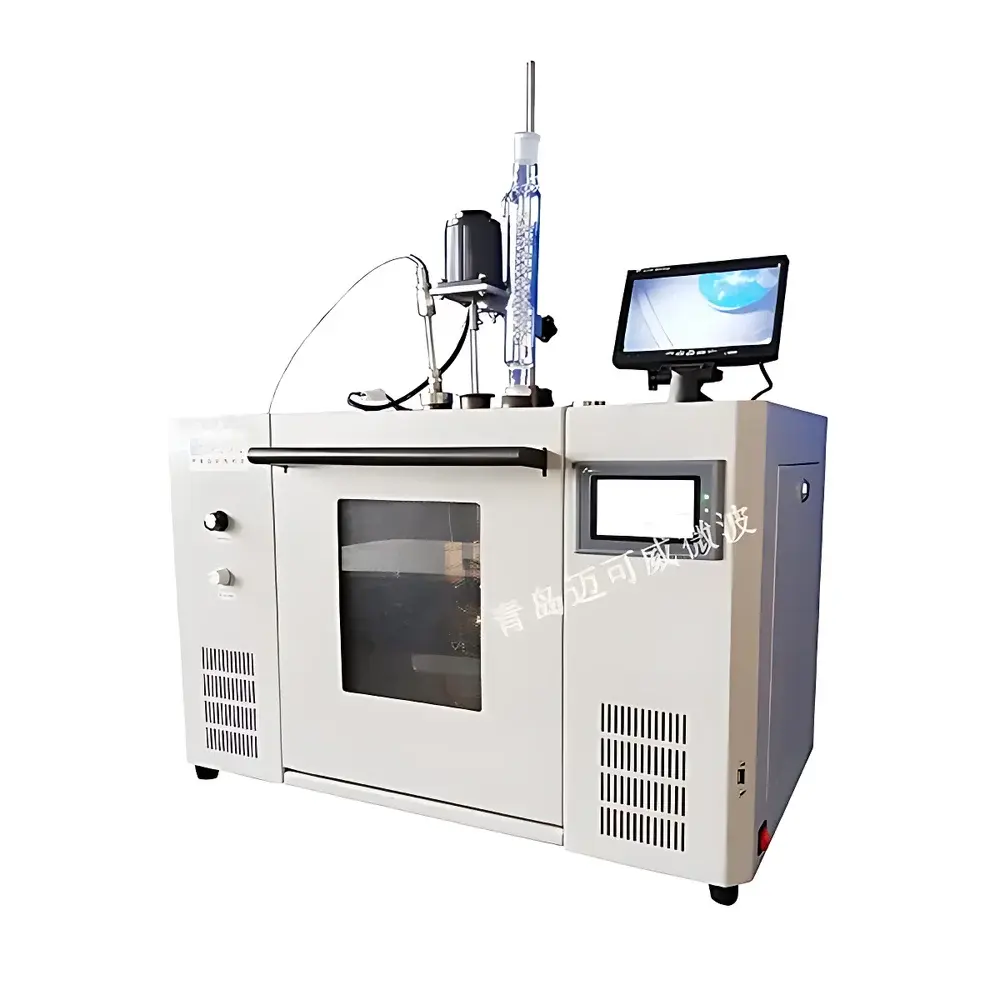
MKX-H1C1U Microwave-Ultraviolet Hybrid Chemical Synthesizer
| Brand | Makewave |
|---|---|
| Origin | Shandong, China |
| Manufacturer Type | Direct Manufacturer |
| Country of Origin | China |
| Model | MKX-H1C1U |
| Temperature Range | 0–300 °C |
| Temperature Control Accuracy | ±0.1 °C |
| Reaction Vessel | Three-Neck Round-Bottom Flask |
| Maximum Reaction Volume | 500 mL |
| Microwave Frequency | 2450 MHz |
| Microwave Power Output | 0–800 W (Continuously Adjustable, Non-Pulsed) |
| UV Wavelength | 254 nm |
| Cooling Requirement | External Chilled Water Circulation |
| Power Supply | 220 V AC / 50 Hz |
| Total Power Consumption | ≤1500 W |
| Net Weight | 60 kg |
| Dimensions (W×H×D) | 782 × 492 × 450 mm (Main Unit), +500 mm Height for Optional UV Mounting Bracket |
Overview
The MKX-H1C1U Microwave-Ultraviolet Hybrid Chemical Synthesizer is an open-atmosphere, benchtop reaction platform engineered for precise, reproducible, and multi-modal chemical synthesis under controlled thermal and photochemical activation. It integrates two complementary energy sources—2450 MHz continuous-wave microwave irradiation and 254 nm ultraviolet light—within a single, unified reaction chamber. This dual-activation architecture enables synergistic reaction pathways not accessible via conventional heating or photolysis alone. The system operates under ambient pressure, eliminating the need for high-pressure autoclaves while maintaining full compatibility with standard glassware—including 500 mL three-neck flasks equipped for temperature monitoring, mechanical stirring, and reflux condensation. Designed for rigorous laboratory environments, the MKX-H1C1U supports applications ranging from transition-metal-catalyzed cross-coupling and photocatalytic C–H functionalization to solvent-free solid-state reactions and accelerated extraction protocols.
Key Features
- Open-atmosphere reaction platform combining microwave (0–800 W, non-pulsed, 2450 MHz) and UV-C (254 nm) irradiation in a single cavity
- Temperature-controlled operation from 0 °C to 300 °C with ±0.1 °C accuracy, monitored via non-contact infrared pyrometry
- Dedicated 500 mL three-neck flask configuration supporting simultaneous insertion of PT100 sensor, anchor-type PTFE-coated stirrer, and reflux condenser
- PTFE-lined 304 stainless steel cavity (≈20 L internal volume; 275 mm vertical clearance) resistant to acid, base, and thermal degradation
- Integrated mechanical stirring with variable-speed DC motor and corrosion-resistant PTFE anchor impeller
- Real-time graphical display of time–temperature–power profiles on 7-inch industrial touchscreen; data exportable via USB to CSV format
- Programmable PLC-based control system with ≥10 user-defined method storage slots, supporting ramp-hold-cool sequences and parameter logging
- Comprehensive safety architecture: interlocked door with λ/4 choke suppression, <5 mW/cm² microwave leakage (per GB 10436), forced exhaust ventilation, and automatic power cutoff upon door opening
Sample Compatibility & Compliance
The MKX-H1C1U accommodates standard borosilicate glass reaction vessels (e.g., Pyrex or equivalent) and is routinely used with heterogeneous catalysts, organometallic precursors, aqueous/organic biphasic mixtures, and thermally sensitive biomolecules. Its open-system design permits direct integration with external gas manifolds, Schlenk lines, or inert atmosphere adapters. All electronic controls comply with IEC 61000-6-3 (EMI emission) and IEC 61000-6-2 (immunity) standards. The device is certified to ISO 9001:2015 for manufacturing quality management. While not intrinsically rated for Class I Div 1 hazardous locations, it meets general laboratory safety requirements per ANSI Z9.5 and is suitable for GLP-compliant method development when paired with audit-trail-enabled data recording (optional firmware upgrade available).
Software & Data Management
The synthesizer employs an embedded industrial PLC with deterministic real-time response and a resistive-touch HMI interface. All operational parameters—including setpoint temperature, actual cavity temperature, applied microwave power, UV exposure duration, and stir speed—are logged at 1-second intervals during each run. Logged datasets are stored internally and exportable as timestamped CSV files for post-processing in MATLAB, Origin, or Excel. The system supports password-protected user roles (Operator, Technician, Administrator) and retains full event history (start/stop times, alarms, door openings). Optional firmware modules enable FDA 21 CFR Part 11 compliance through electronic signatures, audit trails, and data integrity safeguards—critical for regulated pharmaceutical process optimization and QC method validation.
Applications
- Accelerated organic synthesis: Suzuki, Heck, and Buchwald–Hartwig couplings under mild conditions
- Photocatalytic oxidation/reduction using TiO₂, Ru(bpy)₃²⁺, or Ir(ppy)₃ under simultaneous UV excitation and microwave-assisted thermal activation
- Green chemistry protocols: solvent-free esterifications, amidations, and cyclizations with reduced E-factor
- Materials science: rapid sol-gel synthesis of metal oxides (e.g., ZnO, SnO₂) and MOFs with controlled crystallinity
- Extraction optimization: microwave-assisted extraction (MAE) of polyphenols, alkaloids, and essential oils from botanical matrices
- Method development for USP and ASTM D7213-compliant analytical sample preparation workflows
FAQ
Is the MKX-H1C1U compatible with inert atmosphere reactions?
Yes—standard three-neck flask configuration allows installation of septa, gas inlet/outlet adapters, or Schlenk valves. Optional N₂/Ar purge kits are available.
Can the UV lamp be operated independently of microwave irradiation?
Yes—the control system enables standalone UV-only, microwave-only, or synchronized dual-mode operation with independent timing and intensity control.
What cooling requirements does the reflux system impose?
A standard laboratory chiller or tap-water circulation (5–25 °C inlet, flow rate ≥1.5 L/min) is required for condenser operation. No internal refrigeration unit is integrated.
Does the system support external trigger signals or analog I/O for integration into automated labs?
Yes—RS485 Modbus RTU and 0–10 V analog outputs are provided for remote start/stop, temperature setpoint modulation, and real-time data streaming.
Is calibration traceable to national standards?
Infrared temperature sensor calibration is performed against NIST-traceable blackbody references; certificate available upon request.



