
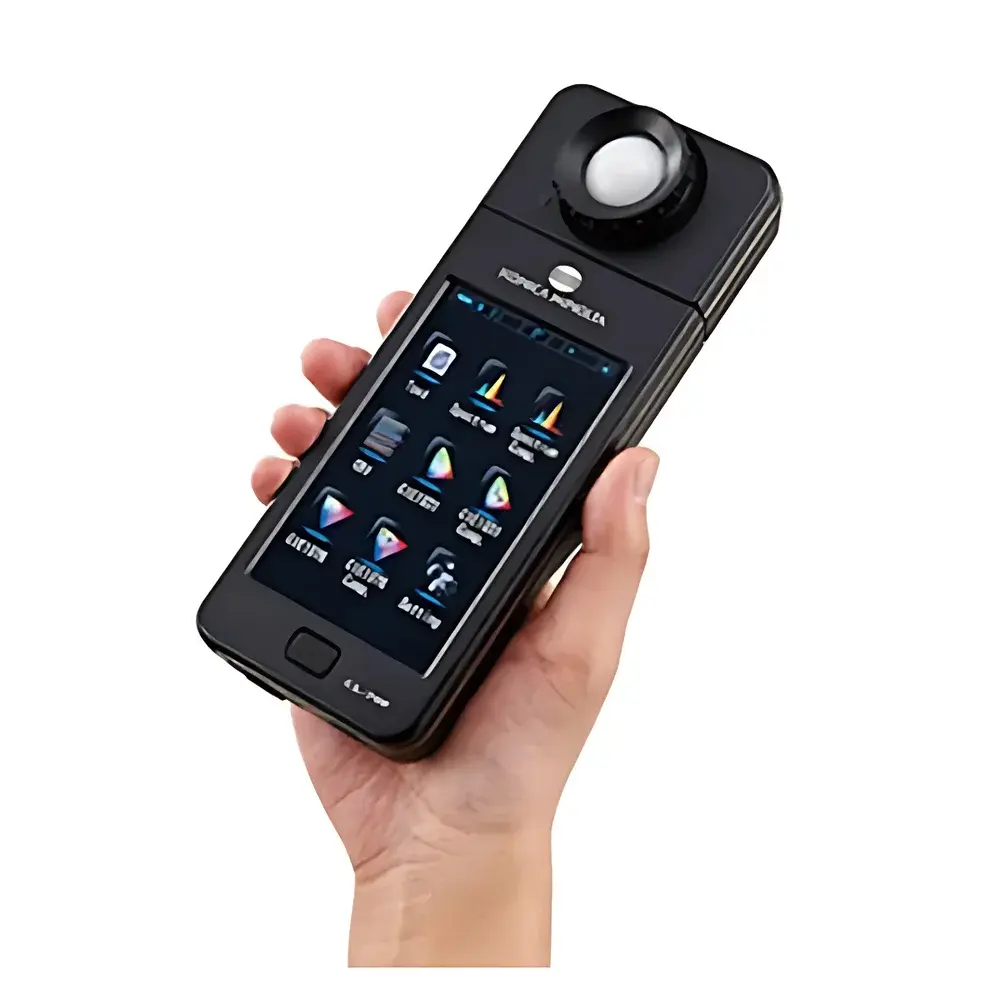
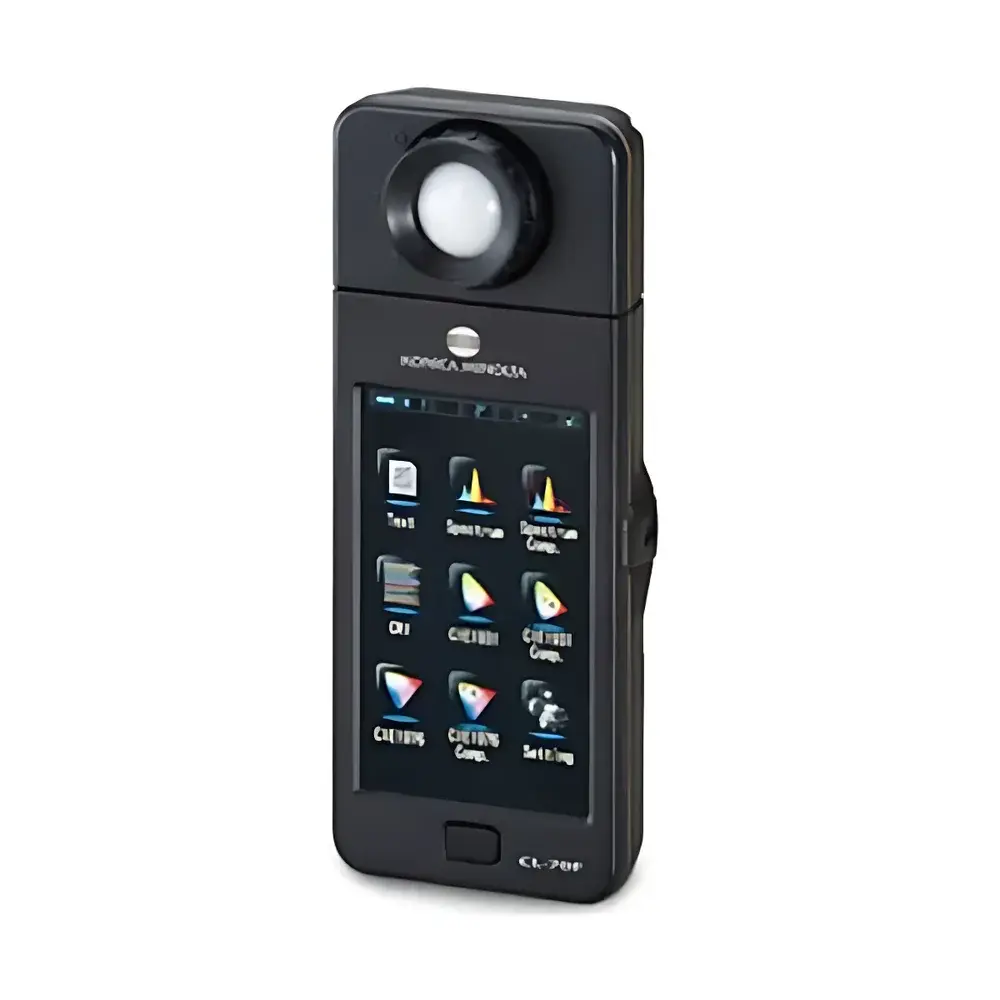
Konica Minolta CL-70F Chromatic Illuminance Meter
| Brand | Konica Minolta |
|---|---|
| Origin | Japan |
| Model | CL-70F |
| Illuminance Range (Continuous) | 1–200,000 lx |
| CCT Range | 1,563–100,000 K (xy display ≥5 lx) |
| Flash Mode | 20–20,500 lx·s |
| Spectral Range | 380–780 nm |
| Resolution | 1 nm |
| Sensor | CMOS linear image sensor |
| Compliance | JIS C1609-1:2006 Class AA, DIN 5032-7 Class C |
| Repeatability (2σ) | EV ±1%+1 digit (30–200,000 lx), xy ±0.001 (500–200,000 lx) |
| Interface | USB 2.0 Mini-B |
| Power | USB bus-powered |
| Operating Temp. | −10 to +40 °C, RH ≤85% (non-condensing) |
| Dimensions | 73 × 183 × 27 mm (W×H×D, excluding protrusions) |
| Data Storage | 999 readings |
| Software | CL-SU1w (included) |
Overview
The Konica Minolta CL-70F Chromatic Illuminance Meter is a precision handheld spectroradiometric instrument engineered for simultaneous measurement of photometric illuminance (Ev) and colorimetric parameters under both continuous and pulsed light sources. Unlike conventional illuminance meters that rely on filtered silicon photodiodes, the CL-70F employs a high-resolution CMOS linear image sensor coupled with a diffraction grating optical system to acquire full spectral irradiance data across the visible range (380–780 nm) at 1-nm intervals. This spectral foundation enables traceable calculation of CIE 1931 tristimulus values (XYZ), chromaticity coordinates (x, y and u′v′), correlated color temperature (CCT), Duv deviation from the Planckian locus, dominant wavelength (λd), purity (Pe), spectral radiant exposure (for flash), and the full set of CIE Ra and Ri (1–15) color rendering indices. Its design complies with JIS C1609-1:2006 Class AA and DIN 5032-7 Class C requirements for illuminance meter accuracy, ensuring metrological validity in lighting validation, product development, and regulatory documentation workflows.
Key Features
- Full-spectrum acquisition (380–780 nm @ 1 nm resolution) enabling first-principles derivation of all CIE colorimetric quantities
- Dual-mode operation: continuous illumination (1–200,000 lx; CCT 1,563–100,000 K) and flash measurement (20–20,500 lx·s; CCT 2,500–100,000 K) via optional sync cable
- Class AA illuminance accuracy per JIS C1609-1:2006 and Class C compliance per DIN 5032-7 — validated against standard illuminant A
- High angular uniformity: cosine correction error (f2) ≤6%, spectral mismatch error (f1′) ≤9%, minimizing measurement bias under off-axis or non-Lambertian sources
- Thermal and humidity stability: illuminance drift ≤±5% and chromaticity shift ≤±0.006 Δxy over operating range (−10 to +40 °C, ≤85% RH)
- On-device storage of up to 999 measurement records with timestamp, mode flag, and full spectral data export capability
- USB 2.0 Mini-B interface for direct power and data transfer — no batteries required during active use
Sample Compatibility & Compliance
The CL-70F is validated for measurement of diverse light-emitting technologies including white and colored LEDs, OLEDs, electroluminescent (EL) panels, fluorescent lamps, metal halide, and photographic flash units. Its spectral response and cosine correction meet the physical constraints required for accurate spatially integrated illuminance assessment in architectural lighting, museum conservation lighting, stage lighting design, and industrial color-critical environments. The instrument supports traceability frameworks aligned with ISO/IEC 17025-accredited calibration practices and is routinely deployed in settings requiring adherence to IES LM-79, CIE S 025/E:2015, and EN 12464-1 lighting performance specifications. While not FDA 21 CFR Part 11–compliant out-of-the-box, raw spectral data exports from CL-SU1w software facilitate integration into GLP/GMP audit trails when paired with validated laboratory procedures.
Software & Data Management
The included CL-SU1w PC application provides comprehensive post-acquisition analysis: spectral graphing, comparative overlay of multiple measurements, CRI component breakdown (R1–R15), CCT binning, deviation mapping against user-defined targets (ΔEuv, ΔEab), and customizable report generation (PDF/CSV). All spectral data are stored in open-format .spc files containing wavelength-indexed irradiance values, enabling third-party processing in MATLAB, Python (NumPy/Pandas), or industry-standard tools such as LightTools or Dialux. Firmware updates and configuration presets (e.g., museum-grade low-CCT tolerance profiles) are managed directly through the software interface. No cloud dependency or proprietary runtime is required — CL-SU1w operates natively on Windows 10/11 (64-bit) without administrative privileges.
Applications
- Validation of LED module spectral power distribution (SPD) and angular color uniformity during production QA
- Commissioning and maintenance of color-critical lighting in galleries, archival storage, and textile dye labs
- Photographic and cinematic lighting setup verification — especially for high-CRI LED fresnels and bi-color fixtures
- Development and field testing of human-centric lighting (HCL) systems targeting circadian stimulus metrics
- Characterization of display backlighting and emissive signage (e.g., LED video walls) for luminance uniformity and gamut fidelity
- Academic research in visual psychophysics, where controlled spectral irradiance and precise CCT stability are prerequisites
- Architectural daylighting simulation ground-truthing and post-occupancy evaluation (POE) of installed luminaires
FAQ
Does the CL-70F require annual recalibration to maintain JIS/DIN compliance?
Yes — while the sensor architecture exhibits long-term stability, Konica Minolta recommends traceable recalibration every 12 months against NIST-traceable standards to sustain Class AA performance claims. Calibration certificates include uncertainty budgets per ISO/IEC 17025.
Can CL-SU1w export spectral data in ASTM E308-compliant format?
Yes — the software supports export of 1-nm SPD data in plain-text CSV with wavelength (nm) and spectral irradiance (µW/cm²/nm) columns, fully compatible with ASTM E308-23 integration for CIE XYZ computation.
Is the device suitable for measuring UV-A (315–400 nm) or near-infrared (780–1100 nm) irradiance?
No — the optical path and sensor quantum efficiency are optimized exclusively for the CIE photopic luminosity function (380–780 nm). Measurements outside this band lack metrological validity and are not supported.
How does the CL-70F handle rapid temporal fluctuations, such as PWM-driven LED dimming?
In continuous mode, it reports time-integrated illuminance and chromaticity. For flicker-sensitive applications, Konica Minolta offers the separate CL-500A spectroradiometer with dedicated flicker analysis firmware.
What is the minimum measurable illuminance for reliable CRI calculation?
CRI and chromaticity values require ≥5 lx for stable xy coordinate convergence. Below this threshold, the instrument displays “LOW LIGHT” and disables colorimetric output while retaining illuminance reading capability down to 1 lx.



