
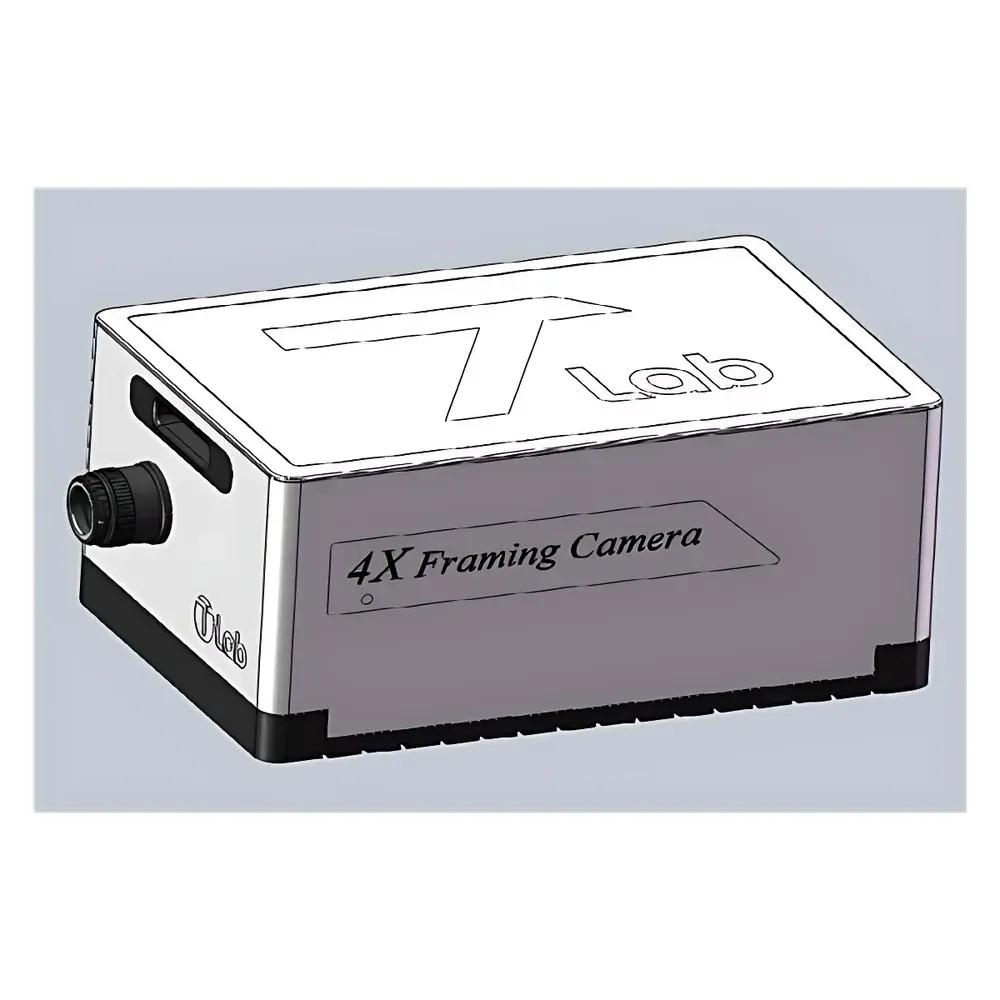
TEO FC Series Visible-Light Framing Camera
| Brand | TEO |
|---|---|
| Origin | Beijing, China |
| Manufacturer Type | Authorized Distributor |
| Product Origin | Domestic (China) |
| Model | FC Series |
| Pricing | Available Upon Request |
| Channel Count | 2 / 4 / 8 channels |
| Spatial Resolution | >30 lp/mm |
| Spectral Response Range | 350–850 nm |
| Gating Width | 3 ns to DC |
| Gating & Delay Adjustment Resolution | 1 ns |
| Delay Range | 0–10 s |
| Intrinsic Trigger Latency | <120 ns |
| Image Intensifier Cathode Diameter | 18 mm |
| Maximum Intensifier Gain | 1×10⁴ |
| Readout Sensor | 2048×2048 sCMOS, 6.5 µm × 6.5 µm pixel pitch, 13.3 mm × 13.3 mm active area |
| A/D Conversion | 16-bit |
Overview
The TEO FC Series Visible-Light Framing Camera is a high-speed, multi-channel optical imaging instrument engineered for ultrafast transient phenomenon capture in the visible spectrum (350–850 nm). Unlike conventional high-speed cameras relying on sequential frame readout, the FC Series employs a true parallel framing architecture based on synchronized gated image intensifiers coupled with precision optical beam splitting. Each channel integrates an independently controllable, nanosecond-gated intensified sCMOS sensor—enabling simultaneous acquisition of 2, 4, or 8 discrete frames from a single light event. The system operates on the principle of optically partitioned photon flux distribution, where incident light is split via reflective or dichroic optics and directed to individual intensified imaging paths. Fast electronic gating—achieved through high-voltage pulsed control of microchannel plate (MCP) intensifiers—allows exposure windows as narrow as 3 ns with sub-nanosecond timing resolution. With intrinsic trigger latency below 120 ns and delay adjustability up to 10 seconds in 1-ns increments, the FC Series supports precisely timed, multi-frame sequences critical for quantitative analysis of non-repetitive, irreversible events such as detonation wave propagation, plasma initiation, or arc discharge evolution.
Key Features
- Multi-channel parallel framing architecture: Configurable for 2-, 4-, or 8-frame acquisition per trigger event
- Nanosecond-precision temporal control: Gating width adjustable from 3 ns to continuous (DC), delay resolution of 1 ns over 0–10 s range
- High spatial fidelity: Optical transfer function (OTF)-verified resolution exceeding 30 line pairs per millimeter at Nyquist-limited contrast
- Low-noise, high-dynamic-range detection: 16-bit digitization paired with 2048×2048 sCMOS sensor (6.5 µm pixels, 13.3 mm × 13.3 mm active area)
- High-gain intensified imaging: 18 mm diameter photocathode image intensifier with maximum gain of 1×10⁴ and linear response across operational gain range
- Integrated timing engine: Hardware-synchronized gate/delay generation with jitter <50 ps RMS, supporting external TTL, LVDS, or optical trigger inputs
- Real-time acquisition and preview: Onboard FPGA-based preprocessing enables live histogram, region-of-interest (ROI) extraction, and frame alignment diagnostics
Sample Compatibility & Compliance
The FC Series is optimized for low-light, short-duration emission sources typical in physical chemistry, plasma physics, and combustion research. It accommodates standard C-mount and F-mount lens interfaces (with optional relay optics for magnification or field flattening), and supports vacuum-compatible configurations for in-situ chamber integration. While not certified for medical or aerospace safety standards, the system complies with CE marking requirements for electromagnetic compatibility (EMC Directive 2014/30/EU) and low-voltage safety (LVD Directive 2014/35/EU). Data integrity features—including timestamped frame metadata, hardware-enforced write-once acquisition buffers, and checksum-verified data streaming—support adherence to GLP-compliant documentation practices. For regulated environments requiring audit trails, optional software modules provide 21 CFR Part 11–compliant user authentication, electronic signatures, and immutable acquisition logs.
Software & Data Management
The FC Series ships with TEO FrameStudio—a cross-platform (Windows/Linux) acquisition and analysis suite built on Qt and HDF5-based I/O architecture. The software provides real-time display of all channels with independent gain/offset control, geometric registration tools for inter-frame alignment correction, and batch export to industry-standard formats (TIFF, HDF5, FITS). Advanced analysis modules include time-resolved intensity profiling, centroid tracking across frames, spectral ratio mapping (when used with bandpass filters), and automated spark/plasma boundary detection using adaptive thresholding. All acquisition parameters—including gate width, delay offsets, sensor ROI, and ADC settings—are stored in human-readable JSON sidecar files alongside raw image data, ensuring full experimental reproducibility. Remote operation is supported via TCP/IP API (Python/C++ SDK included), enabling integration into larger testbed orchestration frameworks (e.g., LabVIEW, MATLAB, or Python-based automation pipelines).
Applications
- Detonation and deflagration front imaging in energetic materials research, with temporal resolution sufficient to resolve shockwave–reaction zone coupling
- Laser-induced breakdown spectroscopy (LIBS) plasma dynamics: spatially resolved temperature and electron density evolution via Abel inversion of time-gated images
- Internal combustion engine combustion diagnostics: flame kernel development, soot formation onset, and lean-burn instability characterization under single-shot conditions
- Pulsed power discharge studies: metal wire explosion morphology, current sheath expansion velocity, and magnetic pinch effects
- Time-resolved bioluminescence and chemiluminescence kinetics in microfluidic reaction platforms
- Ultrafast laser–matter interaction studies including ablation plume expansion and phase transition fronts
FAQ
What is the minimum inter-frame interval achievable with the FC Series?
With proper optical path balancing and timing calibration, the system achieves inter-frame intervals down to 1 ns—limited primarily by optical dispersion in beam splitters and electrical signal propagation skew across intensifier drive lines.
Can the FC Series be synchronized with external lasers or pulse generators?
Yes. The camera accepts TTL, LVDS, or fiber-optic optical triggers with programmable polarity and hold-off. External synchronization enables pump–probe experiments with femtosecond laser systems when combined with appropriate delay generators.
Is vacuum or high-pressure operation supported?
Standard units are air-cooled and rated for ambient laboratory use. Custom variants with CF-flanged housings, conduction-cooled sensors, and feedthrough-compatible HV gating electronics are available upon request for integration into vacuum chambers or high-pressure cells.
How is geometric distortion corrected across multiple channels?
FrameStudio includes a calibration workflow using NIST-traceable grid targets. Per-channel distortion maps (radial/tangential coefficients) are applied in real time during acquisition or post-processing, ensuring sub-pixel registration accuracy across all frames.
Does the system support triggering from analog signals (e.g., photodiode output)?
Yes. An optional analog trigger input module allows threshold-based triggering from continuously varying signals (e.g., photodiode current or voltage transients), with user-defined hysteresis and edge sensitivity to suppress noise-induced false triggers.




