
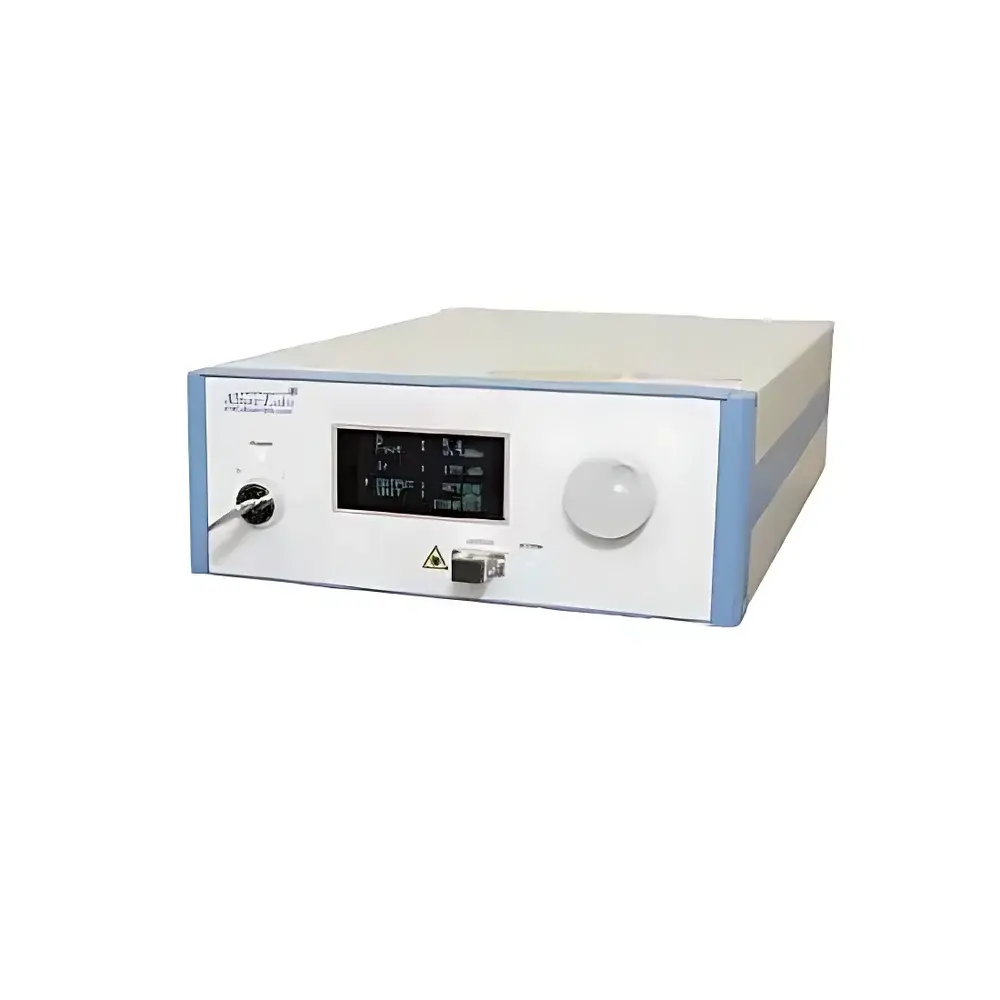
ASE-200 Broadband Amplified Spontaneous Emission Light Source
| Origin | Japan |
|---|---|
| Manufacturer Type | Authorized Distributor |
| Origin Category | Imported |
| Model | ASE-200 |
| Price Range | USD 13,500 – 40,500 (FOB) |
| Core Component | Solid-State Pumped Erbium-Doped Fiber ASE Source |
Overview
The ASE-200 is a high-performance, solid-state pumped broadband amplified spontaneous emission (ASE) light source engineered for precision optical testing and characterization in research laboratories and industrial R&D environments. Operating on the fundamental principle of stimulated emission in erbium-doped fiber under high-power 980 nm or 1480 nm pump excitation, the ASE-200 generates spectrally smooth, low-coherence, high-brightness output across either the C-band (1528–1565 nm) or L-band (1570–1605 nm). Unlike laser diodes or tunable lasers, its inherently broad spectral bandwidth—typically >35 nm full-width at half-maximum (FWHM)—and low temporal coherence make it ideal for applications requiring minimal interference fringes and high spatial resolution. The device delivers up to +23 dBm (200 mW) total optical power with exceptional spectral flatness (< ±0.5 dB ripple over specified band), enabling reliable calibration and reference illumination in demanding photonic measurement systems.
Key Features
- Two configurable spectral bands: C-band (1528–1565 nm) and L-band (1570–1605 nm), selectable at time of order
- Maximum output power: +23 dBm (200 mW) with power spectral density exceeding −2 dBm/nm in C-band and −6 dBm/nm in L-band
- Short-term stability: < ±0.005 dB over 5 minutes; long-term stability: < ±0.02 dB over 8 hours (measured at constant ambient temperature ±0.5 °C)
- High optical isolation: >40 dB return loss to suppress back-reflected signals into the source cavity
- Low polarization-dependent power variation: <5% degree of polarization (DOP), ensuring consistent performance in polarization-sensitive setups
- Front-panel VFD display with wide viewing angle and intuitive menu navigation for real-time monitoring of output status, temperature, and operational mode
- Standard RS232 serial interface for remote control and integration into automated test platforms (SCPI-compatible command set)
- Interchangeable fiber output connectors: FC/PC, FC/APC, SC/PC, SC/APC options available to match system-level fiber infrastructure
Sample Compatibility & Compliance
The ASE-200 is optimized for use with standard single-mode fiber (SMF-28e® compliant), supporting seamless integration into telecom-grade and sensing-grade optical assemblies. Its output spectral profile meets IEC 61280-2-9 requirements for broadband source characterization and aligns with industry practices defined in Telcordia GR-1312-CORE for passive component testing. While not a medical device, its stable, low-noise output supports OCT system validation per ANSI Z136.1 safety guidelines when used with appropriate optical attenuation and beam delivery controls. The unit complies with CE marking directives (EMC 2014/30/EU, LVD 2014/35/EU) and RoHS 2011/65/EU material restrictions. Firmware logs support GLP-compliant audit trails when operated via RS232 with timestamp-enabled host software.
Software & Data Management
The ASE-200 operates in standalone mode without external software but offers full programmability via ASCII-based SCPI commands over RS232. Supported functions include power level setting (0.1 dB resolution), output enable/disable, internal temperature readback, and error code reporting. Integration-ready drivers are provided for LabVIEW™, Python (PySerial), and MATLAB® environments. All communication sessions can be logged locally or externally for traceability—critical for ISO/IEC 17025-accredited calibration labs. No proprietary GUI is bundled; instead, the design prioritizes deterministic, scriptable control suitable for production test benches and automated DWDM filter mapping sequences.
Applications
- Fiber Bragg grating (FBG) interrogation and wavelength calibration in structural health monitoring systems
- Optical coherence tomography (OCT) reference arm illumination, particularly in swept-source and full-field configurations requiring low temporal coherence
- Characterization of wavelength-selective components including arrayed waveguide gratings (AWGs), thin-film filters, and MEMS-based tunable filters
- Testing of dispersion-compensating modules (DCMs) and chromatic dispersion analyzers where broadband spectral coverage is mandatory
- Interferometric fiber sensor development—including laser gyroscope bias stability evaluation and phase noise profiling
- Education and advanced photonics training in university optics laboratories focusing on nonlinear fiber dynamics and amplifier noise modeling
FAQ
What is the typical spectral flatness across the C-band?
Spectral flatness is ≤ ±0.5 dB over 1528–1565 nm when operated at rated output power and stabilized temperature.
Can the ASE-200 be modulated externally?
No analog or digital modulation input is provided. Output is continuous-wave (CW) only; external AOM or EOM required for intensity modulation.
Is the output polarization-maintaining (PM) fiber compatible?
The standard output is SMF-28e. PM fiber variants (e.g., PANDA or bow-tie) are available as custom-order options with additional lead time.
Does the unit support IEEE-488 (GPIB) or USB interfaces?
Only RS232 is natively supported. USB-to-RS232 adapters are widely used and fully functional in practice.
How is thermal stabilization achieved?
Internal thermoelectric cooler (TEC) and high-resolution NTC feedback loop maintain erbium-doped fiber gain medium within ±0.1 °C of setpoint, minimizing drift-induced spectral shift.





