
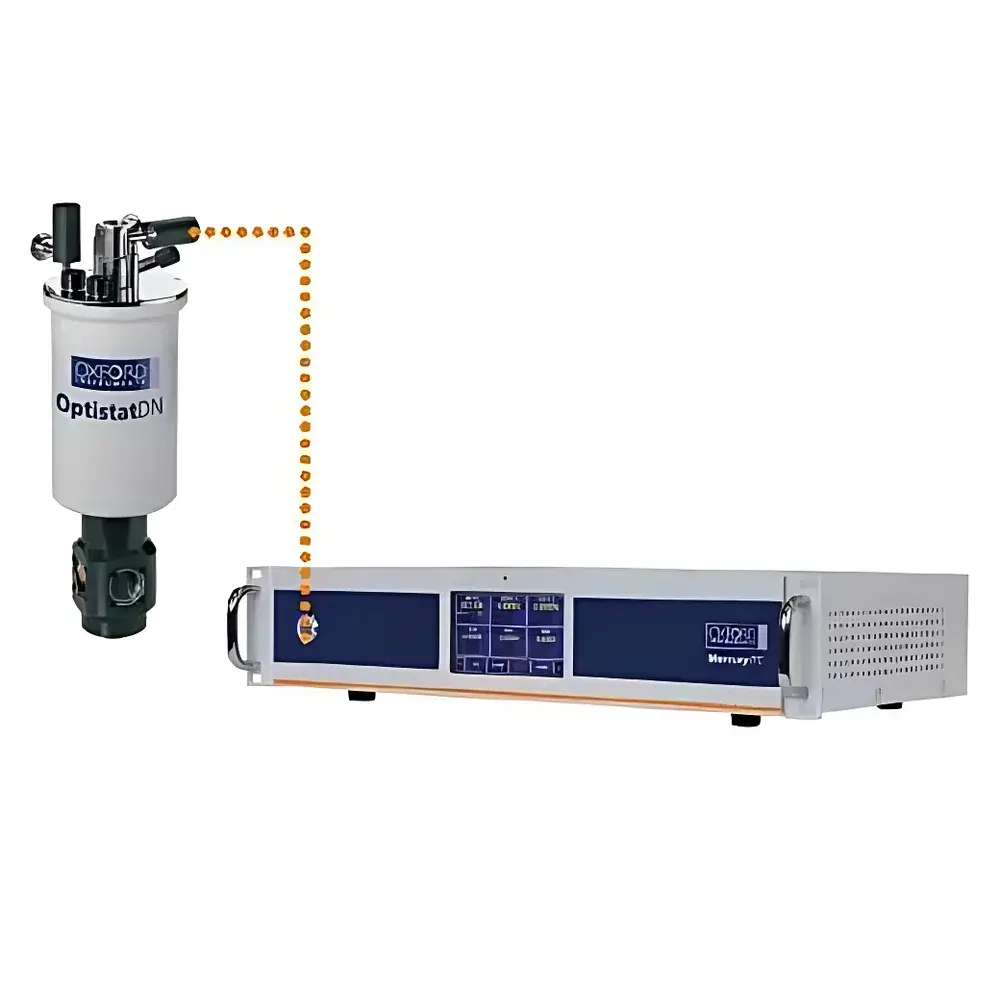
Oxford Instruments Optistat Wet Cryostat
| Origin | UK |
|---|---|
| Manufacturer Type | Authorized Distributor |
| Origin Category | Imported |
| Model | Optistat |
| Price Range | USD 42,000 – 70,000 |
| Temperature Range | 77.2–500 K (standard), up to 500 K with sapphire window option |
| Temperature Stability | ±0.1 K |
| Sample Chamber Diameter | 20 mm |
| Sample Stage Dimensions | 19 mm × 30 mm (OptistatDN), 20 mm × 50 mm (OptistatDN-V) |
| Sample Environment | Exchange gas or high vacuum |
| Sample Exchange Time | 5 min (exchange gas), 60 min (vacuum) |
| Cool-down to 77 K | ≤20 min |
| Liquid Nitrogen Capacity | 1.2 L |
| Hold Time at 77 K | ≥15 h |
| Optical Access | f/1 clear aperture |
| Weight | 5 kg |
Overview
The Oxford Instruments Optistat is a compact, high-performance wet cryostat engineered for precision optical spectroscopy and low-temperature materials characterization in laboratory environments. Based on a liquid nitrogen (LN2)–cooled storage Dewar architecture, the Optistat employs a thermally isolated sample stage suspended within an exchange gas or high-vacuum environment—enabling stable, controllable cooling from 77.2 K up to 500 K. Its design integrates decades of Oxford Instruments’ expertise in cryogenic system engineering, particularly in nanoscience applications where thermal stability, optical accessibility, and rapid sample turnaround are critical. Unlike closed-cycle refrigerators, the Optistat delivers exceptional temperature homogeneity and minimal vibration, making it ideal for confocal microscopy, photoluminescence (PL), Raman spectroscopy, and quantum optics experiments requiring sub-kelvin thermal control without mechanical cryocooler interference.
Key Features
- Two standard configurations: OptistatDN (standard exchange-gas operation) and OptistatDN-V (high-vacuum compatible version with extended sample stage)
- Temperature range: 77.2–500 K; extended upper limit achievable with sapphire optical windows (transmission >85% from 150 nm to 5.5 µm)
- Thermal stability of ±0.1 K over 1 hour, verified under steady-state conditions with PID-controlled heater feedback
- f/1 optical access on both top and side ports—optimized for collimated beam coupling and high numerical aperture collection
- Modular sample mounting: interchangeable stages support custom substrates, electrical feedthroughs (up to 12 leads), and magnetic field-compatible holders
- Rapid sample exchange: ≤5 minutes in exchange-gas mode; vacuum-mode exchange requires <60 minutes including pump-down and bake-out cycles
- Integrated LN2 level sensor and automated refill interface (optional) compliant with ISO 8573-1 Class 4 purity requirements for cryogenic gases
Sample Compatibility & Compliance
The Optistat accommodates samples up to 20 mm in diameter and 30–50 mm in planar footprint, with flexible mounting options for thin films, bulk crystals, 2D materials, and microfabricated devices. All internal surfaces are electropolished stainless steel (AISI 316L), meeting ASTM F86 surface finish standards for ultra-high vacuum compatibility. The system complies with IEC 61000-6-3 (EMC emissions) and IEC 61010-1 (safety requirements for laboratory equipment). Vacuum versions conform to ISO 20483:2021 for residual gas analysis reporting and support GLP/GMP audit trails when paired with Oxford’s ILM software suite.
Software & Data Management
Oxford Instruments’ Intelligent Lab Manager (ILM) software provides full remote control via Ethernet or USB, enabling synchronized temperature ramping, data logging at 10 Hz resolution, and integration with third-party spectrometers (e.g., Horiba, Renishaw, Andor). ILM supports 21 CFR Part 11–compliant electronic signatures, audit logs, and role-based user permissions—essential for regulated QC/QA workflows. Temperature profiles can be exported in HDF5 format for MATLAB, Python (NumPy), or OriginLab interoperability. Optional Python SDK allows scripting of multi-step measurement sequences—including auto-focus correction during thermal drift compensation.
Applications
- Low-temperature photoluminescence mapping of perovskite quantum dots and transition metal dichalcogenides (TMDs)
- Resonant Raman scattering studies of phonon modes in graphene under controlled thermal bias
- Single-photon source characterization in solid-state emitters (e.g., NV centers, SiV defects)
- Temperature-dependent Hall effect and magnetotransport measurements with integrated electrical feedthroughs
- In situ optical diagnostics of superconducting phase transitions in thin-film oxides
- Calibration reference cells for FTIR and UV-Vis-NIR spectrophotometers per ISO/IEC 17025:2017 Annex B
FAQ
What is the minimum base temperature achievable with the Optistat?
The system achieves a base temperature of 77.2 K using liquid nitrogen; no cryogen-free operation is supported.
Can the Optistat be used under ultra-high vacuum (UHV)?
Yes—the OptistatDN-V variant is rated for pressures down to 1×10⁻⁷ mbar and includes ConFlat flanges and all-metal seals compliant with UHV practice ISO 14644-1 Class 4.
Is optical alignment preserved during thermal cycling?
Yes—mechanical drift is limited to <5 µm over 77–300 K due to matched CTE (coefficient of thermal expansion) between the sapphire window mount and stainless-steel body.
Does the system support external magnetic fields?
The standard Optistat is non-magnetic (316L stainless steel and oxygen-free copper); optional mu-metal shielding kits are available for fields up to 0.5 T.
How often must liquid nitrogen be refilled during continuous operation at 77 K?
With a 1.2 L reservoir and typical heat load, hold time exceeds 15 hours; automated refill systems extend unattended operation to >72 h.



