
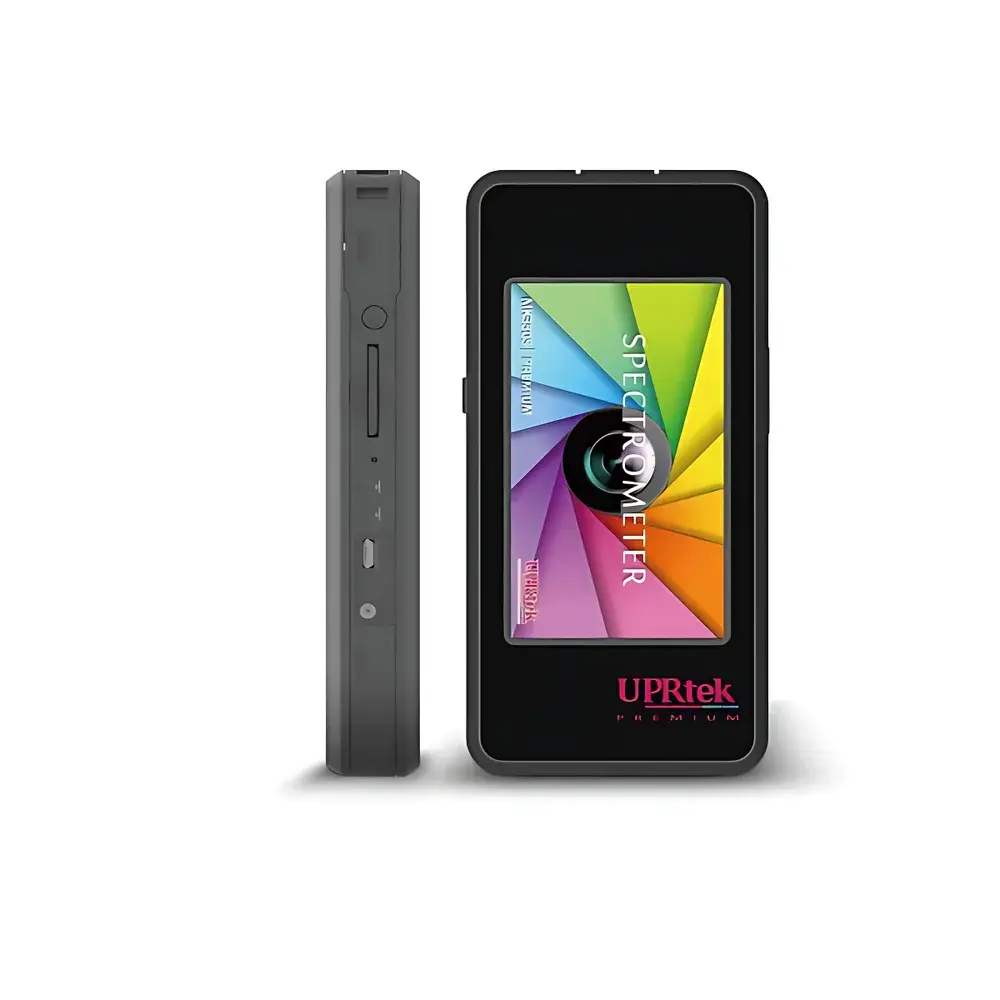
UPRtek MK350S Premium Portable Spectrometer
| Origin | Taiwan |
|---|---|
| Manufacturer Type | Authorized Distributor |
| Regional Origin | Asia-Pacific |
| Model | MK350S Premium |
| Price Range | USD 2,800 – 7,000 |
| Compliance | JIS AA-Class & DIN Class B Illuminance Meter Standards |
| Spectral Range | 360–780 nm |
| Optical Resolution | ~8 nm FWHM |
| Detector | Back-thinned CMOS linear image sensor |
| Integration Time | 10 ms – 10 s |
| Illuminance Accuracy | ±3% (at 500 lux, 555 nm) |
| CCT Accuracy | ±50 K (2000–10,000 K) |
| CRI (Ra) Uncertainty | ±1.5 |
| Data Interface | USB-C & Bluetooth 5.0 |
| Battery Life | Up to 4.5 hours continuous operation |
| Software Compatibility | uSpectrum PC (v5.0+), uFlicker PC (v3.0+), SDK for custom integration |
| Calibration | NIST-traceable factory calibration with optional annual recalibration service |
Overview
The UPRtek MK350S Premium Portable Spectrometer is a field-deployable, high-fidelity optical measurement instrument engineered for quantitative spectral radiometric and photometric analysis of visible light sources (360–780 nm). Based on grating-based diffraction spectroscopy with a back-thinned CMOS linear array detector, it delivers laboratory-grade spectral data in handheld form—enabling real-time acquisition of irradiance, illuminance, chromaticity coordinates (CIE 1931/1976), correlated color temperature (CCT), color rendering indices (CRI, TM-30 Rf/Rg, GAI), photosynthetic photon flux density (PPFD), scotopic-to-photopic (S/P) ratio, temporal light modulation (TLM) metrics, and blue-light hazard (BLH) weighting per IEC 62471. Its optical architecture meets JIS C 1609-1:2017 AA-class and DIN 5032-7:2017 Class B requirements for illuminance meters—ensuring traceability and repeatability suitable for QA/QC, lighting design validation, and regulatory pre-compliance screening.
Key Features
- Multi-parameter spectral acquisition in single measurement: CCT, CRI (Ra, R1–R15), TM-30-20 (Rf, Rg), GAI, TLCI, LUX, cd/m², PPFD, PFD, S/P ratio, dominant wavelength, purity, and Duv
- Integrated IEEE 1789-2015 & ENERGY STAR flicker risk visualization: automatic calculation and graphical overlay of percent flicker, flicker index, SVM, and frequency-domain spectral centroid
- IEC 62471-compliant blue-light hazard assessment: spectrally weighted radiance evaluation at 400–500 nm using the photochemical retinal hazard function (B(λ))
- Auto-dark correction sequence executed prior to each measurement cycle—eliminating thermal drift and dark current variability without user intervention
- Extended dynamic range (1:10⁵) enabled by adaptive gain control and dual-integration-time sampling, supporting measurements from 0.1 lux to 100,000 lux without manual range switching
- USB-C + Bluetooth 5.0 dual-mode connectivity for real-time streaming to Windows PCs or mobile devices; firmware upgradable in-field
Sample Compatibility & Compliance
The MK350S Premium is validated for use with all common artificial light sources—including narrowband LEDs, phosphor-converted white LEDs, OLEDs, fluorescent lamps, metal halide, and incandescent/halogen emitters. It is not intended for pulsed laser sources, UV-C disinfection systems (<280 nm), or broadband thermal sources above 3000 K blackbody equivalent without spectral filtering. Device-level compliance includes JIS AA-class illuminance accuracy, DIN Class B photopic response, and CE/FCC/ROHS certification. Measurement protocols align with ISO/CIE standard observer functions (2° and 10°), and spectral data output conforms to IES LM-63, CIE 15:2018, and IEC TR 62778 for blue-light safety reporting. Optional NIST-traceable calibration certificates support GLP/GMP documentation requirements.
Software & Data Management
The instrument operates natively with uSpectrum PC v5.2 and uFlicker PC v3.1—Windows-based applications offering batch spectral averaging, comparative spectral overlays, pass/fail limit setting, CSV/PDF report generation, and automated compliance flagging per ENERGY STAR V2.1, IEEE 1789, and IEC TR 61000-3-3. Both platforms support full metadata embedding (GPS, timestamp, operator ID, device serial) and audit trail logging compliant with FDA 21 CFR Part 11 (when deployed with electronic signature module). An open SDK (C/C++, Python, .NET) enables integration into custom LIMS, MES, or automated test benches. Spectral data is stored in standardized JDX and ASCII formats compatible with MATLAB, OriginLab, and LightTools.
Applications
- Architectural & landscape lighting design verification: quantifying spatial illuminance uniformity, vertical illuminance on façades, and mesopic adaptation modeling
- LED product development labs: binning validation, phosphor degradation tracking, and thermal roll-off characterization across drive currents and heatsink temperatures
- Lighting quality assurance: production-line CCT/CRI/PPFD sampling per IES LM-79-19 Annex A, including spatial averaging and thermal stabilization protocols
- Human-centric lighting (HCL) commissioning: circadian stimulus (CS) calculation, melanopic EDI derivation, and tunable-white system spectral tuning verification
- Educational & research settings: undergraduate optics labs, photobiology studies, and spectral database curation for spectral power distribution (SPD) libraries
FAQ
Does the MK350S Premium support third-party calibration against NIST-traceable standards?
Yes—UPRtek offers accredited recalibration services with documented uncertainty budgets per ISO/IEC 17025:2017, including spectral irradiance, illuminance, and CCT traceability to NIST SRM 2020 and 2021.
Can spectral data be exported in machine-readable format for statistical process control (SPC)?
Yes—CSV exports include raw counts, calibrated irradiance (µW/cm²/nm), photometric units (lux, cd/m²), and derived metrics with timestamps; compatible with JMP, Minitab, and Python pandas workflows.
Is the device suitable for outdoor daylight measurement under variable sky conditions?
It is rated IP52 for dust resistance and limited moisture exposure; however, direct solar irradiance measurement requires optional cosine corrector and thermal stabilization—standard configuration is optimized for indoor/artificial source analysis.
How frequently must dark calibration be performed?
The auto-dark correction runs automatically before every measurement; no manual intervention is required. For extended field use (>8 hrs/day), a full warm-up and dark reference cycle is recommended every 2 hours.
Does uSpectrum software comply with 21 CFR Part 11 for regulated environments?
Yes—when configured with electronic signatures, audit trail logging, and role-based access control, uSpectrum PC v5.2 meets ALCOA+ data integrity principles and supports FDA inspection readiness.




