
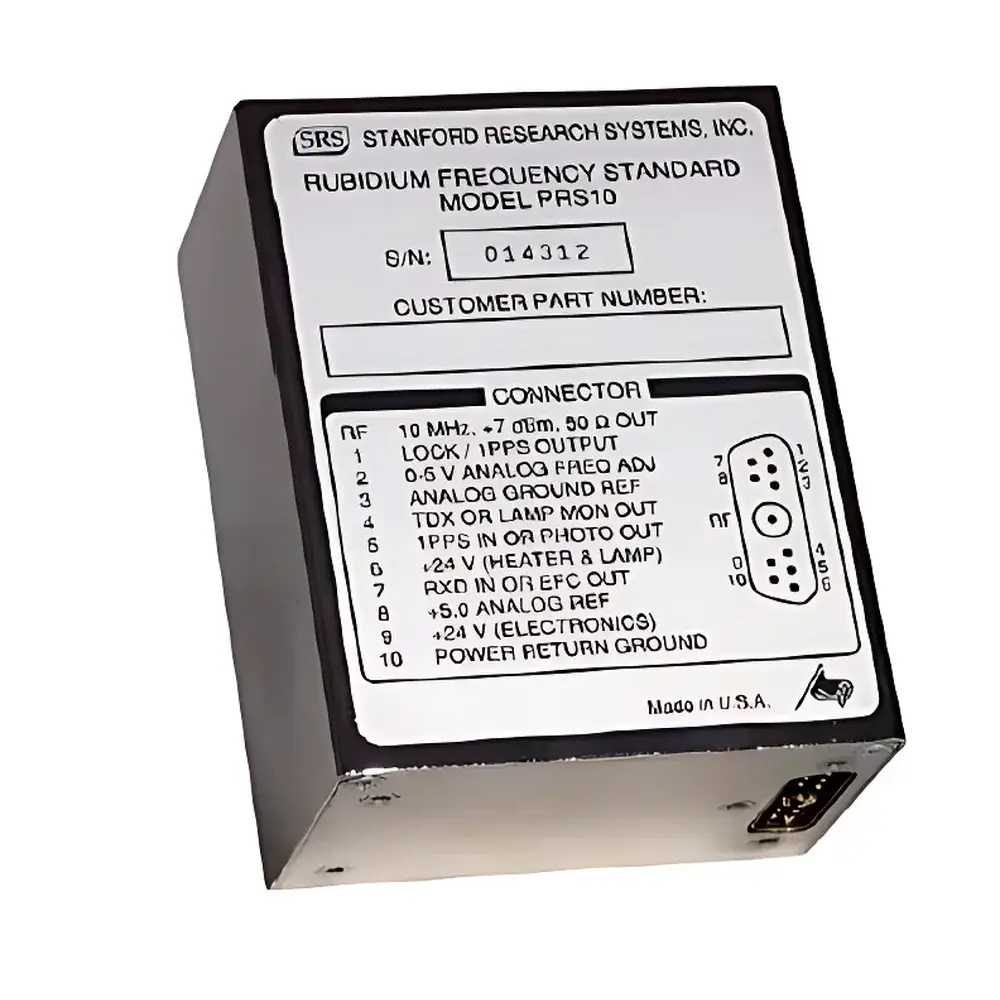
SRS PRS10 Rubidium Atomic Frequency Standard
| Brand | SRS/Stanford Research Systems |
|---|---|
| Origin | USA |
| Manufacturer Type | Authorized Distributor |
| Import Status | Imported |
| Model | PRS10 |
| Output Frequency | 10 MHz sine wave |
| Output Amplitude | 0.5 Vrms ±1% |
| Long-term Aging (Monthly) | <5×10⁻¹¹ |
| Long-term Aging (Annual) | <5×10⁻¹⁰ |
| Short-term Stability (Allan Deviation) | <2×10⁻¹¹ @ 1 s |
| Harmonic Distortion | <-25 dBc |
| Warm-up & Lock Time | 6 min to lock, frequency deviation <1×10⁻⁹ within 7 min |
| Power Supply | +24 VDC |
| Dimensions | 76 × 101 × 51 mm (3″ × 4″ × 2″) |
| Phase Noise | <-130 dBc/Hz @ 10 Hz offset |
| 1 PPS Input | Yes, for external reference disciplining (e.g., GPS) |
| Holdover Performance | Stratum 1 compliant for ≥72 hours |
| Interface | RS-232 serial port |
| Expected Lifetime | ≥20 years |
Overview
The SRS PRS10 Rubidium Atomic Frequency Standard is a high-stability, laboratory-grade atomic oscillator engineered for precision timing and frequency reference applications in scientific instrumentation, telecommunications infrastructure, defense systems, and metrology laboratories. Based on the hyperfine transition of rubidium-87 atoms (6.834682611 GHz), the PRS10 employs optical pumping and microwave interrogation in a gas-cell architecture to generate an exceptionally stable 10 MHz output signal. Unlike quartz oscillators, which drift significantly under temperature variation and aging, the PRS10 leverages atomic resonance as an intrinsic physical constant—delivering long-term stability orders of magnitude superior to OCXOs. Its design prioritizes low phase noise, minimal thermal hysteresis, and robust environmental immunity—making it suitable as a primary timebase in spectrum analyzers, signal generators, laser stabilization loops, and time-of-arrival measurement systems.
Key Features
- Ultra-low phase noise: <-130 dBc/Hz at 10 Hz offset from carrier—critical for narrowband communication demodulation and low-jitter sampling clocking
- Exceptional short-term stability: Allan deviation of <2×10⁻¹¹ at 1 s, <1×10⁻¹¹ at 10 s, and <2×10⁻¹² at 100 s—enabling high-resolution spectral analysis and coherent radar processing
- Low aging rate: <5×10⁻¹¹ per month and <5×10⁻¹⁰ per year—ensuring traceable frequency accuracy over extended calibration intervals without frequent re-synchronization
- Fast warm-up and lock: Achieves full specification stability within 7 minutes; locks to internal atomic resonance in ≤6 minutes
- External disciplining capability: Integrated 1 pulse-per-second (1 PPS) input allows synchronization to GPS-disciplined references or other Stratum-1 sources, enhancing long-term absolute accuracy
- Stratum 1 holdover performance: Maintains <1×10⁻¹¹ frequency error for ≥72 hours after loss of external reference—meeting Telcordia GR-1244-CORE and ITU-T G.811 requirements
- Compact OEM form factor: 76 × 101 × 51 mm chassis with standardized mounting and +24 VDC power input—designed for integration into rack-mounted test systems and field-deployable instrumentation
- RS-232 serial interface: Enables remote monitoring of status, temperature, lock state, and aging compensation coefficients—supporting automated calibration logging and GLP-compliant audit trails
Sample Compatibility & Compliance
The PRS10 is not a sample-analyzing instrument but a metrological reference source. As such, it does not process chemical or biological samples. Its compliance framework aligns with international timing and frequency standards: it meets the stability and holdover criteria defined in IEEE Std 1139 (Definitions of Physical Quantities for Fundamental Frequency and Time Metrology) and supports traceability to UTC via GPS-disciplined operation. The device conforms to FCC Part 15 Class B emissions limits and operates within IEC 61000-4 immunity specifications for industrial environments. While not certified to ISO/IEC 17025 itself, its performance characteristics enable accredited calibration laboratories to meet uncertainty budgets required for ISO/IEC 17025 Clause 5.10.2 (traceability of measurements).
Software & Data Management
The PRS10 communicates via ASCII command protocol over RS-232 at 9600 baud (8N1). Supported commands include query of real-time frequency offset, internal oven temperature, lock status, and elapsed operational hours. SRS provides a Windows-based terminal utility for configuration and diagnostics; third-party integration is enabled through standard serial I/O drivers compatible with LabVIEW, MATLAB, Python (pySerial), and SCPI-compliant automation frameworks. All status logs can be timestamped and exported for inclusion in electronic lab notebooks (ELNs) or quality management systems (QMS) satisfying FDA 21 CFR Part 11 requirements when paired with appropriate audit-trail and electronic-signature controls.
Applications
- Primary frequency reference in RF/microwave test benches—synchronizing vector network analyzers, signal analyzers, and arbitrary waveform generators
- Stabilization of ultra-narrow-linewidth lasers in atomic physics experiments and optical frequency comb systems
- Holdover timing source in telecom base stations and packet-switched networks during GNSS outages
- Timebase for high-precision time-of-flight mass spectrometry and pulsed NMR systems
- Calibration anchor in national metrology institutes and secondary standards laboratories supporting SI-traceable frequency dissemination
- Embedded timing core in airborne/spaceborne radar altimeters and synthetic aperture radar (SAR) processors requiring radiation-tolerant stability
FAQ
What is the recommended warm-up procedure before achieving full specification stability?
The PRS10 requires continuous operation for ≥7 minutes after power-on to reach full short- and long-term stability specifications. During this period, the rubidium lamp and absorption cell stabilize thermally and optically.
Can the PRS10 be operated in a temperature-controlled environment to further reduce drift?
While the unit incorporates internal oven control for the Rb cell, ambient temperature fluctuations outside 0–50 °C may affect lamp lifetime and long-term aging. Operation within 15–30 °C is optimal for maximizing 20-year service life.
Is the RS-232 interface optically isolated?
No—the RS-232 port is electrically connected to the internal ground plane. For installations requiring galvanic isolation, an external opto-isolated RS-232 transceiver must be used.
Does the PRS10 support IEEE-488 (GPIB) or USB interfaces?
No—only RS-232 is provided natively. GPIB or USB connectivity requires external protocol converters certified for use with timing-critical serial devices.
How is traceability to national standards maintained during calibration?
Traceability is established by comparing the PRS10’s 10 MHz output against a higher-tier reference (e.g., hydrogen maser or Cs fountain) using a dual-mixer time-difference (DMTD) system, with uncertainty contributions documented per ISO/IEC Guide 98-3 (GUM).



