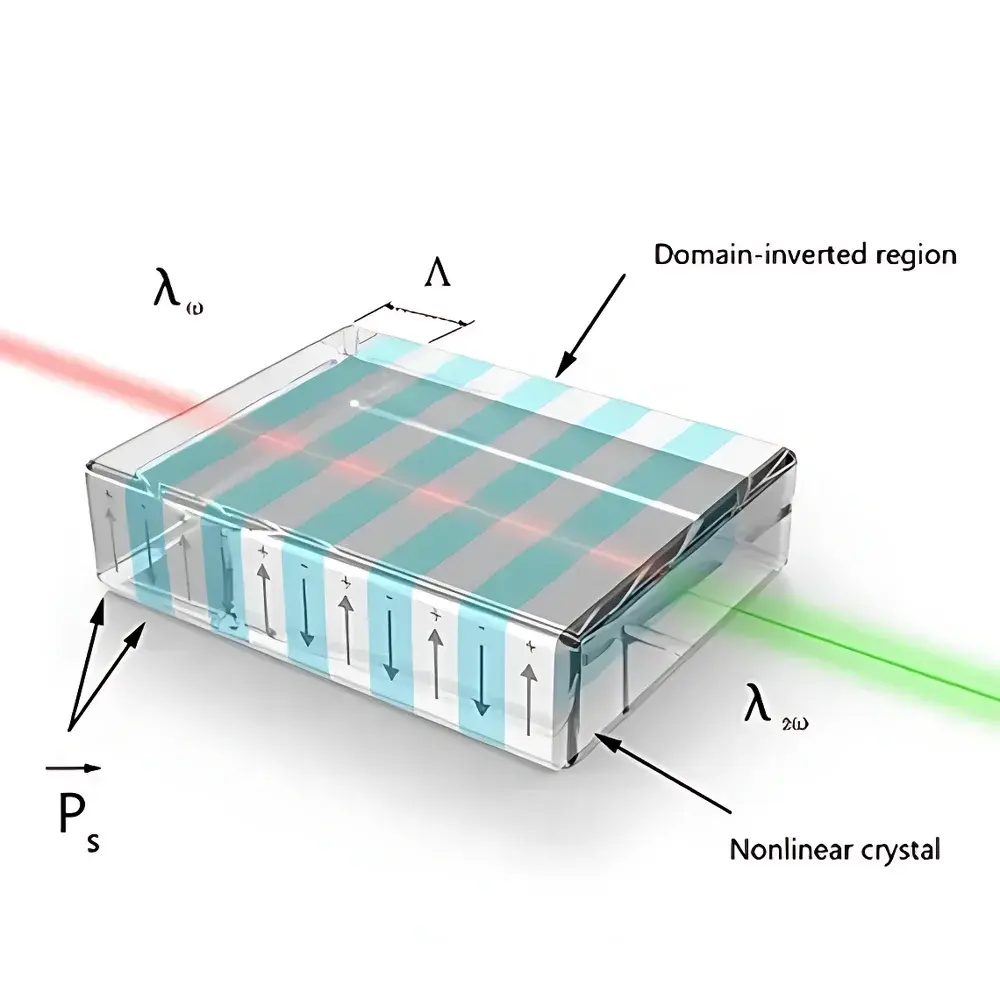
Periodically Poled Potassium Titanyl Phosphate (PPKTP) Crystal
| Brand | TEO |
|---|---|
| Origin | Israel |
| Manufacturer Type | Authorized Distributor |
| Import Status | Imported |
| Model | PPKTP |
| Pricing | Available Upon Request |
Overview
Periodically Poled Potassium Titanyl Phosphate (PPKTP) is a ferroelectric nonlinear optical crystal engineered for quasi-phase-matched (QPM) frequency conversion processes. Unlike conventional birefringent phase matching, QPM leverages periodic reversal of the crystal’s spontaneous polarization to compensate for wavevector mismatch induced by material dispersion across interacting optical fields. This enables highly efficient second-harmonic generation (SHG), sum-frequency generation (SFG), difference-frequency generation (DFG), and optical parametric oscillation (OPO) over broad wavelength ranges—particularly in the visible to near-infrared spectrum (400–1600 nm). Manufactured under strict process control by Raicol Crystals (Israel), PPKTP exhibits superior domain uniformity, low propagation loss (<0.05 cm⁻¹ at 1064 nm), and high damage threshold (>500 MW/cm² for nanosecond pulses), making it a benchmark material for quantum photonics, precision metrology, and compact laser source development.
Key Features
- Engineered domain period accuracy: ±0.5% over full aperture (typical 3–35 µm periods, tailored per application)
- High electro-optic coefficient (r₃₃ ≈ 36 pm/V) and effective nonlinear coefficient (deff up to 14 pm/V for Type 0, ~7 pm/V for Type II)
- Low walk-off angle (<0.5 mrad) and negligible dephasing due to absence of natural birefringence reliance
- Wide angular acceptance bandwidth (Δθ > 10 mrad·cm for SHG at 1064 nm → 532 nm)
- Thermal stability: phase-matching temperature bandwidth ΔT ≈ 15–25 °C·cm for common configurations
- AR-coated options available for dual-wavelength (e.g., 775/1550 nm or 405/810 nm) or broadband operation (R < 0.2% per surface)
Sample Compatibility & Compliance
PPKTP crystals are supplied as polished, poled, and optionally coated wafers (standard dimensions: 1 × 1 × 0.5 mm³ to 10 × 10 × 1 mm³; custom geometries available). All units undergo full interferometric inspection and domain verification via etch-and-SEM or confocal SHG microscopy. Crystals comply with ISO 10110-7 (surface quality), ISO 14997 (laser damage testing per ISO 21254-1), and meet RoHS Directive 2011/65/EU requirements. For regulated environments—including GLP-compliant quantum optics labs and FDA-audited photonic device qualification—full traceability documentation (including batch-specific poling map files and spectral response data) is provided upon request.
Software & Data Management
Integration with standard optical design and simulation tools is supported: domain period libraries are compatible with MATLAB-based QPM calculators (e.g., SNLO, WinSPM), Lumerical MODE, and COMSOL Multiphysics® (Wave Optics Module). Raicol provides downloadable .csv and .mat files containing measured deff vs. temperature/wavelength datasets for each production lot. For enterprise-level deployment, TEO offers optional calibration-certified delivery packages including NIST-traceable spectral responsivity reports and automated alignment assist scripts for OEM integration into turnkey OPO or entanglement sources.
Applications
- Quantum Information Science: High-fidelity spontaneous parametric down-conversion (SPDC) in Type 0 (degenerate/non-degenerate) and Type II configurations for polarization-entangled photon pair generation (e.g., 775 nm pump → 1550 nm signal/idler; 405 nm → 810 nm).
- Quantum Key Distribution (QKD): Compact, fiber-coupled entanglement sources meeting ETSI EN 303 645 cybersecurity baseline for trusted-node architectures.
- Squeezed Light Generation: Single-pass or cavity-enhanced optical parametric amplification (OPA) using monolithic or half-monolithic resonators—optimized via PPKTP’s low group-velocity mismatch.
- Frequency Conversion in Metrology: SHG of distributed feedback (DFB) diodes for 780 nm rubidium spectroscopy; DFG-based mid-IR generation (3–5 µm) when pumped by telecom-band lasers.
- Biophotonics & Imaging: Coherent anti-Stokes Raman scattering (CARS) light sources leveraging simultaneous SFG/DFG tuning in a single crystal platform.
FAQ
What distinguishes Type 0 from Type II phase matching in PPKTP?
Type 0 uses collinear e + e → e interaction (all fields extraordinary), maximizing deff and spectral brightness but requiring tight temperature control. Type II employs e + o → e configuration, offering broader temperature acceptance and inherent polarization entanglement—ideal for SPDC without additional compensation optics.
Can PPKTP be used in continuous-wave (CW) versus pulsed regimes?
Yes. Its high thermal conductivity (κ ≈ 2.5 W/m·K) and low photorefractive sensitivity enable stable CW operation up to multi-watt pump levels. For ultrafast applications (<1 ps), group-velocity dispersion management is recommended via crystal length optimization.
Is custom periodic poling available for non-standard wavelengths?
Yes. Raicol supports bespoke domain engineering for wavelengths from 355 nm to 4.5 µm, subject to feasibility review based on coherence length constraints and fabrication yield modeling.
How is long-term stability validated for quantum experiments?
Each batch undergoes accelerated aging tests (85°C/85% RH, 1000 h) per IEC 60747-17, with post-test verification of domain fidelity via SHG intensity mapping and spectral linewidth consistency.