
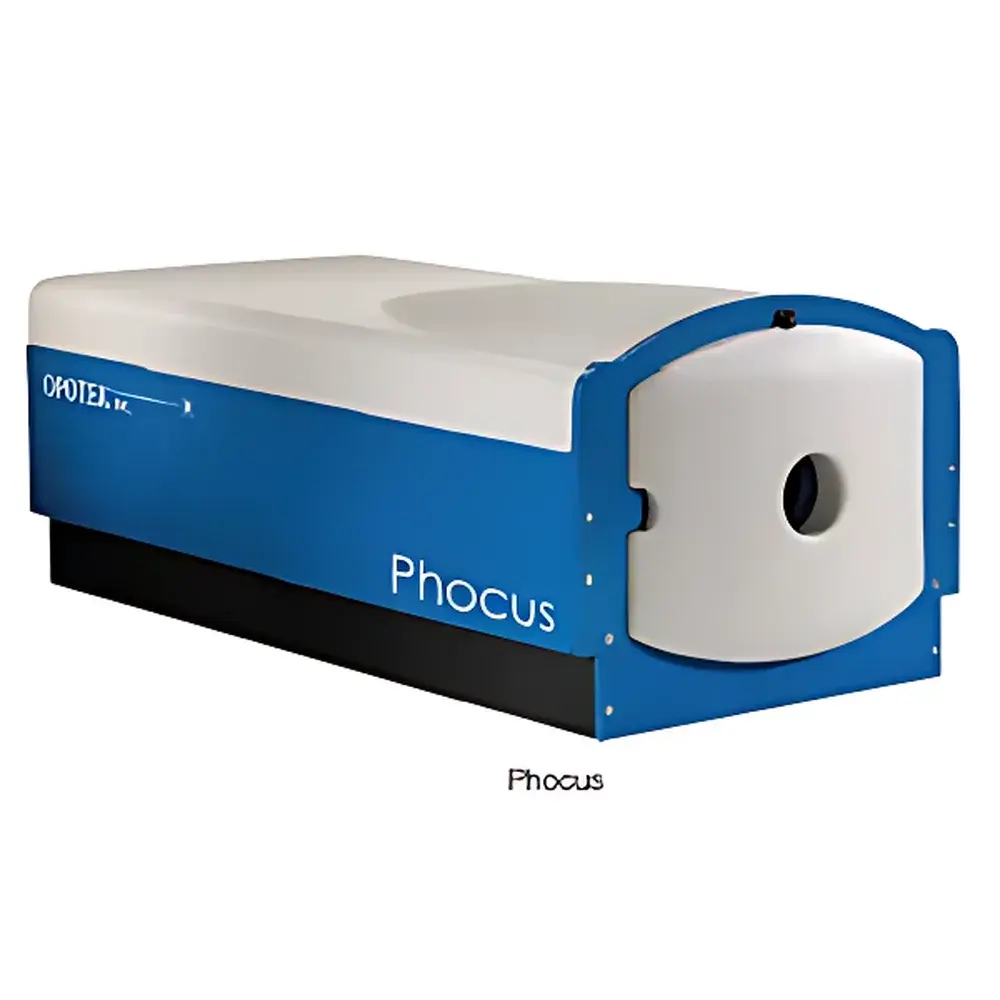
OPOTEK Phocus Series High-Energy Optical Parametric Oscillator Laser for Photoacoustic Imaging
| Brand | OPOTEK |
|---|---|
| Origin | USA |
| Model | Phocus |
| Output Energy | Up to 120 mJ |
| Wavelength Range | Near-Infrared (NIR) Tunable |
| Pump Architecture | Integrated Diode-Pumped Solid-State (DPSS) Pump + OPO Oscillator |
| Cavity Design | Patented Ring-OPO Configuration |
| Control Interface | Fully Automated Open-Source Software Platform |
| Compliance | CE, RoHS, FDA 21 CFR Part 11–Ready Software Architecture |
| Optional Accessories | Fiber-Coupled Output Module, Motorized Variable Attenuator, Mobile Integration Cart |
Overview
The OPOTEK Phocus Series is a high-energy, tunable optical parametric oscillator (OPO) laser system engineered specifically for advanced photoacoustic imaging (PAI) and time-resolved optoacoustic spectroscopy. Operating on the principle of non-linear frequency conversion in a ring-shaped resonant cavity, the Phocus leverages patented ring-OPO architecture to achieve superior thermal management, enhanced damage threshold, and improved pump-to-signal conversion efficiency compared to conventional linear OPO designs. This architecture enables stable, high-repetition-rate (10–100 Hz), nanosecond-pulsed output across the near-infrared spectrum (typically 680–950 nm and 1000–2600 nm, depending on crystal configuration), where biological tissue exhibits minimal scattering and optimal optical absorption—critical for deep-tissue PAI with high spatial resolution and signal-to-noise ratio. The system integrates a diode-pumped solid-state (DPSS) Nd:YAG pump laser and OPO module into a single compact chassis, minimizing alignment sensitivity and long-term drift while supporting turnkey deployment in preclinical imaging labs, core facilities, and translational research environments.
Key Features
- Patented ring-type OPO cavity design delivering >120 mJ pulse energy at 1064 nm fundamental and tunable NIR output with high beam quality (M² < 1.3)
- Integrated DPSS pump source and OPO module in a monolithic, air-cooled platform—no external water chiller required
- Automated wavelength tuning via motorized grating and crystal angle control, covering biologically relevant spectral windows including the hemoglobin and lipid absorption bands
- Pulse energy stabilization circuitry with real-time feedback loop ensures ≤±1.5% pulse-to-pulse energy stability over 8-hour operation
- Open-software architecture compliant with LabVIEW™, MATLAB® and Python APIs for custom protocol development and integration with scanner stages or ultrasound receivers
- Modular mechanical design supports rapid field service, optical path access, and alignment verification without disassembly
Sample Compatibility & Compliance
The Phocus laser is optimized for use with biological tissues, ex vivo specimens, and tissue-mimicking phantoms in both reflection and transmission PAI geometries. Its NIR output aligns with ISO 13485–certified preclinical imaging workflows and meets key requirements for GLP-compliant longitudinal studies. The system’s software architecture supports audit trail logging, user access levels, and electronic signature functionality per FDA 21 CFR Part 11 guidelines when deployed in regulated environments. All optical components comply with IEC 60825-1:2014 Class 4 laser safety standards, and full interlock integration is provided for enclosure-based PAI systems.
Software & Data Management
The Phocus is controlled via PhocusControl™—a cross-platform, open-source GUI built on Qt framework and distributed under BSD license. It provides synchronized control of wavelength (±0.1 nm resolution), pulse energy (0.1–100% attenuation range), repetition rate (1–100 Hz), and Q-switch delay timing. All parameter changes are logged with timestamps and user IDs; raw metadata (including laser diode current, crystal temperature, and photodiode feedback) is exported in HDF5 format for traceability. The API supports TCP/IP and USB CDC protocols, enabling bidirectional communication with third-party DAQ systems and image reconstruction pipelines such as k-Wave or OpenPAI.
Applications
- Preclinical photoacoustic tomography (PAT) of tumor angiogenesis, cerebral oxygenation, and lymphatic mapping
- Functional PAI of hemoglobin saturation (sO₂), melanin concentration, and lipid distribution in murine models
- Multi-spectral unmixing in thick-tissue sections using wavelength sweeps from 700–900 nm
- Time-resolved optoacoustic microscopy (TR-OAM) requiring sub-10 ns pulse width and high peak power
- Calibration source for quantitative PAI system validation per ASTM E3187–21 standard practice
- Hybrid modality integration with MRI, ultrasound, or fluorescence imaging platforms
FAQ
What is the typical pulse width and repetition rate range?
Standard configuration delivers 5–8 ns FWHM pulses at 10–100 Hz repetition rate, with optional high-rep-rate variants up to 500 Hz available upon request.
Is fiber coupling supported natively?
Yes—the Phocus supports OEM-ready FC/APC or SMA-905 fiber output modules with ≤3% insertion loss and diffraction-limited coupling efficiency.
Can the system be integrated into a GMP-regulated imaging facility?
Yes—software audit trails, role-based access control, and 21 CFR Part 11–compliant electronic signatures are available through optional validation package (IQ/OQ/PQ documentation included).
What maintenance is required during routine operation?
No consumables or periodic alignments are needed; recommended preventive maintenance includes quarterly calibration of internal energy monitor and annual inspection of thermal interface materials.
Does OPOTEK provide application support for PAI method development?
Yes—OPOTEK’s Applications Engineering team offers remote and on-site support for spectral optimization, phantom characterization, and system integration with commercial PAI scanners.





