
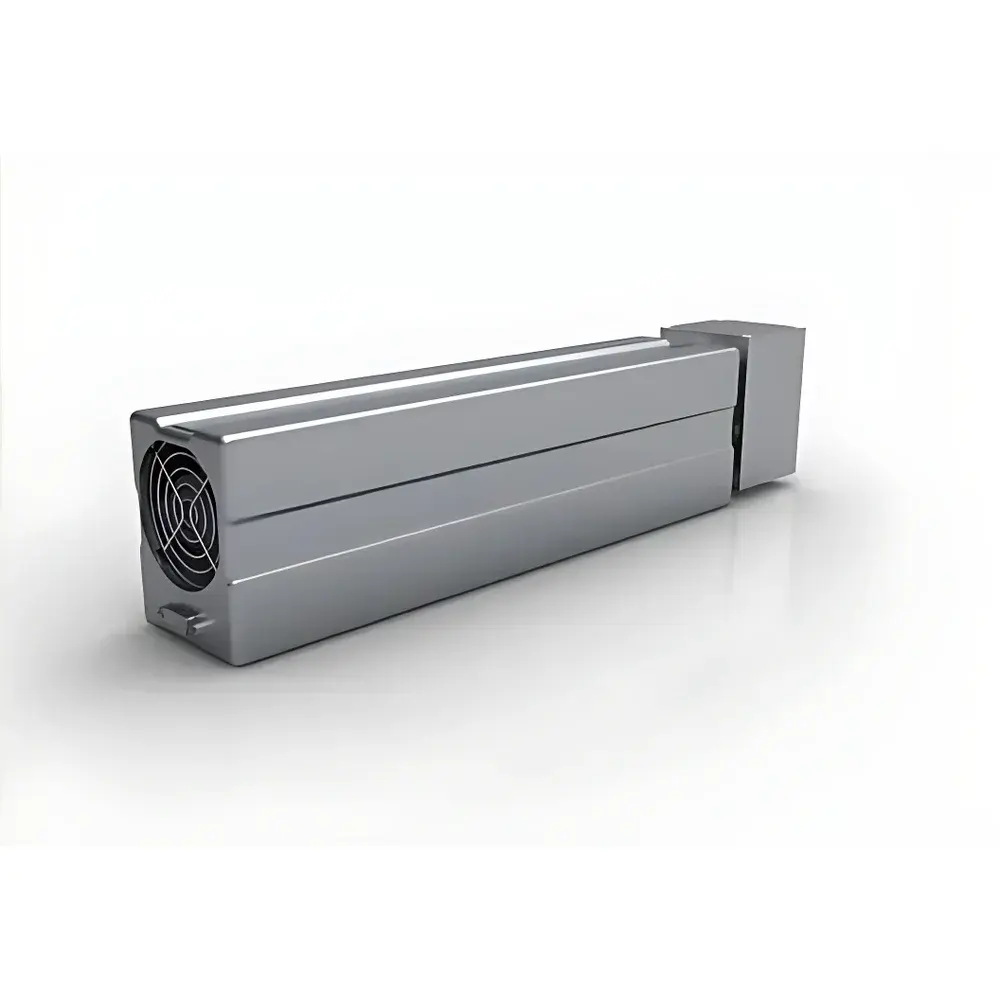
Universal ULCR-50 CO₂ Laser System
| Brand | Universal |
|---|---|
| Origin | USA |
| Model | ULCR-50 |
| Output Power | 50 W |
| Wavelength | 10.6 µm or 9.3 µm |
| Beam Quality (M²) | 1.3 ± 0.2 |
| Power Stability | ±5% |
| Beam Diameter | 4 ± 1 mm |
| Beam Divergence (Full Angle) | 5 ± 1 mrad |
| Polarization | Linear |
| Beam Directional Stability | 200 µrad |
| Pulse Rise Time | 120 ± 40 µs |
| Max Pulse Frequency | 5 kHz |
| Modulation Input | TTL |
| Cooling | Air or Water |
| Supply Voltage | 48 VDC |
| Supply Current | 18 A |
| Operating Mode | CW or Pulsed |
| RF Excitation | Integrated |
| Safety Class | Class 4 (configurable) |
| Compliance | CE, FDA 21 CFR Part 1040.10/1040.11, IEC 60825-1 |
Overview
The Universal ULCR-50 CO₂ Laser System is a sealed-tube, radio-frequency (RF)-excited gas laser engineered for industrial material processing applications requiring stable, high-reliability mid-infrared output at 10.6 µm or 9.3 µm. Based on Universal Laser Systems’ proprietary multi-pass slab cavity architecture, the ULCR-50 delivers consistent 50 W nominal average power with exceptional beam quality (M² ≤ 1.5), low pointing instability, and minimal thermal drift—enabling precise integration into OEM laser marking, cutting, and engraving platforms. Unlike traditional DC-excited CO₂ lasers, its monolithic RF discharge design eliminates cathode sputtering and gas degradation, contributing directly to its industry-leading mean time between failures (MTBF) exceeding 55,000 hours. The system operates under continuous-wave (CW) or externally triggered pulsed mode (up to 5 kHz), with TTL-compatible modulation input and built-in safety interlocks compliant with IEC 60825-1:2014 Edition 3 requirements for Class 4 laser products.
Key Features
- Patented multi-pass slab resonator design ensures high spatial coherence, low divergence (5 ± 1 mrad full angle), and excellent long-term power stability (±5% over 8 hours).
- Integrated RF power supply and internal “tickle” trigger circuit eliminate external HV modules—reducing footprint and EMI sensitivity while enabling seamless OEM integration.
- Compact form factor with dual cooling options: forced-air (OEM Standard/OEM Basic variants) or recirculating water (OEM Basic/Safety Class 4 variants); no external chiller required for air-cooled configurations.
- Factory-configurable output wavelength selection: 10.6 µm optimized for organic materials (wood, acrylic, leather, textiles) and 9.3 µm preferred for polyester, polyimide, and certain composite laminates.
- Three mechanical configurations available: OEM Basic (bare module, no enclosure), OEM Standard (anodized aluminum housing + integrated fan), and Class 4 Safety Enclosure (IP54-rated housing with key switch, door interlock, and emission indicator per EN 60825-1 Annex B).
- Beam delivery flexibility: optional red aiming beam (635 nm) and 90° beam fold mirror kits support space-constrained optical path layouts without compromising alignment repeatability.
Sample Compatibility & Compliance
The ULCR-50 is routinely deployed in regulated manufacturing environments where traceability and process validation are critical. Its stable output profile and deterministic pulse response meet baseline requirements for ISO 9001-compliant production lines and FDA-regulated medical device labeling (21 CFR Part 820). While the laser itself does not carry UL certification, it is designed to facilitate system-level compliance with UL 61010-1 (Electrical Safety for Measurement Equipment) and EN 61000-6-3 (EMC Emission Limits) when integrated into properly grounded enclosures. All units ship with CE marking documentation, RoHS 2011/65/EU declaration, and FDA accession numbers for U.S. import under 21 CFR 1040.10/1040.11. Optional factory-installed beam diagnostics (power meter interface, beam profiler port) support GLP/GMP audit readiness by enabling periodic verification of output parameters against baseline calibration records.
Software & Data Management
The ULCR-50 operates as a hardware-level subsystem—requiring no embedded firmware or host software for basic operation. Control is implemented via industry-standard TTL logic signals (5 V CMOS compatible) for enable/disable, pulse triggering, and analog power modulation (0–5 V input maps linearly to 0–100% output). For traceable operation in automated systems, users integrate the laser with motion controllers or PLCs that log timestamped trigger events, power setpoints, and runtime counters. Universal provides detailed electrical interface schematics, timing diagrams, and interlock wiring protocols in the OEM Integration Manual (Rev. 4.2), supporting implementation of 21 CFR Part 11-compliant electronic records when paired with validated SCADA or MES platforms. No proprietary drivers or cloud connectivity are included—ensuring deterministic real-time performance and eliminating cybersecurity attack surfaces common in networked laser sources.
Applications
- Industrial Marking: High-contrast, non-contact marking of anodized aluminum, stainless steel (with marking compound), ceramics, and engineered plastics used in aerospace, automotive, and electronics components.
- Non-Metal Cutting: Precision contour cutting of PETG, polycarbonate, ABS, plywood, MDF, corrugated cardboard, and natural leather—common in packaging prototyping and signage fabrication.
- Textile & Composite Processing: Clean edge cutting of polyester-based fabrics, carbon fiber prepreg, and fiberglass laminates—leveraging 9.3 µm absorption peaks to minimize thermal damage and delamination.
- OEM Machine Integration: Core laser engine for benchtop engravers, roll-to-roll flexographic plate cutters, PCB depaneling systems, and automated labelling stations where compact size (< 300 mm × 120 mm × 100 mm for OEM Basic variant), low weight (< 4.2 kg), and 48 VDC input simplify power architecture.
FAQ
What is the expected lifetime of the ULCR-50 laser tube?
The RF-excited sealed CO₂ gas tube has a rated operational lifetime of ≥55,000 hours (≥6.3 years at 24/7 duty cycle), verified through accelerated life testing per MIL-STD-781H. Actual field data from >30,000 installed ULR-series units shows median time to first maintenance event exceeds 48,000 hours.
Can the ULCR-50 operate in both CW and pulsed modes simultaneously?
No. It supports either continuous-wave output or externally gated pulsing (TTL-triggered), but not simultaneous dual-mode operation. Pulse width and frequency are determined by the external controller; the laser responds with <120 µs rise time and maintains full rated power across the 0–5 kHz range.
Is water cooling mandatory for 50 W operation?
No. The ULCR-50 OEM Basic and OEM Standard configurations support forced-air cooling up to 50 W ambient temperature ≤35 °C. Water cooling is recommended for sustained operation above 40 °C ambient or in enclosed cabinets lacking active ventilation.
Does Universal provide beam profiling or power calibration certificates?
Yes. NIST-traceable power calibration certificates (±2% uncertainty) are available as a factory option. Beam parameter measurements (M², divergence, centroid position) per ISO 11146-1 are provided upon request for qualification batches, with full test reports issued under Universal’s ISO/IEC 17025-accredited laboratory scope.





