
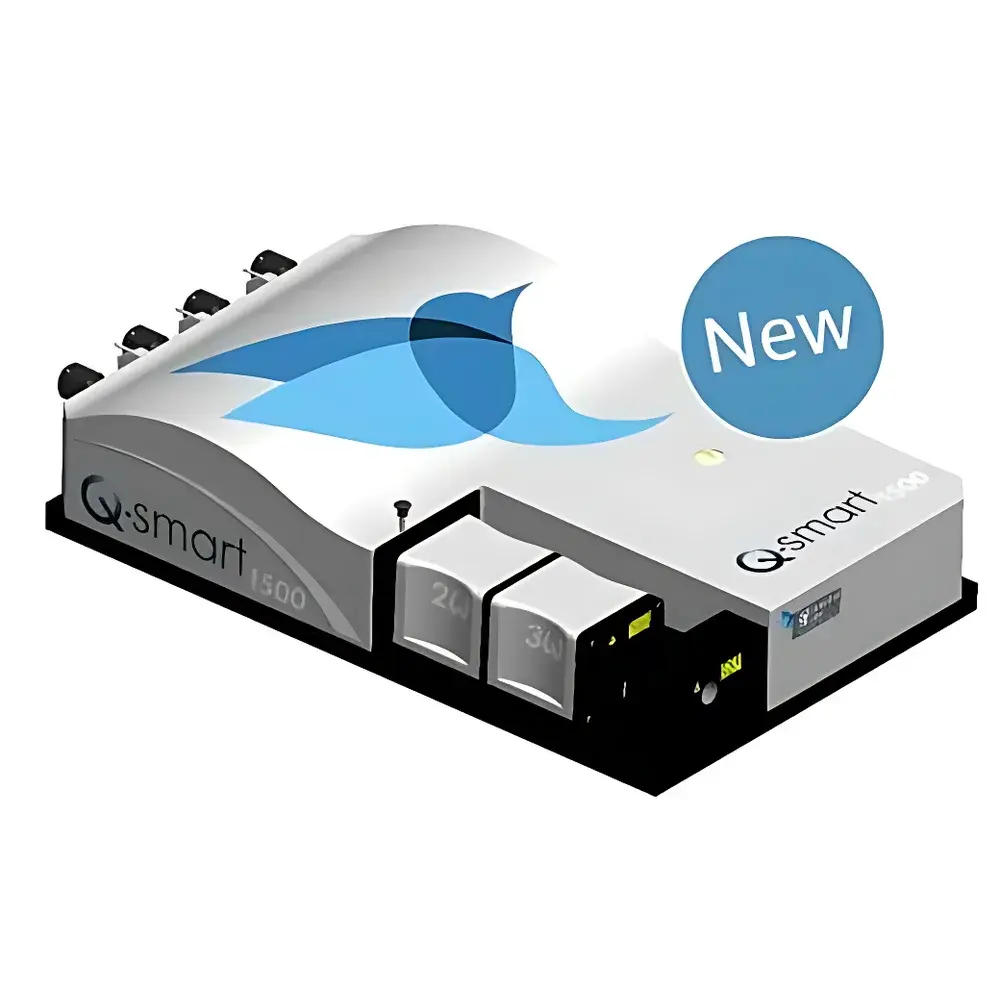
Quantel Q-Smart 1200 Diode-Pumped Solid-State Q-Switched Laser System
| Brand | Quantel |
|---|---|
| Origin | France |
| Model | Q-Smart 1200 |
| Output Wavelengths | 1064 nm / 532 nm / 355 nm / 266 nm |
| Pulse Energy (1064 nm) | 1200 mJ |
| Repetition Rate | 10 Hz |
| Pulse Width (1064 nm) | 5–10 ns |
| Beam Diameter (1064 nm) | ≤10 mm |
| Beam Divergence (1064 nm) | ≤0.5 mrad |
| Polarization Extinction Ratio (1064 nm) | ≥80% |
| Near-Field M² (1064 nm) | ≤2 |
| Far-Field Gaussian Fit (1064 nm) | ≥0.9 |
| Energy Stability (rms, 1064 nm) | ±0.6% |
| Power Stability (8 h, ΔT ≤ ±3°C, 1064 nm) | ±3% |
| Pointing Stability (1064 nm) | <40 μrad |
| Pulse Timing Jitter (standard) | ±0.5 ns |
| Spectral Linewidth (standard) | ≤0.7 cm⁻¹ |
| Operating Temperature Range | 18–28 °C |
| Cooling | Air–Water Heat Exchanger (no external chiller required) |
| Input Power | Single-phase, 100–240 VAC |
Overview
The Quantel Q-Smart 1200 is a high-energy, diode-pumped solid-state (DPSS), Q-switched Nd:YAG laser system engineered for demanding industrial, scientific, and defense applications requiring robust pulse energy, long-term operational stability, and field-deployable reliability. Unlike legacy lamp-pumped architectures, the Q-Smart 1200 leverages Quantel’s proprietary thermal management design, monolithic resonator architecture, and active phase-matching control to deliver consistent output across all harmonic wavelengths—1064 nm (fundamental), 532 nm (second harmonic), 355 nm (third harmonic), and 266 nm (fourth harmonic)—without external water circulation or complex alignment procedures. Its core operating principle relies on electro-optic Q-switching within a thermally optimized Nd:YAG rod cavity, enabling precise temporal control of nanosecond-scale pulses with high spatial coherence (M² ≤ 2) and exceptional pointing stability (<40 μrad). Designed for continuous duty in environments where ambient temperature fluctuates between 18 °C and 28 °C, the system integrates an air–water heat exchanger that eliminates dependency on external chillers—a critical advantage for mobile lidar platforms, remote combustion diagnostics, and cleanroom-compatible PLD (pulsed laser deposition) setups.
Key Features
- High pulse energy: 1200 mJ at 1064 nm, scalable to 600 mJ (532 nm), 280 mJ (355 nm), and 130 mJ (266 nm) with >80% polarization extinction ratio
- Stable repetition rate of 10 Hz with sub-nanosecond timing jitter (±0.5 ns standard; ±1 ns with optional single-longitudinal-mode (SLM) configuration)
- Integrated thermal regulation: Passive conduction cooling combined with compact air–water heat exchange ensures stable operation without external coolant loops
- Automated crystal phasing: Real-time adjustment of nonlinear crystal orientation for optimal harmonic conversion efficiency across environmental drift
- Wide-input AC compatibility: Operates from 100–240 VAC, single-phase, enabling global deployment without custom power conditioning
- Low beam divergence (≤0.5 mrad) and high Gaussian fidelity (≥0.9 far-field fit) support long-path optical diagnostics and tight focusing in micromachining and ablation
- Comprehensive stability metrics: ±0.6% RMS energy stability (1064 nm), ±3% power stability over 8 hours under ±3 °C ambient variation
Sample Compatibility & Compliance
The Q-Smart 1200 is compatible with a broad range of optical materials, including fused silica optics, BBO/LBO/KDP nonlinear crystals, and reflective coatings rated for >500 MW/cm² peak intensity. Its harmonics meet ISO 11146–1:2019 beam quality requirements and are routinely employed in ASTM E2799–22 (laser-induced breakdown spectroscopy) and ISO 14644–1 (cleanroom particle generation studies via PLD). The system conforms to IEC 60825–1:2014 Class 4 laser safety standards, with integrated interlock circuits compliant with EN 61511–1 (functional safety for laser subsystems). While not FDA-cleared as a medical device, its output parameters align with USP guidelines for laser source validation in pharmaceutical particulate analysis systems.
Software & Data Management
The Q-Smart 1200 interfaces via RS-232 and Ethernet (TCP/IP) with Quantel’s LaserLink™ control suite, supporting remote parameter configuration, real-time pulse monitoring, and automated logging of energy, timing, and thermal sensor data. All operational records—including shot count, energy history, and internal temperature logs—are timestamped and exportable in CSV/JSON format for traceability. Audit trails comply with GLP/GMP principles, and optional firmware enables 21 CFR Part 11–compliant electronic signatures when paired with validated host software. No proprietary drivers are required; native Linux and Windows SDKs facilitate integration into LabVIEW, MATLAB, or Python-based acquisition pipelines.
Applications
- Atmospheric lidar and differential absorption lidar (DIAL) for aerosol profiling and greenhouse gas mapping
- Pulsed laser deposition (PLD) of high-Tc superconductors, transparent conductive oxides, and perovskite thin films
- Pump source for tunable OPOs and Ti:sapphire amplifiers in ultrafast spectroscopy
- Combustion and fluid dynamics diagnostics—including planar laser-induced fluorescence (PLIF), particle image velocimetry (PIV), and Rayleigh scattering
- Laser-induced breakdown spectroscopy (LIBS) for elemental analysis in mining, metallurgy, and nuclear safeguards
- Calibration of high-dynamic-range photodetectors and streak cameras
FAQ
Is the Q-Smart 1200 lamp-pumped or diode-pumped?
It is a diode-pumped solid-state (DPSS) laser. Although Quantel historically offered lamp-pumped YG-series lasers, the Q-Smart platform uses highly efficient, long-lifetime laser diodes for pumping—resulting in superior wall-plug efficiency, reduced thermal lensing, and improved pulse-to-pulse stability.
Does it require external chilled water?
No. The integrated air–water heat exchanger dissipates waste heat without external recirculating chillers, making it suitable for field-deployable and space-constrained installations.
Can it operate continuously for extended periods?
Yes. With proper ventilation and ambient temperature maintained between 18 °C and 28 °C, the system supports uninterrupted operation for >8 hours while maintaining specified energy and pointing stability.
What harmonic generation options are factory-configured?
All four wavelengths (1064 nm, 532 nm, 355 nm, 266 nm) are available simultaneously via internal harmonic separation optics; wavelength selection is software-controlled without manual realignment.
Is spectral narrowing (SLM operation) available as an option?
Yes. An optional SLM cavity configuration reduces spectral linewidth from ≤0.7 cm⁻¹ (standard) to ≤0.005 cm⁻¹, enabling high-resolution Raman excitation and coherent nonlinear mixing applications.



