
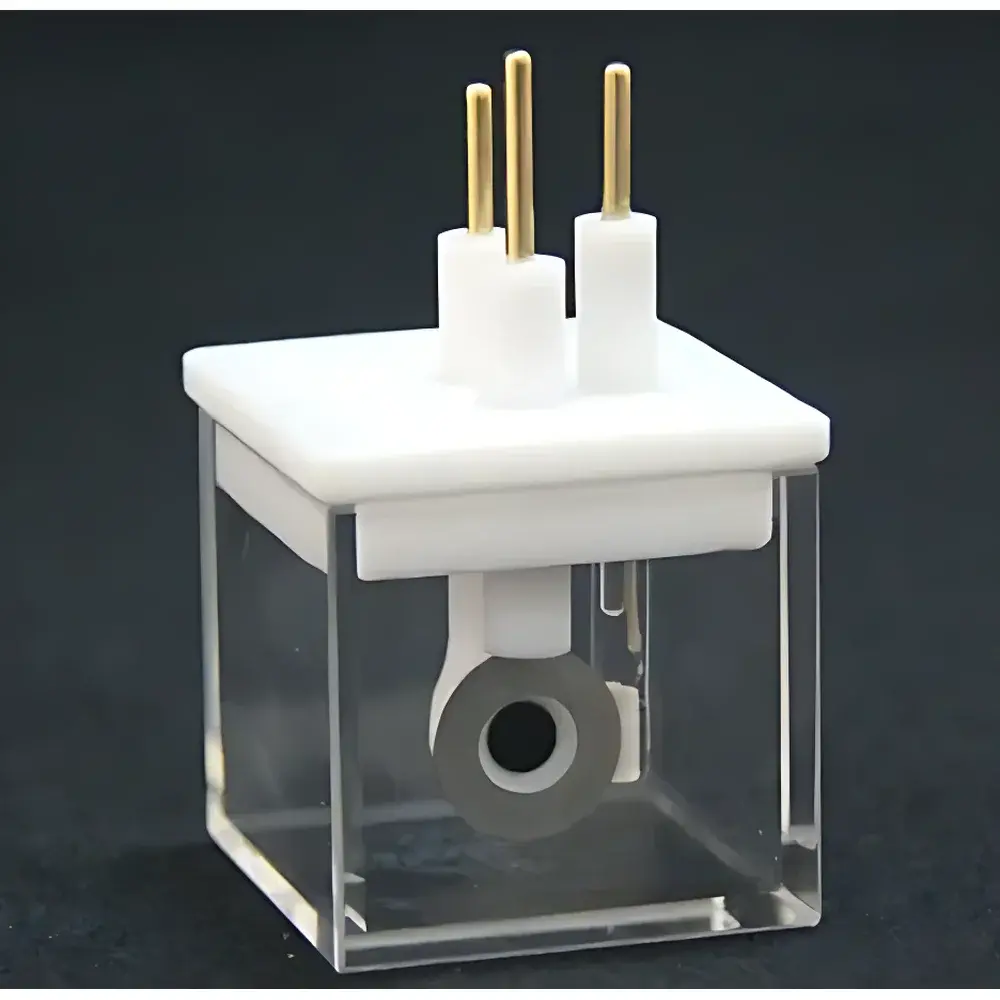
PECK125 Quartz Square Photoelectrochemical Cell
| Brand | CME (Zhongjiao Jinyuan) |
|---|---|
| Model | PECK125 |
| Body Material | Fused Quartz |
| Dimensions | 50 mm × 50 mm × 50 mm (125 mL) |
| Optical Configuration | Four-side optical access |
| Cap Material | PTFE |
| Standard Electrode Set | Pt wire counter electrode, Ag/AgCl reference electrode, Pt electrode clamp for working electrode |
| Compliance | Designed for ISO/IEC 17025-aligned electrochemical testing environments |
Overview
The PECK125 Quartz Square Photoelectrochemical Cell is a precision-engineered optical-electrochemical reaction vessel designed for controlled illumination and simultaneous electrochemical interrogation of photoactive materials. Built upon the Couette–Taylor principle of uniform light distribution and minimal optical distortion, it enables quantitative photocurrent measurement, incident photon-to-current efficiency (IPCE) mapping, and transient photocurrent/photovoltage analysis under standardized irradiation conditions. Its fused quartz construction ensures high UV–vis transparency (180–2500 nm), thermal stability up to 800 °C, and chemical inertness toward aggressive electrolytes—including aqueous halides, acidic/alkaline media, and organic solvents such as acetonitrile or DMF. The symmetrical cubic geometry (50 mm × 50 mm × 50 mm, 125 mL internal volume) supports reproducible light path length and uniform photon flux distribution across the electrode surface—critical for comparative studies in photoelectrocatalysis, perovskite solar cell characterization, and semiconductor/electrolyte interface kinetics.
Key Features
- Fused quartz body fabricated via high-purity melting process—zero hydroxyl content (<1 ppm), negligible autofluorescence, and <0.1% transmission loss at 254 nm.
- Four orthogonal optical windows (each 45 mm × 45 mm) enable collimated front-, side-, or back-illumination configurations compatible with monochromators, LED arrays, or solar simulators (AM1.5G, Class AAA).
- Chemically resistant PTFE cap with integrated O-ring seal (Viton optional) maintains leak-tight integrity under vacuum or positive pressure (up to 0.3 MPa).
- Modular three-electrode configuration: Pt wire counter electrode (diameter 0.5 mm, length 40 mm), Ag/AgCl (3 M KCl) reference electrode with double-junction option, and universal Pt electrode clamp accommodating rod-, foil-, or FTO-coated substrates (max. thickness 3 mm).
- Standardized electrode alignment ports ensure fixed inter-electrode distances (working–counter: 15 mm; working–reference: 10 mm) traceable to NIST-referenced calibration protocols.
Sample Compatibility & Compliance
The PECK125 cell accommodates heterogeneous photoanodes (e.g., BiVO4, Fe2O3, TiO2), photocathodes (CuInGaSe2, Si microwires), and molecular photosensitizers immobilized on conductive substrates. Its design conforms to ASTM E2611–21 (Standard Practice for Measuring Photocurrent Response of Photoelectrodes) and supports GLP-compliant documentation workflows. All wetted components meet USP Class VI biocompatibility requirements and are certified free of heavy-metal leachables (Pb, Cd, Hg, Cr⁶⁺) per RoHS Directive 2011/65/EU. The cell is suitable for integration into automated potentiostat systems compliant with IEC 61000-4-3 (EMC immunity) and FDA 21 CFR Part 11 when paired with audit-trail-enabled software.
Software & Data Management
While the PECK125 is hardware-only, it interfaces seamlessly with commercial electrochemical workstations (e.g., BioLogic SP-300, Metrohm Autolab PGSTAT302N, CH Instruments 760E) supporting time-resolved current sampling (≥100 kS/s), impedance spectroscopy (10 µHz–1 MHz), and multi-step chronopotentiometry. When used with compliant software platforms, experimental metadata—including illumination intensity (measured via calibrated Si photodiode), temperature (via embedded PT100 sensor port), and electrode positioning—is automatically logged with timestamped digital signatures. Raw data export follows HDF5 format, enabling traceable reprocessing in Python (SciPy, Pandas) or MATLAB environments under ISO/IEC 17025 clause 7.7 (Data control).
Applications
- Quantitative photoelectrochemical water splitting efficiency assessment (ABPE, STH) under simulated solar irradiance.
- In situ spectroelectrochemical coupling with UV–vis-NIR spectrophotometers (fiber-optic probe integration supported).
- Stability testing of metal–organic frameworks (MOFs) and covalent organic frameworks (COFs) under operational bias and illumination.
- Photoinduced charge transfer kinetics modeling using intensity-modulated photocurrent spectroscopy (IMPS).
- Standardization of photocorrosion resistance metrics for emerging chalcogenide photoelectrodes (e.g., CZTS, SnS).
FAQ
Can the PECK125 be used under anaerobic conditions?
Yes—equipped with gas-tight PTFE cap and dual-port inlet/outlet fittings, it supports continuous N2 or Ar purging and long-term O2-free operation.
Is custom electrode geometry supported?
Yes—the internal chamber allows user-defined placement of working electrodes up to 40 mm × 40 mm; optional quartz slide holders and spring-loaded contacts are available separately.
What is the maximum operating temperature?
The fused quartz body remains dimensionally stable up to 800 °C; however, PTFE cap limits practical use to ≤260 °C—Viton-sealed variants extend this to 300 °C.
Does the cell comply with electrochemical safety standards?
It meets IEC 61010-1:2012 requirements for laboratory equipment, including creepage/clearance distances and dielectric strength testing (2.5 kV AC, 1 min).
Can it be integrated with synchrotron beamlines?
Yes—its all-quartz construction and absence of magnetic materials make it compatible with X-ray absorption spectroscopy (XAS) and time-resolved XRD endstations.



