
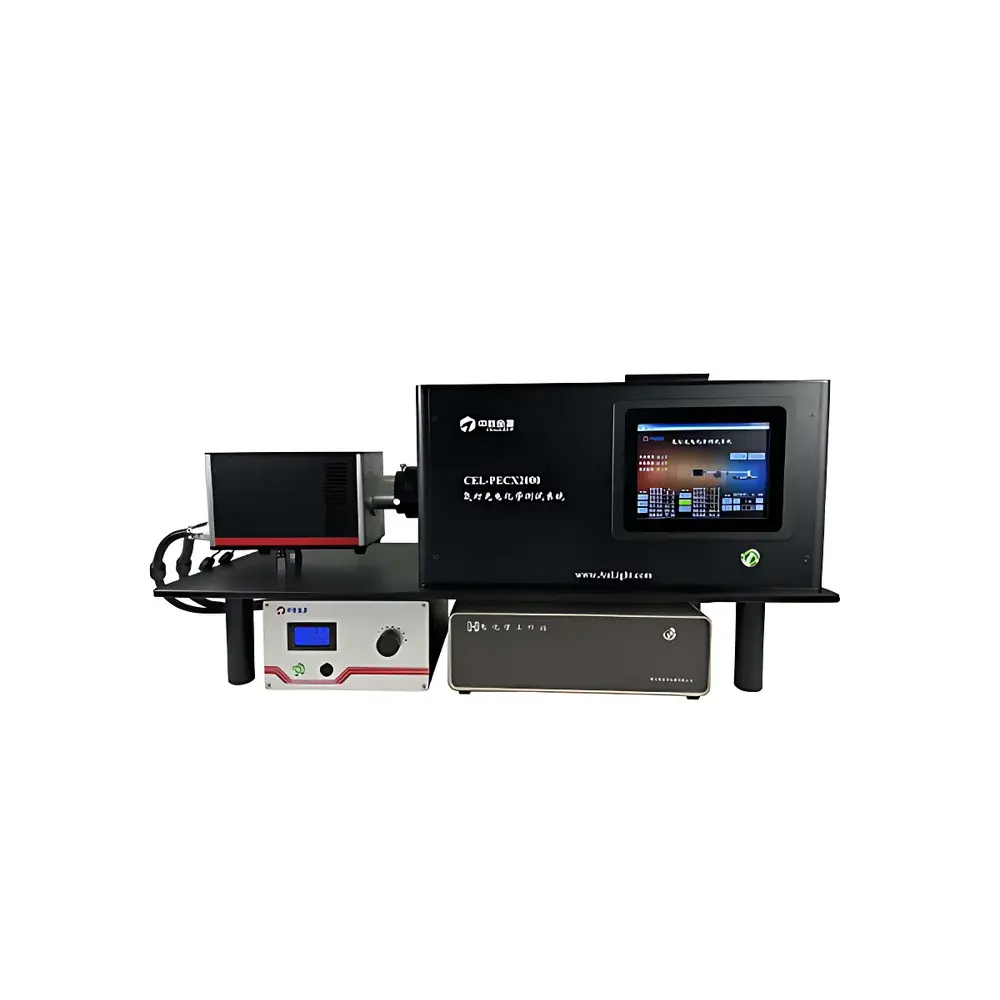
CEL-PECX2000 Xenon-Lamp-Based Photoelectrochemical Testing System
| Brand | CEL (China Education Goldsource) |
|---|---|
| Origin | Beijing, China |
| Manufacturer | OEM Producer |
| Type | Domestic |
| Model | CEL-PECX2000 |
| Light Source | 300 W Short-Arc Xenon Lamp (CEL-PF300-T8) |
| Illumination Mode | External Irradiation |
| Filter Wheel | Motorized, 20-position, φ25.4 mm & M62 mounts |
| Standard Filters | 10 × φ25.4 mm (365, 405, 420, 450, 475, 500, 520, 550, 600, 650 nm) + 10 × M62 (334, 350, 380, 435, 578, 630, 670, 700, 730, 765 nm) |
| Monochromatic Irradiance | >300 mW/cm² (visible range, uncollimated, at output aperture <25 mm) |
| Adjustable Aperture | 1–20 mm |
| Shutter | Electromagnetic, 0.1 ms minimum exposure time |
| Temperature Monitoring | Dual-point (system ambient + reactor cell) |
| Sample Stage | Motorized XYZ translation with automated horizontal leveling (240 mm travel) |
| Electrode Compatibility | Plug-and-play ITO and glassy carbon working electrodes |
| Enclosure | Fully light-tight optical path integrated with sample chamber |
| Control Architecture | Industrial PLC + 7-inch HMI touchscreen interface |
| Standard Cell | Multi-functional photoelectrochemical cell with auxiliary electrode |
| Optional Accessories | PINE, Gamry, Zahner, or CHI potentiostats |
Overview
The CEL-PECX2000 Xenon-Lamp-Based Photoelectrochemical Testing System is an engineered platform for quantitative, wavelength-resolved photoelectrochemical (PEC) characterization under controlled irradiation conditions. It operates on the principle of external illumination using a stabilized 300 W short-arc xenon lamp (CEL-PF300-T8), delivering broad-spectrum output from UV to NIR (≈250–2500 nm) with high temporal stability and spatial uniformity. Unlike conventional solar simulators, the PECX2000 integrates monochromatic capability via a dual-filter-wheel architecture—supporting both standard and specialty bandpass filters—to enable precise photon-energy-dependent studies of charge carrier generation, interfacial electron transfer kinetics, and surface recombination dynamics. Its fully enclosed, monolithic optical path eliminates ambient light interference and ensures reproducible irradiance delivery to the electrochemical cell. Designed for laboratory-scale mechanistic investigation—not industrial throughput—the system supports fundamental research in photocatalysis, dye-sensitized solar cells (DSSCs), perovskite photoelectrodes, and molecular photo-redox systems under potentiostatic or galvanostatic control.
Key Features
- Stabilized 300 W xenon lamp with active thermal management to suppress convective drift and spectral shift over extended operation (>100 h continuous use without recalibration)
- Motorized 20-position filter wheel with dual-mount compatibility (φ25.4 mm and M62), enabling rapid, software-triggered spectral selection without manual intervention
- Adjustable iris diaphragm (1–20 mm aperture) for precise control of illuminated area and irradiance density at the electrode surface
- Electromagnetic shutter with 0.1 ms minimum gating resolution, synchronized to electrochemical waveform triggers for transient photocurrent analysis (e.g., chopped-light chronoamperometry)
- Fully motorized XYZ sample stage with closed-loop horizontal auto-leveling (±0.02° repeatability), ensuring consistent electrode alignment across multi-wavelength experiments
- Integrated dual-point temperature monitoring: one sensor embedded in the chassis heat sink, another directly contacting the electrochemical cell body—data logged alongside electrochemical signals
- Industrial-grade PLC controller with deterministic real-time response (<5 ms I/O cycle), interfaced via a 7-inch resistive touchscreen HMI running a deterministic state-machine logic engine
- Light-tight monocoque enclosure: optomechanical integration of sample chamber and beam path eliminates stray light ingress, meeting ISO/IEC 17025-compliant measurement traceability requirements for low-noise photocurrent detection
Sample Compatibility & Compliance
The CEL-PECX2000 accommodates standard three-electrode PEC configurations (working, counter, reference) with plug-and-play compatibility for transparent conductive oxide (ITO) and glassy carbon electrodes. The modular cell design accepts custom geometries—including flat-plate, cylindrical, and flow-through reactors—up to 50 mL volume. All optical interfaces utilize SM1-threaded mounts and kinematic alignment features to ensure repeatable coupling with external accessories (e.g., fiber-optic spectrometers or thermally regulated photodiodes). The system complies with electrical safety standards IEC 61010-1 (Measurement, Control and Laboratory Equipment) and electromagnetic compatibility per EN 61326-1. While not certified for GMP production environments, its deterministic PLC architecture, audit-trail-capable HMI logging, and timestamp-synchronized data acquisition support GLP-aligned experimental documentation and FDA 21 CFR Part 11–compliant workflows when paired with validated third-party electrochemical workstations (e.g., Zahner IM6 or CHI 760E).
Software & Data Management
Control and data acquisition are coordinated through the embedded HMI interface, which provides direct access to lamp ignition, filter selection, shutter timing, aperture size, and stage positioning. All parameters are stored with UTC timestamps and exported as CSV files containing metadata (filter ID, irradiance estimate, shutter open/close times, temperature readings). The system exposes Modbus TCP registers for seamless integration into lab-wide SCADA environments or custom Python/Matlab automation scripts. When coupled with optional electrochemical workstations (PINE WaveDriver, Gamry Interface 1010E, Zahner PP211), synchronized trigger signals enable hardware-level coordination of light pulses and potential sweeps—critical for incident-photon-to-current-efficiency (IPCE) mapping and intensity-modulated photocurrent spectroscopy (IMPS). No proprietary cloud service or vendor-hosted platform is required; all firmware and configuration reside locally on the PLC controller.
Applications
The CEL-PECX2000 serves as a core instrumentation platform for academic and industrial R&D laboratories engaged in energy conversion science. Typical use cases include: quantifying wavelength-dependent quantum efficiency of metal oxide photoanodes (e.g., BiVO₄, Fe₂O₃, WO₃) under simulated AM 1.5G or monochromatic illumination; evaluating charge separation lifetimes in heterojunction photocatalysts via transient absorption-correlated photocurrent decay; benchmarking dye regeneration kinetics in DSSCs using 405 nm or 532 nm excitation; assessing photovoltage build-up in perovskite thin-film devices under variable light intensity and bias; and probing photoinduced corrosion mechanisms in semiconductor electrodes via in situ pH-controlled PEC impedance spectroscopy. Its ability to decouple photon energy from flux enables rigorous testing of theoretical models such as the Butler–Volmer–photocurrent extension and Marcus–Gerischer interfacial electron transfer theory.
FAQ
What is the spectral irradiance uncertainty across the standard filter set?
Calibrated irradiance values (e.g., 365 nm @ 80 mW/cm²) are traceable to NIM (National Institute of Metrology, China) standards; expanded uncertainty (k=2) is ±4.2% for wavelengths ≥365 nm and ±6.8% for UV-C region filters.
Can the system be upgraded to support in situ spectroelectrochemical coupling?
Yes—via optional fiber-optic ports (SMA905) integrated into the sample chamber lid, compatible with Ocean Insight or Avantes spectrometers for simultaneous absorption/transmission monitoring during PEC polarization.
Is the PLC control logic accessible for custom scripting?
The ladder logic is locked per IEC 61131-3 safety compliance, but Modbus TCP register mapping is fully documented and supports read/write access to all operational parameters.
Does the system include radiometric calibration for each filter?
A full NIST-traceable spectral irradiance map (300–1100 nm, 1 nm resolution) is provided with each unit, measured using a calibrated silicon photodiode and referenced to a secondary standard thermopile.
How is thermal drift mitigated during long-duration IPCE scans?
Active air-cooling of the lamp housing, combined with real-time reactor temperature feedback to the PLC, triggers dynamic lamp current modulation to maintain ±0.3 °C stability at the electrode surface over 8-hour acquisitions.




