
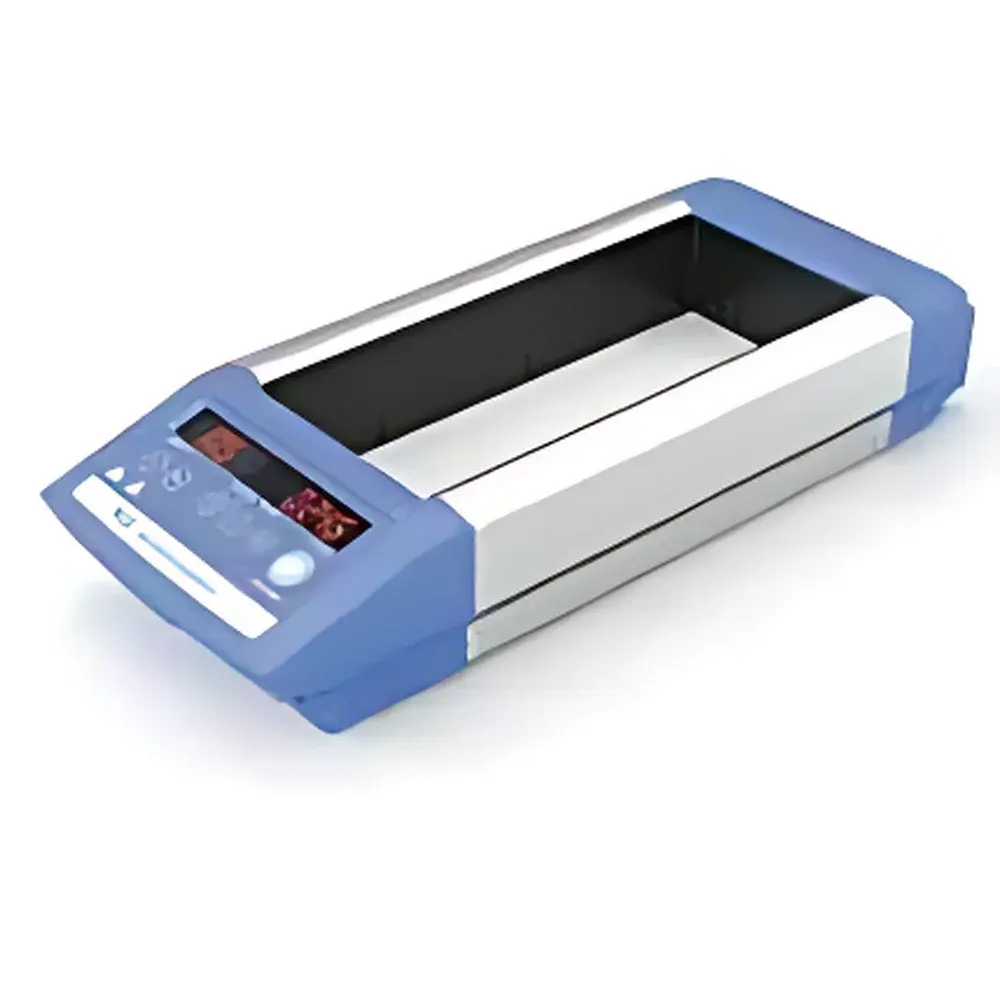
IKA Dry Block Heater 3 Metal Bath
| Brand | IKA |
|---|---|
| Origin | Germany |
| Model | Dry Block Heater 3 |
| Heating Blocks | 3 |
| Max Temperature | 120 °C |
| Temp Stability at 37 °C | ±0.2 K |
| Temp Stability at 60 °C | ±0.2 K |
| Heating Rate | up to 4 K/min |
| Temperature Accuracy (DIN 12878 compliant) | ≤ ±(0.15 + 0.002× |
| External PT-1000 Sensor Interface | Yes |
| Timer Range | 1 s – 99 h 59 min |
| Timer Function | Elapsed time display & countdown |
| Safety Cut-off | 150 °C fixed overtemperature protection |
| Power Input | 220–240 V / 115 V, 50/60 Hz |
| Power Consumption | 330 W |
| Housing Protection Rating | IP21 (DIN EN 60529) |
| Ambient Operating Conditions | 5–40 °C, ≤80 % RH |
| Dimensions (W × H × D) | 151 × 380 × 73 mm |
| Weight | 1.6 kg |
| Workplate Material | Anodized aluminum |
| Workplate Dimensions | 96 × 228 mm |
| RS232 Interface | No |
| USB Interface | No |
Overview
The IKA Dry Block Heater 3 is a precision-engineered metal bath designed for consistent, contact-based thermal control of small-volume samples in life science, clinical diagnostics, and quality control laboratories. Unlike water baths or air ovens, this dry block system delivers rapid, uniform heating through direct conduction from three independently controllable aluminum heating blocks—minimizing thermal lag and eliminating contamination risks associated with liquid media. Its core operation relies on PID-controlled resistive heating combined with real-time feedback from an integrated or optional external PT-1000 sensor, enabling accurate sample-centric temperature regulation rather than ambient block surface control. The device complies with DIN 12 878 for temperature sensor interface standards and meets general safety requirements per DIN EN 60529 (IP21 ingress protection), making it suitable for routine use in GLP-compliant environments where traceability and reproducibility are essential.
Key Features
- Triple independent heating blocks: Each block operates with identical thermal performance, supporting parallel processing of heterogeneous sample formats without cross-contamination.
- Sample-directed temperature control: Optional PT-1000 probe insertion directly into tubes or wells enables closed-loop regulation based on actual sample temperature—not block surface reading—critical for enzymatic assays and nucleic acid denaturation protocols.
- Precise thermal stability: Achieves ±0.2 K stability at both 37 °C and 60 °C, verified per DIN 12 878 calibration methodology, ensuring repeatability across shift changes and multi-day experiments.
- Programmable dual-timer system: Supports both countdown (1 s to 99 h 59 min) and elapsed-time tracking, with audible end-of-cycle alert—enabling unattended incubation during overnight PCR setup or enzyme kinetics studies.
- Fixed overtemperature safety circuit: A hardware-level 150 °C cut-off prevents thermal runaway under fault conditions, satisfying basic functional safety expectations for Class II laboratory equipment.
- Modular block compatibility: Designed to accept standardized IKA heating inserts—including 0.2 mL, 0.5 mL, 1.5/2.0 mL tube, 96-well microplate, and cuvette configurations—without tooling or recalibration.
Sample Compatibility & Compliance
The Dry Block Heater 3 accommodates common laboratory consumables including PCR tubes (single and strip), Greiner Bio-One polypropylene tubes, standard 96-well microplates (flat-bottom and U/V-bottom), quartz and plastic cuvettes, and capillary viscometry cells. Its aluminum workplate ensures rapid thermal equilibration and minimal gradient deviation (<0.3 K across 96-well footprint at 60 °C). From a regulatory standpoint, the instrument supports documentation workflows aligned with ISO/IEC 17025 and FDA 21 CFR Part 11 when used with validated SOPs—though native electronic audit trail functionality is not embedded due to absence of USB/RS232 data logging interfaces. Users implementing this unit in GMP or CLIA-certified labs should perform periodic verification using NIST-traceable reference thermometers and document calibration intervals per internal quality management procedures.
Software & Data Management
This model operates as a standalone analog-digital hybrid controller with no embedded firmware-based software stack or network connectivity. All parameter entry and status monitoring occur via front-panel push-button interface with LED numeric display. Temperature setpoints, timer values, and error codes (e.g., E1 = sensor open circuit, E2 = overtemperature warning) are displayed in real time. While it lacks digital export capability, its compliance with DIN 12 878 allows integration with third-party data acquisition systems via external PT-1000 signal routing—enabling manual logging into LIMS or ELN platforms when paired with compatible analog-to-digital converters. For laboratories requiring full electronic record integrity, supplementary validation of manual entry processes remains the responsibility of the end user per ALCOA+ principles.
Applications
- Thermal activation of restriction enzymes and ligases in molecular cloning workflows
- Controlled DNA denaturation and annealing steps in endpoint and real-time PCR preparation
- Standardized incubation for immunoassays (e.g., ELISA plate warming prior to substrate addition)
- Consistent pre-heating of culture media and reagents in microbiology QC testing
- Boiling point and melting point determination of pharmaceutical excipients using capillary methods
- Coagulation assays (e.g., fibrinogen quantification) requiring precise 37 °C maintenance
- In situ hybridization (ISH) probe denaturation at 75–80 °C with tight thermal tolerance
- Blood urea nitrogen (BUN) colorimetric assays dependent on defined reaction temperature windows
FAQ
Does the Dry Block Heater 3 support external data logging?
No—this model lacks USB, RS232, or Ethernet interfaces. Data recording requires manual entry or integration via external analog signal capture from the PT-1000 output.
Can I use non-IKA heating blocks with this unit?
Only IKA-certified blocks conforming to DIN 12 878 mechanical and thermal interface specifications are guaranteed to maintain stated accuracy and safety performance.
What is the recommended calibration frequency?
Per ISO/IEC 17025 guidance, annual verification against traceable standards is advised; more frequent checks (e.g., daily before critical assays) are recommended in high-throughput diagnostic settings.
Is the device suitable for flammable solvent applications?
No—aluminum block surfaces reach up to 120 °C, exceeding flash points of common organic solvents; use only with aqueous or non-volatile samples.
How does the fixed 150 °C safety cutoff interact with the main temperature controller?
It operates independently of the PID loop as a fail-safe hardware limiter, interrupting power to all heating elements immediately upon detection of block temperature exceeding 150 °C.



