
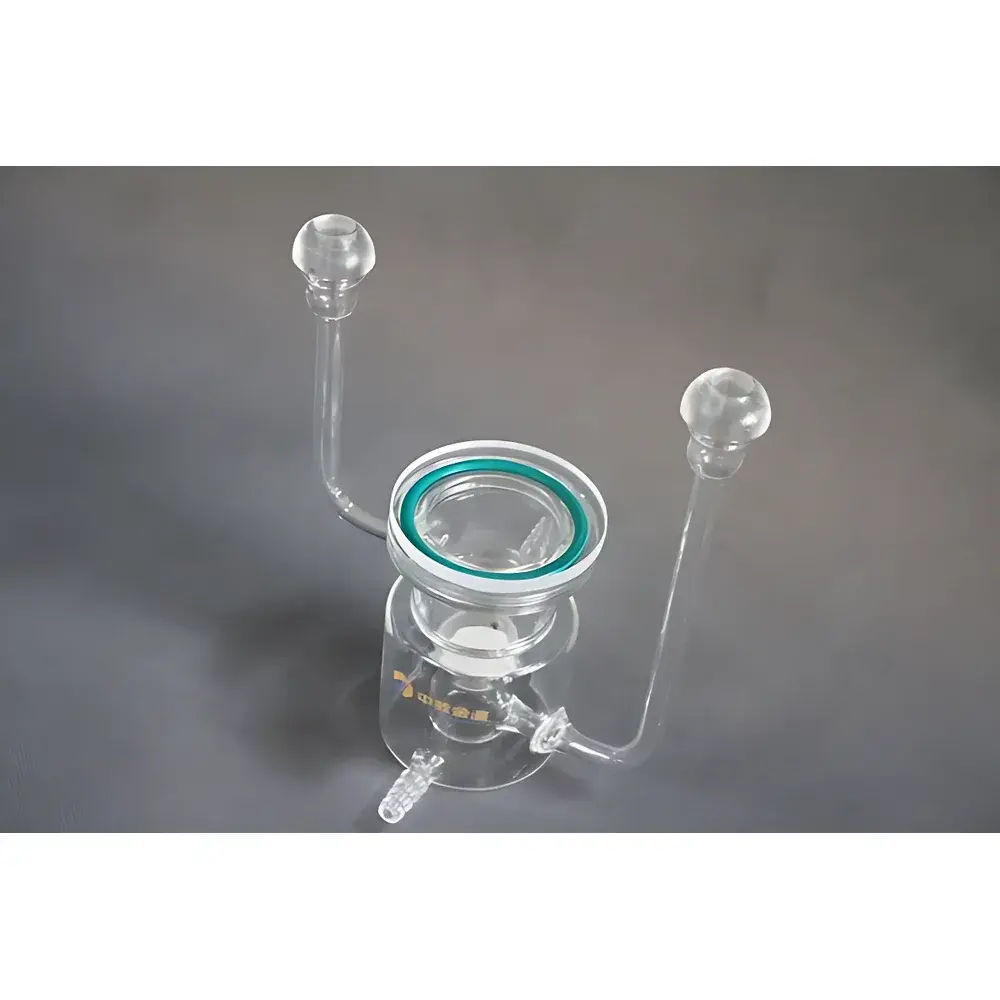
Zhongjiaojinyuan AULTT-TSPC50 Photocatalytic CO₂ Reduction Online Reactor
| Brand | Zhongjiaojinyuan |
|---|---|
| Origin | Beijing, China |
| Manufacturer Type | Direct Manufacturer |
| Product Origin | Domestic (China) |
| Model | AULTT-TSPC50 |
| Price Range | USD 0–2,800 |
| Reaction Volume | 50 mL (micro-scale) |
| Construction Material | Borosilicate Glass (3.3) |
| Operating Pressure | Low-pressure (ambient to ≤0.1 MPa gauge) |
| Vacuum Capability | Not rated for vacuum operation |
| Sealing Interface | Standard 28/30 ground-glass joint with fluorosilicone O-ring flange seal |
| Catalyst Support | Removable sintered glass frit (porosity G3, ~15–40 µm pore size) |
| Integrated Functionality | Simultaneous photocatalysis, gas-phase CO₂ reduction, and controlled-temperature gas-solid reaction with internal recirculation loop |
Overview
The Zhongjiaojinyuan AULTT-TSPC50 Photocatalytic CO₂ Reduction Online Reactor is a purpose-built, micro-scale gas-solid photocatalytic reaction system engineered for real-time evaluation of CO₂ photoreduction performance under controlled thermal and irradiation conditions. Designed around the principles of heterogeneous photocatalysis, it enables quantitative assessment of catalyst activity via continuous gas-phase monitoring—particularly suited for studies involving TiO₂, g-C₃N₄, MOFs, or perovskite-based photocatalysts. The reactor operates on a closed-loop recirculation principle: CO₂ (optionally mixed with H₂O vapor or co-reactants such as H₂ or CH₄) flows over a solid catalyst bed supported on a replaceable sintered glass frit, while incident light—delivered via external collimated UV-Vis or solar-simulated sources—is coupled through a quartz viewport or top-mounted optical window. Temperature control is achieved via external jacketed circulation or Peltier-assisted heating/cooling blocks (not integrated but compatible), maintaining isothermal zones across the catalyst bed. Its low-pressure design ensures safe handling of reactive gas mixtures without requiring high-integrity pressure containment.
Key Features
- Micro-scale 50 mL reaction volume optimized for catalyst screening with minimal reagent consumption and rapid equilibration kinetics
- Borosilicate glass (Duran®-grade) construction offering high UV transparency (>85% transmission down to 290 nm), chemical inertness toward acidic/basic photocatalytic intermediates, and thermal shock resistance up to 150 °C
- Standardized 28/30 ground-glass joint interface enabling modular integration with vacuum manifolds, mass flow controllers, online GC sampling lines, or FTIR gas cells
- Removable G3 sintered glass frit (15–40 µm pore size) facilitating uniform catalyst deposition, mechanical stability during gas flow, and straightforward post-reaction recovery without filter membrane interference
- O-ring flange sealing using fluorosilicone elastomer (FKM/FVMQ) rated for continuous service at ≤120 °C and compatible with CO₂, H₂O, CH₄, CO, and trace hydrocarbons
- No internal moving parts or electrical components—fully passive design compliant with Class I Division 2 hazardous area requirements when used with appropriate external instrumentation
Sample Compatibility & Compliance
The AULTT-TSPC50 supports heterogeneous photocatalysts in powder, pelletized, or immobilized thin-film formats. It accommodates aqueous co-feed introduction (via syringe port or vapor saturation column) for proton-coupled electron transfer studies. Gas compatibility includes CO₂, N₂, Ar, H₂, O₂ (dilute), CH₄, and CO—subject to material compatibility verification per ASTM D471 and ISO 1817. While not certified to ASME BPVC Section VIII or PED 2014/68/EU, its low-pressure classification (<0.1 MPa) places it outside mandatory pressure equipment directives in most jurisdictions. For GLP-compliant catalytic testing, users may implement external audit-trail-capable data loggers aligned with ISO/IEC 17025:2017 clause 7.7 and USP analytical instrument qualification protocols.
Software & Data Management
As a hardware-only reactor, the AULTT-TSPC50 does not include embedded firmware or proprietary software. It is fully interoperable with third-party process control systems including LabVIEW™, MATLAB® Data Acquisition Toolbox, or Python-based PyVISA frameworks. When paired with online gas analyzers (e.g., Agilent 490 Micro GC, INFICON Transpector™), raw chromatographic or spectroscopic output can be timestamped and correlated with temperature, flow rate, and irradiance data using vendor-neutral CSV/JSON export formats. Full traceability—including operator ID, calibration records, and environmental metadata—is achievable via LIMS integration following 21 CFR Part 11 Annex 11 guidelines when deployed in regulated R&D environments.
Applications
- Quantitative kinetic modeling of CO₂-to-CO, CH₄, or C₂H₄ photoreduction pathways under varied light intensities (10–300 mW/cm²) and residence times (1–120 s)
- Structure–activity relationship (SAR) studies comparing catalyst morphology, crystallinity, and surface functionalization under identical irradiation and mass transport conditions
- In situ DRIFTS or Raman coupling for identifying adsorbed intermediates (e.g., *COOH, *CHO, *CH₃O) during steady-state operation
- Long-duration stability testing (≥100 h) with periodic GC-TCD/FID analysis to assess deactivation mechanisms including carbon deposition or metal leaching
- Integration into automated high-throughput photocatalytic screening platforms using robotic liquid handlers and multi-position light sources
FAQ
Is the reactor suitable for high-pressure CO₂ hydrogenation studies?
No—the AULTT-TSPC50 is designed exclusively for low-pressure operation (≤0.1 MPa gauge) and lacks pressure-rated fittings or safety certification for elevated pressures.
Can the sintered glass frit be replaced with alternative substrates such as quartz wool or ceramic membranes?
Yes, provided dimensional compatibility with the 28/30 joint and thermal/chemical stability under reaction conditions; however, porosity and pressure drop must be empirically validated.
Does the reactor include temperature sensing or heating elements?
No—temperature measurement and control require external Pt100 probes and circulatory chillers/heaters; the glass body provides no built-in thermocouple ports.
What optical window options are available for enhanced UV transmission?
Standard configuration uses borosilicate glass; optional fused silica (Suprasil®) or MgF₂ windows can be supplied upon request for extended UV cutoff below 200 nm.
Is the O-ring material compatible with humidified CO₂ streams containing 5–20% water vapor?
Yes—fluorosilicone O-rings exhibit minimal swelling (<5% volume change after 72 h immersion in 25°C saturated H₂O/CO₂) per ASTM D471 testing.



