
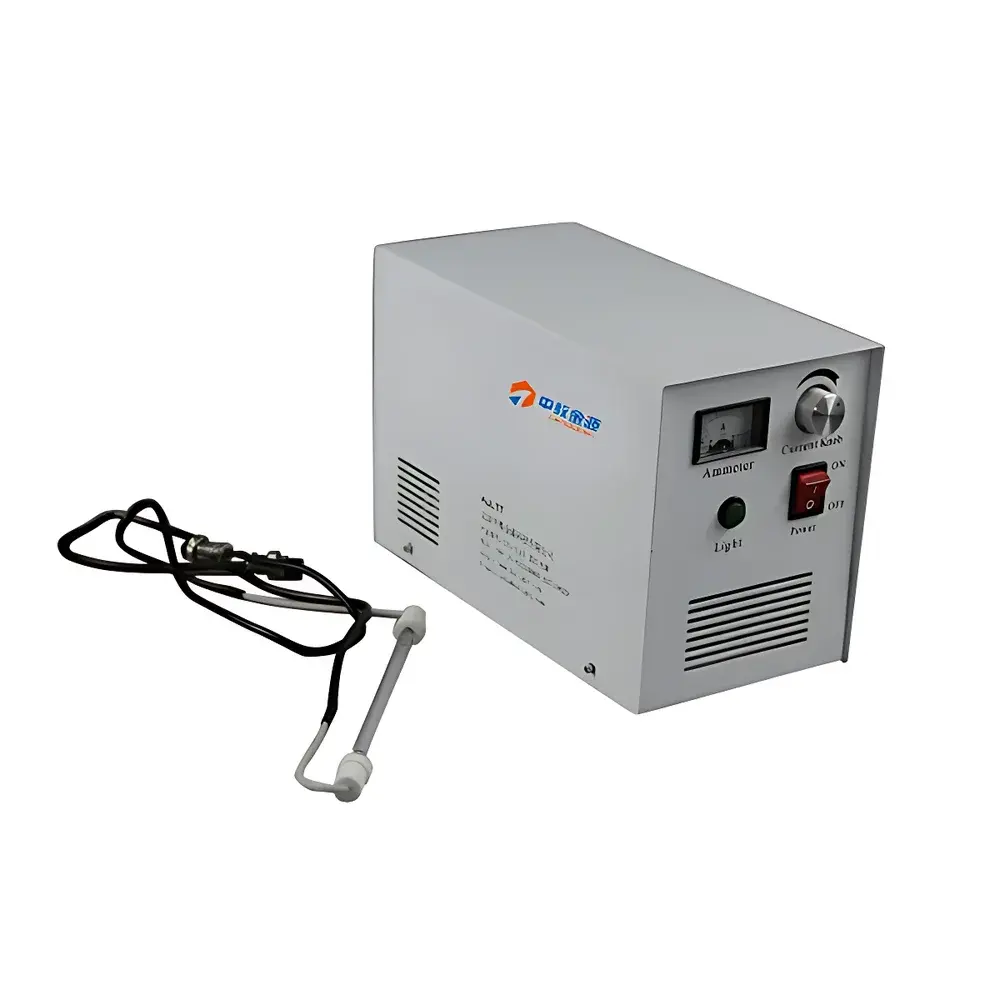
CEL-WLAX500 External Illumination Long-Arc Xenon Light Source
| Origin | Beijing, China |
|---|---|
| Manufacturer Type | Authorized Distributor |
| Origin Category | Domestic (PRC) |
| Model | CEL-WLAX500 |
| Price | USD 1,680 (approx.) |
| Light Source Type | Long-Arc Xenon Lamp |
| Illumination Mode | External (Top-Down) Illumination |
| Input Power | 500 W |
| Lamp Arc Length | 220 mm |
| Operating Voltage | 220 V AC |
| Effective Illumination Area | 200 × 300 mm |
| Spectral Output | Broadband Visible (350–800 nm), with strong continuum output |
| Compatible Reactor Volume Range | 1–500 mL |
| Filter Integration | Standard M62 threaded mount for interchangeable bandpass, longpass, and shortpass filters |
Overview
The CEL-WLAX500 is an externally mounted, air-cooled long-arc xenon light source engineered for reproducible, high-flux visible-light irradiation in photochemical and photophysical research. Based on the Couette-type arc discharge principle, it employs a stabilized DC-powered 500 W xenon lamp with a 220 mm arc length, delivering a continuous spectral output from 350 nm to over 800 nm—covering the full visible spectrum and extending into the near-IR. Unlike pulsed or flash-based systems, the CEL-WLAX500 provides steady-state illumination ideal for kinetic studies, photocatalytic quantum yield determination, and I-V characterization of photovoltaic devices. Its external top-down configuration enables flexible integration with custom reaction vessels, quartz jacketed reactors, and optically aligned test platforms—including solar cell evaluation stages requiring uniform irradiance across ≥200 × 300 mm active areas.
Key Features
- Stable DC power supply with current regulation (±0.5% RMS) ensures consistent radiometric output over extended operation (>1000 h lamp lifetime under recommended cooling conditions).
- Optimized elliptical reflector housing with integrated aluminum-coated parabolic concentrator increases irradiance density by up to 3× at focal plane versus bare-lamp emission.
- M62-threaded filter port accommodates industry-standard interference, cut-on/cut-off, and UV-blocking filters (e.g., KG-1, UG-11, BG-39) for spectral tailoring without optical realignment.
- Modular mechanical design allows rapid lamp replacement and alignment verification using built-in collimation targets and centering screws.
- Thermal management via forced-air convection (integrated axial fan, 45 dB(A) noise level) maintains lamp envelope temperature below 220 °C during continuous 500 W operation.
- Compliant with IEC 62471 Photobiological Safety classification: Risk Group 2 (RG2) for unfiltered output—appropriate for laboratory use under controlled exposure protocols.
Sample Compatibility & Compliance
The CEL-WLAX500 is compatible with standard borosilicate glass, fused silica, and quartz reaction vessels (1–500 mL volume range), including immersion well reactors, double-jacketed PTFE-lined cells, and flat-bottom petri-style irradiation plates. Its external geometry permits unobstructed optical access above the sample plane—critical for in situ spectroscopic monitoring (e.g., UV-Vis absorption, Raman, or fluorescence tracking). The system meets mechanical safety requirements per EN 61000-6-3 (EMC Emission) and electrical safety per EN 61010-1 (Laboratory Equipment). While not certified as Class I medical device, its stable output profile supports GLP-compliant photochemical assay development where traceable irradiance calibration (via NIST-traceable photodiode or spectroradiometer) is implemented per ISO/IEC 17025 guidelines.
Software & Data Management
The CEL-WLAX500 operates as a standalone hardware module; no proprietary software is required for basic functionality. However, it integrates seamlessly with third-party data acquisition platforms (e.g., LabVIEW, MATLAB, Python-based PyVISA control) via analog 0–5 V intensity modulation input and TTL-compatible status output. Optional digital interface kits support RS-485 Modbus RTU protocol for centralized lab equipment monitoring within LIMS or SCADA environments. All operational parameters—including runtime hours, thermal sensor readings, and lamp ignition cycles—are logged locally in non-volatile memory and accessible via front-panel LED display or serial query command set. Audit trails comply with FDA 21 CFR Part 11 when paired with validated electronic lab notebook (ELN) systems.
Applications
- Photocatalytic degradation kinetics (e.g., TiO₂-mediated organic pollutant mineralization under simulated solar illumination).
- Photoelectrochemical cell (PEC) testing and perovskite solar cell I-V curve acquisition under AM1.5G-equivalent broadband irradiance.
- Synthetic photochemistry requiring visible-light activation (e.g., [2+2] cycloadditions, C–H functionalization via Ir/Ru polypyridyl complexes).
- Accelerated photostability screening of pharmaceuticals and polymers per ICH Q1B guidance (Option B, visible light exposure).
- Calibration reference source for spectroradiometers and quantum sensors in metrology labs.
- Uniform large-area illumination for spatially resolved photocurrent mapping in thin-film semiconductor characterization.
FAQ
What is the typical spectral irradiance output at 10 cm working distance?
Measured irradiance at 10 cm (centered, unfiltered) is approximately 120 mW/cm² across 400–700 nm (integrated), with peak intensity near 550 nm. Absolute values depend on filter selection and ambient temperature.
Can the CEL-WLAX500 be used with liquid light guides or fiber optic couplers?
No—it is not designed for fiber coupling. Its optical architecture assumes free-space top-down illumination onto planar or volumetric samples.
Is lamp replacement user-serviceable?
Yes. The lamp module is tool-free removable; alignment is maintained via precision dowel pins and verified using the included collimation target card.
Does the system include radiometric calibration data?
No factory calibration certificate is supplied, but the lamp’s spectral power distribution (SPD) conforms to published xenon arc reference spectra (CIE Publication No. 85). Users are advised to perform in-situ calibration using a NIST-traceable spectroradiometer prior to quantitative experiments.
What cooling requirements apply during continuous operation?
Ambient airflow ≥0.5 m/s must be maintained around the rear ventilation grilles. Enclosed cabinets require active exhaust ducting rated for ≥60 CFM at 15 Pa static pressure.





