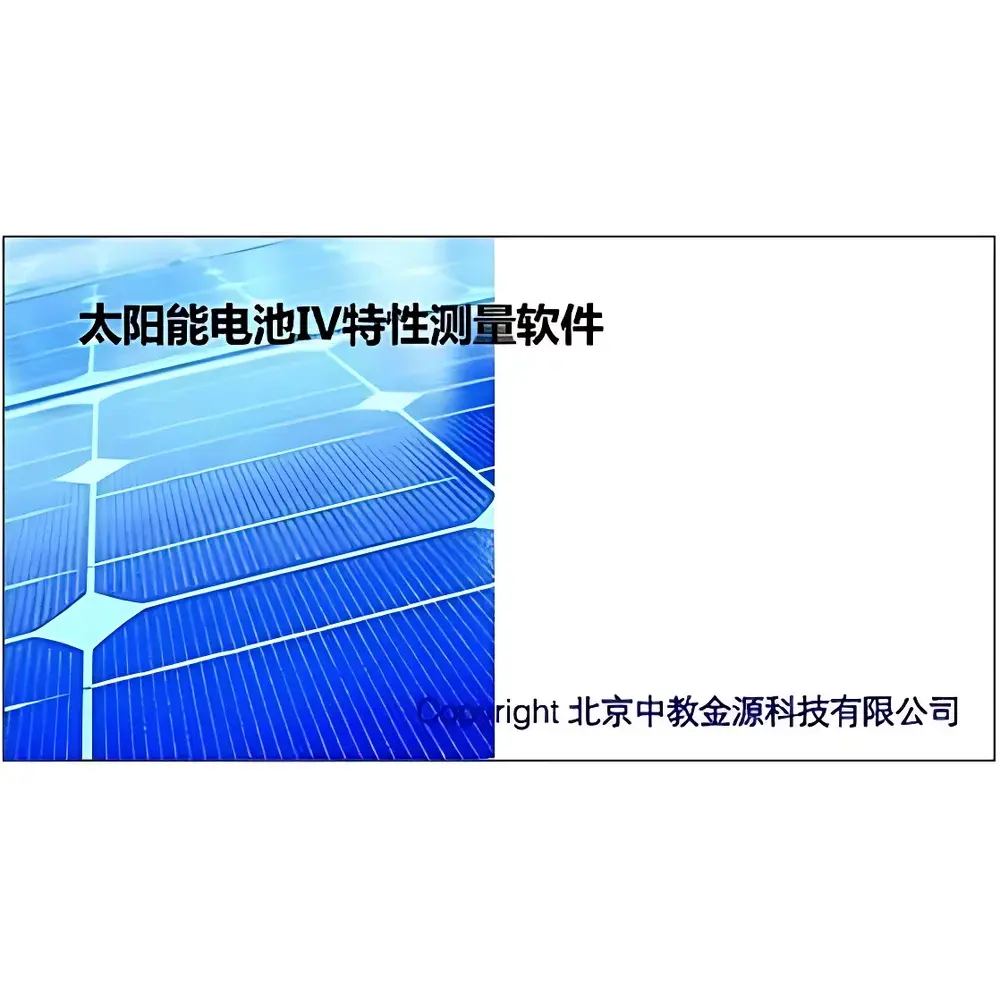
IV Testing Software by CEL (China Education Goldsource) – Solar Cell I-V Characterization Suite
| Brand | CEL (China Education Goldsource) |
|---|---|
| Origin | Beijing, China |
| Manufacturer Type | Original Equipment Manufacturer (OEM) |
| Regional Origin | Domestic (PRC) |
| Model | CEL-IV |
| Software Type | Photovoltaic Characterization Software |
| Compliance | IEC 60904-1, IEC 60904-3, IEC 61215, IEC 61646 |
| Interface | RS232 Communication Protocol |
| Data Export Formats | Excel (.xlsx), ASCII (.txt), XML |
| Report Output | Printable PDF & HTML Reports |
| Operating System | Windows 10/11 (64-bit) |
| Language | Chinese UI Only |
| Hardware Integration | Keithley 2400 SourceMeter®, CEL-S500 Solar Simulator, CEL-RCCN/RCCO Reference Cells |
Overview
The CEL-IV I-V Characterization Software is a purpose-built, laboratory-grade application engineered for precise current–voltage (I-V) and power–voltage (P-V) curve acquisition and analysis of photovoltaic (PV) devices under standardized illumination and dark conditions. Designed in strict alignment with IEC 60904 series standards—including IEC 60904-1 (measurement principles), IEC 60904-3 (reference solar spectral irradiance), and IEC 61215 (crystalline silicon terrestrial PV module qualification)—the software serves as the central control and analytical engine within a complete PV characterization workstation. It interfaces directly with the Keithley 2400 SourceMeter via RS232 serial communication, enabling synchronized voltage sourcing and current measurement across user-defined sweep profiles. The software implements rigorous standard test condition (STC) correction algorithms—accounting for spectral mismatch, temperature deviation, and reference cell calibration—to ensure metrologically traceable efficiency calculations. Its architecture supports both single-sweep and bidirectional voltage sweeps (e.g., forward and reverse scans), with up to 2500 programmable data points per scan, facilitating high-resolution extraction of critical parameters including open-circuit voltage (Voc), short-circuit current (Isc), maximum power point (Vmpp, Impp), fill factor (FF), and photoelectric conversion efficiency (η).
Key Features
- Full compliance with IEC 60904-1, IEC 60904-3, and IEC 61215 for standardized PV device evaluation
- Integrated STC correction engine applying temperature coefficient compensation and spectral mismatch factor (MMF) adjustment
- Support for dual-mode operation: illuminated (AM1.5G simulated sunlight) and dark (zero-irradiance) I-V acquisition
- Configurable voltage sweep parameters: start/end voltage, step size, sweep direction (unidirectional or bidirectional), and dwell time per point
- Real-time graphical display of I-V and P-V curves with dynamic scaling, cursor-based parameter readout, and overlay comparison
- Automated calculation and annotation of Voc, Isc, Jsc (current density), Vmpp, Impp, FF, η, series resistance (Rs), and shunt resistance (Rsh)
- Vacuum-assisted sample stage integration support (via optional hardware interface) for stable device positioning during measurement
- Temperature-controlled measurement environment synchronization (via external PT100 or thermocouple input, if configured in system)
- Minimized probe shadowing algorithm applied during four-point probe configuration to reduce optical loss artifacts
Sample Compatibility & Compliance
The CEL-IV software is validated for use with crystalline silicon (c-Si), multicrystalline silicon (mc-Si), thin-film (CIGS, CdTe, a-Si), perovskite, and organic photovoltaic (OPV) devices. It supports calibration against CEL-RCCN (monocrystalline Si) and CEL-RCCO (multicrystalline Si) reference cells traceable to NIM (National Institute of Metrology, China). All measurement workflows adhere to GLP-aligned documentation practices: each test session generates a timestamped, immutable metadata log—including instrument IDs, environmental readings (temperature, irradiance), operator ID, and calibration certificate expiry dates. Audit trails meet requirements for internal quality assurance and are compatible with laboratory accreditation frameworks referencing ISO/IEC 17025.
Software & Data Management
Data acquisition occurs natively through RS232 without requiring GPIB-to-USB adapters (e.g., KUSB-488). Raw measurement datasets—including voltage, current, time stamp, and auxiliary sensor values—are stored in a structured binary format with embedded metadata headers. Export functionality includes Excel (.xlsx) for statistical post-processing, ASCII (.txt) for third-party modeling tools (e.g., MATLAB, Python SciPy), and XML for LIMS interoperability. Graphical outputs (I-V, P-V) are renderable at publication-grade resolution and exportable as BMP or JPG. Comprehensive reporting modules generate printable test reports conforming to internal QA templates or customer-specific formats—each report embedding calibrated irradiance values, ambient temperature, reference cell responsivity, and uncertainty estimates per IEC 61215 Annex A.
Applications
CEL-IV is deployed across R&D laboratories, PV module manufacturing QC lines, independent testing labs (e.g., TÜV Rheinland-accredited facilities), and university photovoltaics research centers. Typical use cases include: qualification testing of new absorber materials; batch consistency verification of commercial solar cells; degradation analysis under light soaking or thermal cycling; validation of anti-reflective coating performance; and inter-laboratory round-robin studies requiring harmonized I-V methodology. Its deterministic measurement protocol and STC correction fidelity make it suitable for comparative benchmarking in multi-technology PV development programs.
FAQ
Does CEL-IV support ASTM E1036 or other non-IEC standards?
CEL-IV implements core IEC 60904 methodologies; users may manually apply ASTM E1036 correction factors externally using exported raw data.
Is FDA 21 CFR Part 11 compliance available?
The current release does not include electronic signature or audit trail encryption features required for Part 11; however, metadata logs and immutable file naming conventions support retrospective validation in regulated environments.
Can the software interface with third-party solar simulators?
Yes—provided the simulator offers analog/digital irradiance feedback signals and the source meter remains the primary voltage/current control element.
What is the minimum required hardware configuration?
Windows 10/11 64-bit, Intel Core i5 or equivalent, 8 GB RAM, RS232 port or USB-to-serial adapter, and a Keithley 2400 (or compatible SCPI-compliant SMU).
Is source code or API access available for custom automation?
No—CEL-IV is a closed-binary application; however, ASCII export enables full integration into Python, LabVIEW, or MATLAB automation pipelines.
Related Products