
Zhongjiaojinyuan BRS-GPPC High-Temperature Catalytic In Situ Raman Monitoring System
| Brand | Zhongjiaojinyuan |
|---|---|
| Origin | Beijing, China |
| Manufacturer Type | OEM Manufacturer |
| Product Origin | Domestic (China) |
| Model | BRS-GPPC |
| Pricing | Upon Request |
Overview
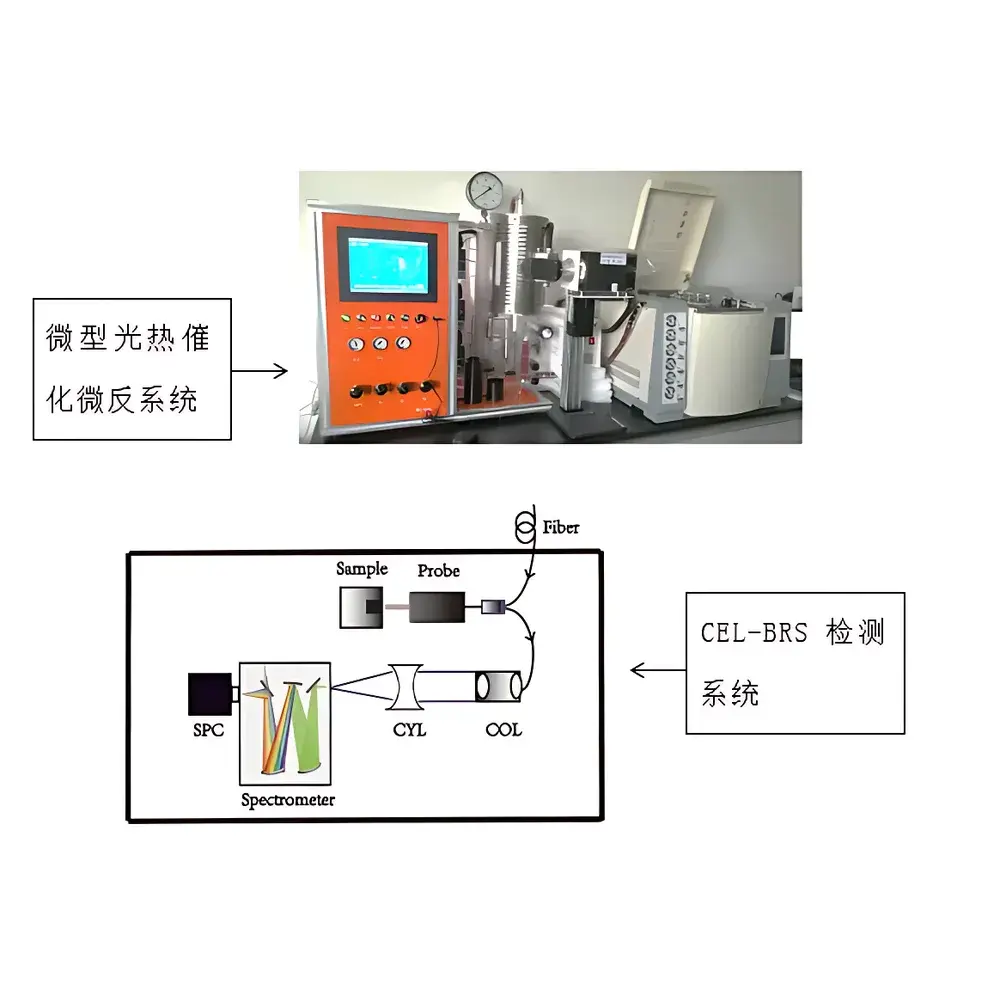
The Zhongjiaojinyuan BRS-GPPC is an engineered high-temperature catalytic in situ Raman monitoring system designed for real-time, time-resolved molecular fingerprinting under extreme process conditions—including elevated temperatures (up to 800 °C), controlled gas atmospheres, and simultaneous light irradiation. Unlike conventional dispersive Raman spectrometers constrained by ambient light sensitivity and thermal background interference, the BRS-GPPC integrates nanosecond-gated single-photon detection with high-repetition-rate pulsed excitation (532 nm, 2.5 kHz, <1 ns pulse width) to achieve robust signal isolation via temporal gating. Its core architecture leverages time-of-flight discrimination: by synchronizing a 3 ns electronic shutter on a 2D SPAD (Single-Photon Avalanche Diode) array camera with laser pulses, the system selectively captures only photons arriving within a precise temporal window—effectively rejecting broadband thermal radiation, solar background, Rayleigh scatter, and fluorescence lifetimes longer than the gate duration. This enables reliable remote Raman acquisition even under unshielded daylight conditions and at distances up to several meters—critical for industrial furnace monitoring or flame-adjacent catalysis studies.
Key Features
- Time-gated Raman detection with sub-3 ns electronic shutter resolution and <35 ps timing jitter, enabling picosecond-level temporal slicing of Raman scattering events
- Integrated high-power xenon lamp (200–1100 nm) with multi-stage spectral filtering and air-cooled lamp housing for stable photochemical excitation during in situ experiments
- Modular micro-reactor platform supporting both photothermal and photocatalytic operation: GPPCM (high-temperature) and GPPCT (high-temperature/high-pressure) configurations with quartz reaction chambers for optical access
- Precision environmental control: temperature stability ±1 °C, pressure resolution ±0.01 MPa, mass flow accuracy ±1 % F.S., and closed-loop thermal regulation via PID-controlled furnace
- Automated Czerny–Turner spectrograph (MS2004) with aberration-corrected optics, motorized slit adjustment, and software-controlled shutter activation
- Fully synchronized hardware architecture: external trigger distribution from laser to delay generator, gate driver, gain controller, and SPAD camera ensures deterministic timing alignment across all subsystems
Sample Compatibility & Compliance
The BRS-GPPC accommodates heterogeneous catalysts (e.g., TiO2, g-C3N4, perovskites), molten salts, metal oxides, and plasma-generated intermediates in static or dynamic gas environments (N2, Ar, CO2, H2, O2, synthetic air). Its quartz-based reactor design complies with ISO 17025-compliant calibration traceability requirements for optical path integrity. The system supports GLP/GMP-aligned data integrity through audit-trail-enabled software logging (user actions, parameter changes, timestamps), consistent with FDA 21 CFR Part 11 principles for regulated research environments. All electrical components meet CE/GB standards for industrial laboratory deployment; no modifications are required for integration into Class I explosion-proof enclosures when used with compatible gas-handling modules.
Software & Data Management
The proprietary acquisition suite provides dual-mode operation: single-frame capture for rapid spectral verification and interval-based time-series acquisition (programmable intervals from 10 s to 24 h, user-defined frame count, auto-saved .csv/.cie output). Each acquired spectrum includes embedded metadata (laser energy, gate delay, integration time, temperature/pressure logs). Time-resolved datasets support 3D visualization (Raman shift × time × intensity) and kinetic deconvolution of transient surface species (e.g., *COOH, *O, Ti3+ states). Exported files conform to ASTM E131-22 spectral data interchange conventions and are directly importable into Igor Pro, MATLAB, or Python-based chemometric toolchains (e.g., scikit-learn PCA, MCR-ALS). Raw photon-counting frames retain full spatial resolution (1920 × 1200 pixels, 8 µm pitch), permitting pixel-wise lifetime analysis or region-of-interest (ROI) averaging without loss of statistical fidelity.
Applications
The BRS-GPPC addresses three primary application domains requiring simultaneous thermal, optical, and chemical resolution: (1) High-temperature metallurgical process monitoring, where in situ oxide layer evolution on molten alloys or slag phase transitions are tracked under reducing/oxidizing atmospheres; (2) Photocatalytic reaction mechanism studies, including real-time observation of adsorbed intermediates during CO2 reduction or water splitting on semiconductor surfaces under operando illumination and heating; and (3) Combustion and plasma chemistry diagnostics, such as identification of short-lived radicals (CH, C2, CN) and soot precursors in laminar flames or non-thermal plasma jets. Published validation studies demonstrate reproducible detection of Ti–O vibrational modes (144 cm−1) and hydroxyl stretching (3400 cm−1) on TiO2 over 3-hour continuous acquisition with 5-minute intervals—without spectral drift or detector saturation.
FAQ
What is the minimum detectable Raman cross-section under high-temperature conditions?
The system achieves effective signal-to-noise ratios >50:1 for crystalline TiO2 anatase modes at 600 °C using 30-second accumulations, enabled by temporal rejection of blackbody continuum emission.
Can the BRS-GPPC be integrated with existing gas chromatography or mass spectrometry platforms?
Yes—the reactor outlet supports standard Swagelok fittings (1/4″ VCR); optional heated transfer lines and pressure-regulated sampling valves enable coupling to online GC-MS systems for complementary product analysis.
Is spectral calibration traceable to NIST standards?
Factory calibration uses NIST-traceable neon and argon emission lines; users may perform daily wavelength verification using built-in LED references or external Ne lamp modules.
Does the software support automated peak fitting and quantitative time-series modeling?
Baseline correction, Lorentzian/Gaussian peak decomposition, and first-order kinetic modeling are available via plugin modules compliant with Python 3.9+ environments.
What safety certifications apply to the laser subsystem?
The 532 nm laser module conforms to IEC 60825-1:2014 Class IV requirements; interlocked enclosure design and beam path containment meet EN 61000-6-4 electromagnetic compatibility directives.



