
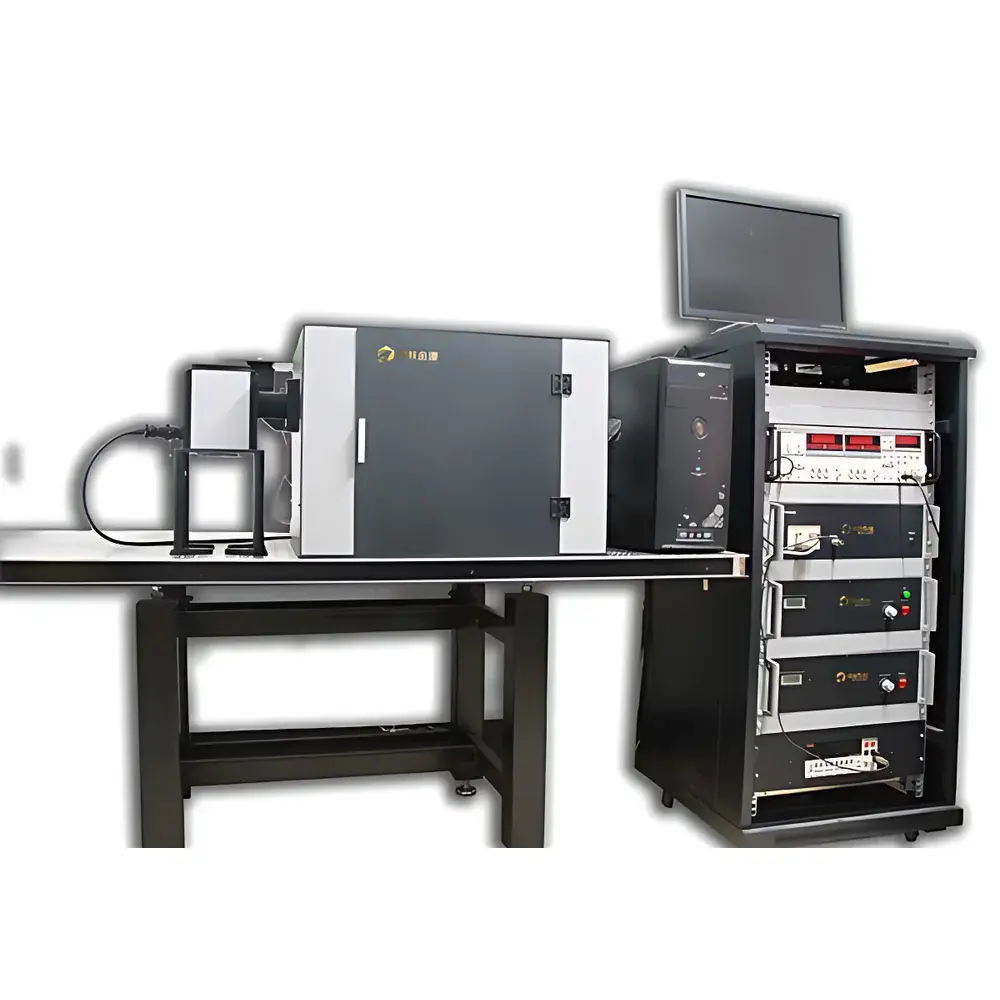
CEL-SPCT Surface Photovoltage Spectroscopy Upgrade Module for Perovskite Solar Cells
| Brand | CEA-Light |
|---|---|
| Model | CEL-SPCT |
| Origin | Beijing, China |
| Manufacturer Type | OEM Manufacturer |
| Regional Classification | Domestic (China) |
| Pricing | Upon Request |
| Measurement Mode | DC-based Surface Photovoltage (SPV) Spectroscopy |
| Bias Light Source | Integrated Adjustable LED/Laser Bias Illumination |
| Source Meter | Keithley 2400/2450 Series Precision SMU |
| Sample Stage | Motorized XYZ Translation + Tilt Adjustment |
| Optical Path | Optimized Collimated Monochromatic Beam Delivery with Dual-Channel Detection |
| Spectral Range | 200–1100 nm (Grating-Driven Monochromator) |
| Scan Mode | Fully Automated Continuous Scanning |
| QE/IPCE Calibration | NIST-Traceable Si/Ge/InGaAs Reference Detectors |
| Key Outputs | Absolute Spectral Responsivity (A/W), External Quantum Efficiency (EQE), Spectral Transmittance, J<sub>sc</sub> under AM1.5G (100 mW/cm²), Spatial Uniformity Mapping (±0.5% pixel-to-pixel deviation) |
| Repeatability | <0.3% RSD for Short-Circuit Current Density (J<sub>sc</sub>) |
Overview
The CEL-SPCT Surface Photovoltage Spectroscopy (SPS) Upgrade Module is an engineered instrumentation solution designed to extend the functional capability of existing solar cell characterization platforms—specifically for perovskite photovoltaic (PV) devices, dye-sensitized solar cells (DSSCs), and thin-film semiconductor absorbers. Unlike conventional photocurrent-based quantum efficiency systems, the CEL-SPCT operates on the principle of contactless surface photovoltage detection, measuring the built-in potential shift induced by monochromatic illumination without requiring electrical contacts or external bias circuits. This enables non-destructive, high-sensitivity evaluation of charge separation dynamics, interfacial recombination kinetics, and band-edge alignment in optoelectronic thin films. The module integrates a precision source measurement unit (SMU) from Keithley (2400/2450 series) for synchronized voltage sourcing and current monitoring, while its optomechanical architecture supports both DC-mode SPV mapping and AC-phase-resolved analysis via lock-in detection (when paired with optional modulation hardware). Its spectral coverage spans 200–1100 nm—encompassing UV, visible, and near-infrared regions—making it suitable for wide-bandgap perovskites (e.g., CsPbBr₃), mixed-halide compositions, and tandem-relevant sub-cells.
Key Features
- Modular integration architecture compatible with standard solar simulator frames and probe stations
- Automated monochromator-driven spectral scanning with <1 nm wavelength resolution and <0.1 nm step accuracy
- Dual-path optical design enabling simultaneous reference beam monitoring and sample illumination
- Motorized XYZ sample stage with ±0.1 µm positioning repeatability and angular tilt adjustment (±5°) for oblique incidence studies
- Integrated bias light subsystem with independently controllable intensity (0–100 mW/cm²) and spectral tuning (365–940 nm LEDs or laser diodes)
- NIST-traceable calibration protocol for absolute responsivity using certified Si (200–1100 nm), Ge (800–1800 nm), and InGaAs (900–1700 nm) reference detectors
- Compliance-ready data logging supporting timestamped metadata, instrument configuration snapshots, and raw waveform export (CSV, HDF5)
Sample Compatibility & Compliance
The CEL-SPCT accommodates planar and mesoporous device architectures up to 25 mm × 25 mm active area, including spin-coated, blade-coated, and vacuum-deposited perovskite layers on FTO/ITO/glass, flexible PET substrates, and textured silicon wafers. It supports ambient, inert-gas glovebox, and low-humidity (<5% RH) operational environments. All firmware and data acquisition routines are structured to align with GLP-compliant workflows: audit trails record user ID, session start/stop time, calibration certificate IDs, and parameter modifications. While not FDA-certified as standalone medical equipment, the system’s software architecture satisfies foundational requirements for 21 CFR Part 11 compliance when deployed with validated electronic signature modules and role-based access control (RBAC) extensions.
Software & Data Management
Control and analysis are executed via SPCT-Control Suite v3.x—a Windows-based application developed in LabVIEW and Python (PyQt). The suite provides real-time visualization of SPV transients, EQE spectra, and spatial uniformity heatmaps; supports batch processing of multi-sample datasets; and exports results in ASTM E1021-22 compliant formats. Raw voltage/time traces and spectral response curves are stored with embedded EXIF-style metadata—including monochromator grating position, SMU compliance limits, integration time, and environmental sensor readings (T, RH). Export options include ASCII (tab-delimited), MATLAB .mat, and ISO-standardized PV-XML schema for interoperability with PVLib and IEA-PVPS reporting tools.
Applications
- Quantitative assessment of defect-assisted recombination in MAPbI₃ and FA-based perovskites through SPV decay kinetics
- Interfacial energy-level alignment verification at ETL/perovskite and HTL/perovskite junctions
- Thickness-dependent carrier diffusion length estimation in quasi-2D Ruddlesden–Popper phases
- Light-soaking stability profiling via time-resolved SPV amplitude tracking under constant bias illumination
- Comparative EQE analysis across fabrication batches to identify spectral-response outliers linked to compositional drift
- Calibration transfer between reference cells and production-line testers under AM1.5G spectral mismatch conditions
FAQ
Can the CEL-SPCT be used for transient SPV measurements?
Yes—when configured with an external function generator and oscilloscope interface, the module supports pulsed illumination experiments with temporal resolution down to 10 ns.
Is vacuum compatibility supported?
The base module is rated for operation in dry nitrogen or argon gloveboxes; vacuum-rated variants (≤10⁻³ mbar) require custom feedthroughs and are available upon engineering review.
Does the system include AM1.5G spectral correction?
Yes—the software applies real-time spectral mismatch correction using ASTM G173-22 reference spectra and user-defined incident irradiance profiles.
What detector options are available for extended NIR sensitivity?
Optional InGaAs photodiode modules (900–1700 nm) and liquid-nitrogen-cooled MCT detectors (up to 2500 nm) can be integrated via OEM collaboration.
How is calibration traceability documented?
Each shipment includes a calibration certificate referencing NIST SRM 2035 (Si photodiode) and SRM 2036 (Ge photodiode), with uncertainty budgets per ISO/IEC 17025:2017 Annex A.



