
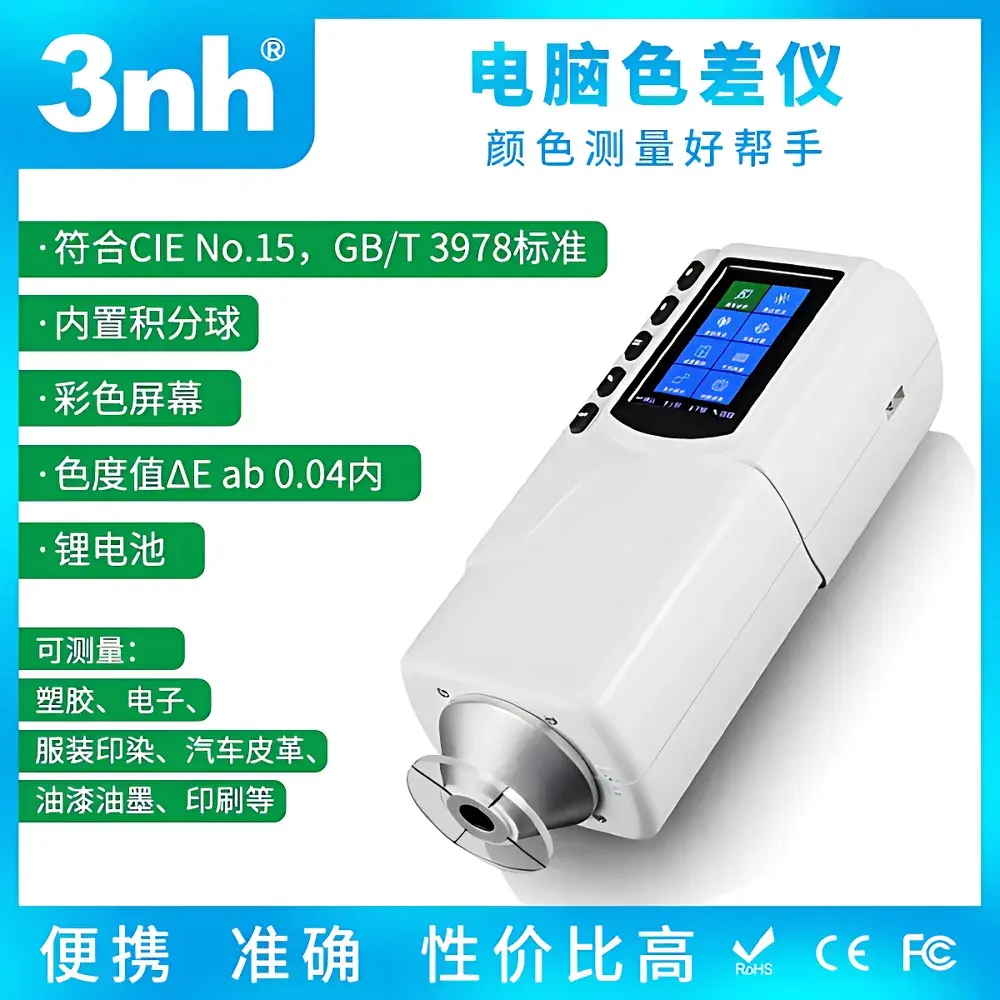
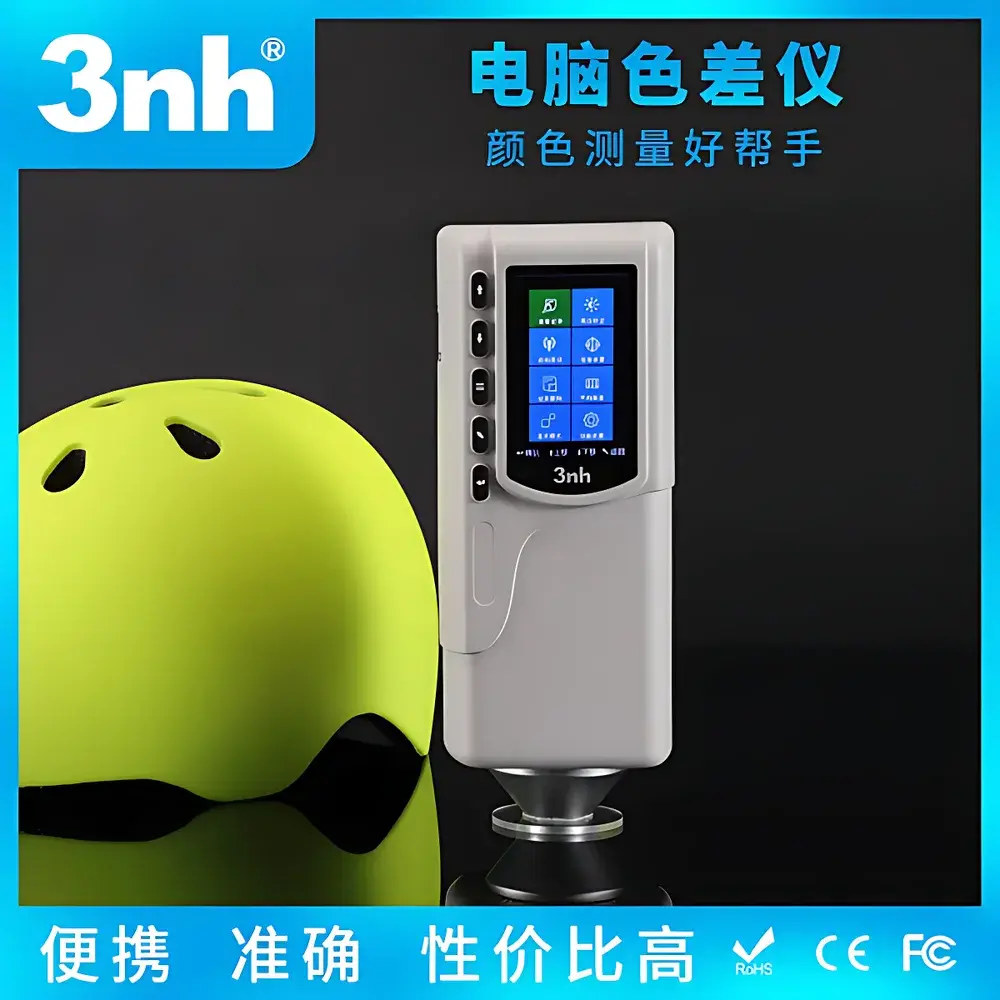
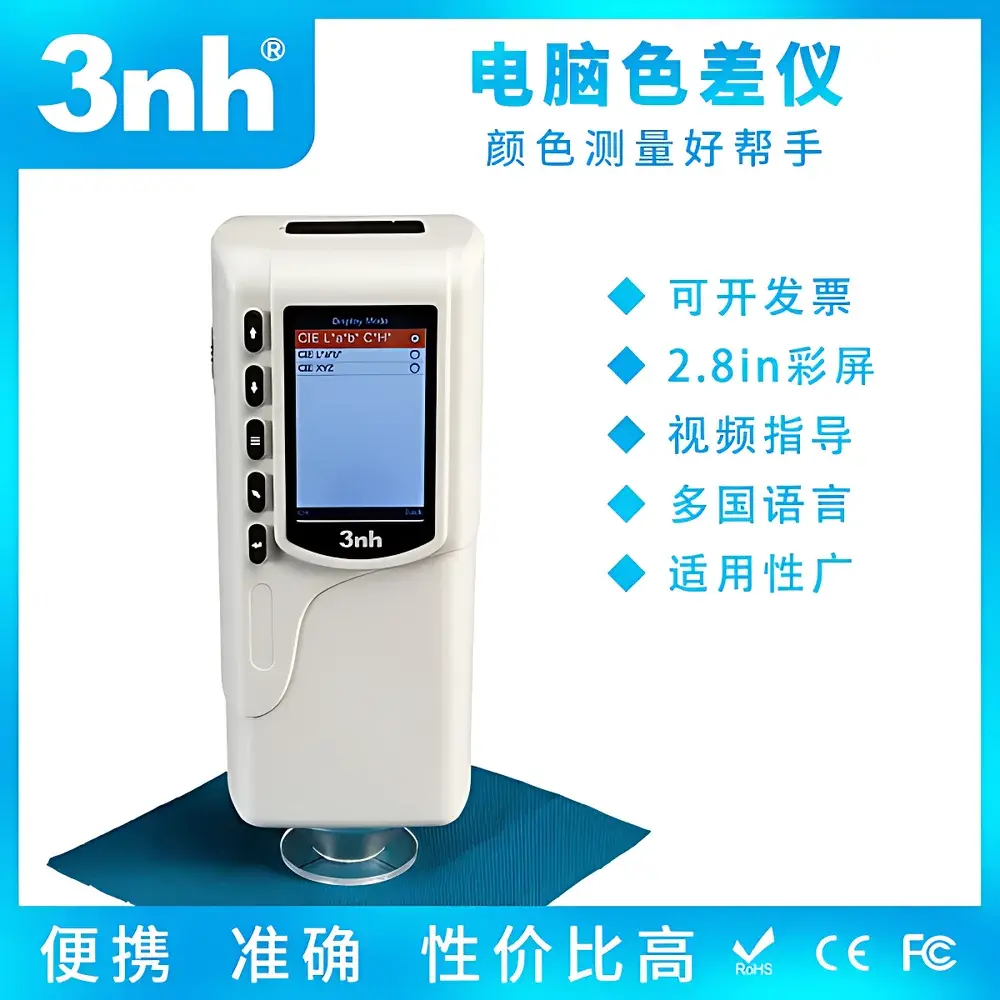
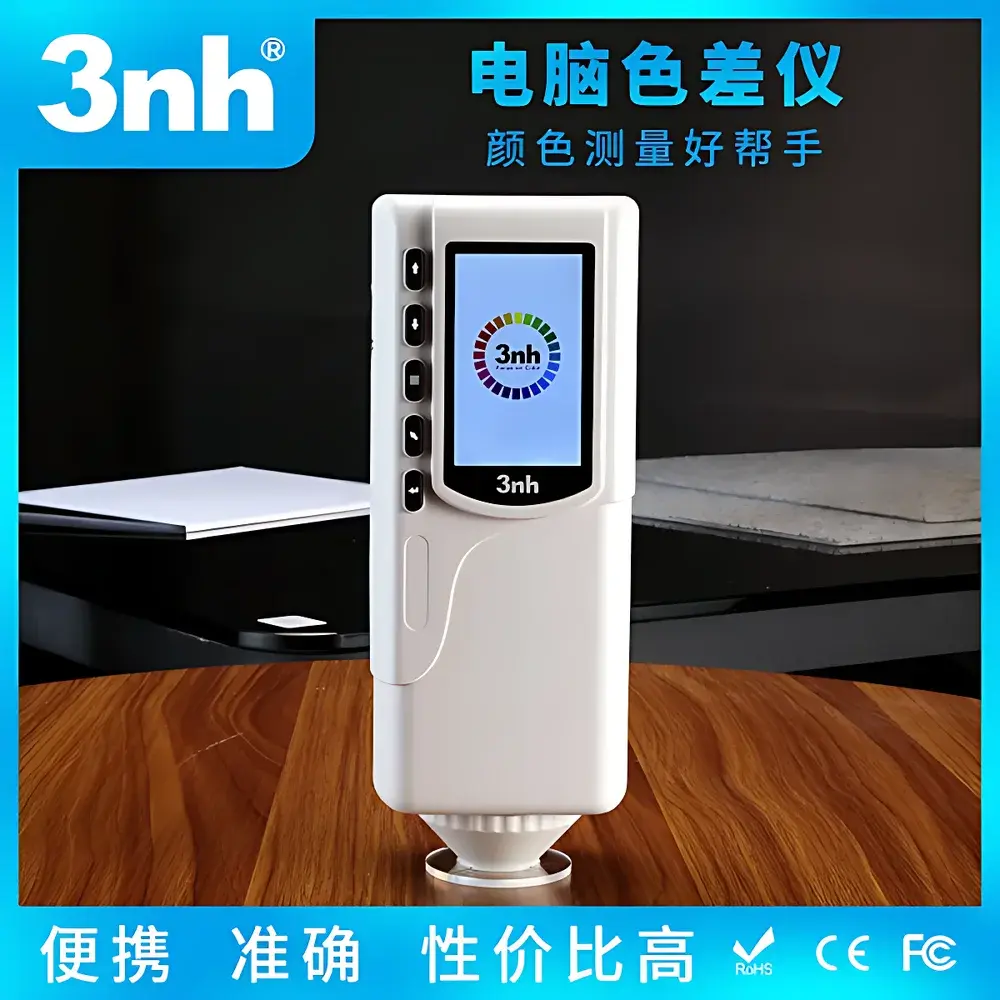
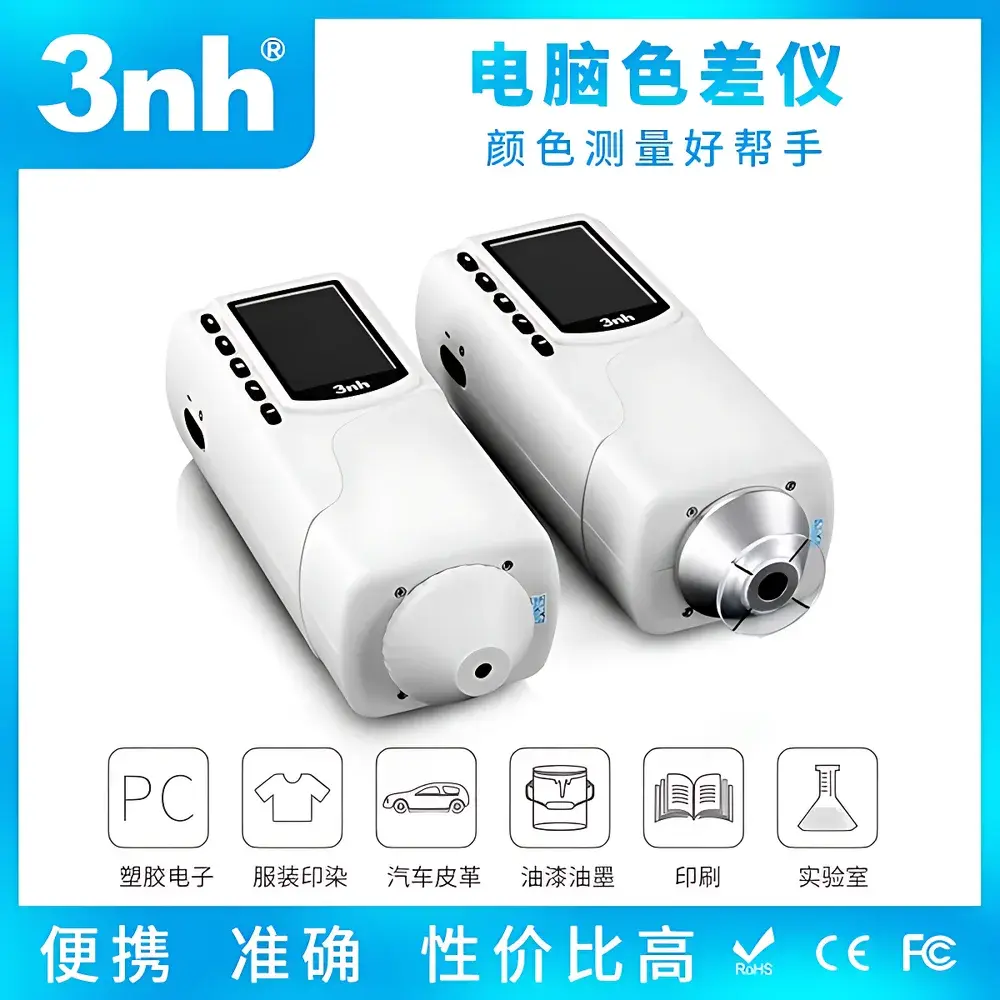
3nh NR110+ Handheld Color Difference Meter for Textile and Dyeing Applications
| Brand | 3nh |
|---|---|
| Origin | Guangdong, China |
| Manufacturer Type | Direct Manufacturer |
| Origin Category | Domestic (China) |
| Model | NR110+ |
| Product Type | Color Difference Meter |
| Instrument Type | Portable |
| Optical Geometry | 8°/d (8° illumination / diffuse reception) |
| Light Source | Full-spectrum LED |
| Spectral Range | 400–700 nm |
| Repeatability | ≤0.08 ΔE*ab (Φ4 mm aperture, after warm-up and calibration, 30 measurements on white tile at 5 s intervals) |
| Inter-instrument Agreement | ≤0.4 ΔE*ab (BCRA Series II 12-color tile set, average) |
| Measurement Time | 1.5 s |
| Display | 2.8″ TFT true-color screen (16:9 aspect ratio) |
| Battery | Rechargeable Li-polymer, 3.7 V @ 3200 mAh |
| Operating Temperature | 0–40 °C |
| Storage Temperature | −20–50 °C |
| Dimensions | 205 × 67 × 80 mm |
| Weight | 400 g |
| Data Storage | 100 standards + 20,000 samples |
| Compliance | CE, TÜV, SCM Metrology Certification, ISO 9001 Quality Management System |
Overview
The 3nh NR110+ Handheld Color Difference Meter is a precision optical instrument engineered for reliable, repeatable color assessment in textile dyeing, garment manufacturing, and related industrial quality control environments. Based on the CIE 15:2004 and GB/T 3978–2008 standards, it employs an 8°/d (8-degree illumination/diffuse viewing) optical geometry—fully compliant with CIE No. 15 and widely adopted in textile and paint industries for its robustness against surface texture variation. The device utilizes a full-spectrum LED light source covering 400–700 nm, enabling high-fidelity spectral sampling across the human visible range. Its dual-optical-path CMOS sensor architecture minimizes stray light interference between primary and auxiliary channels, contributing to stable photometric response under variable ambient conditions. Designed for field-deployable use without sacrificing metrological integrity, the NR110+ delivers laboratory-grade repeatability (≤0.08 ΔE*ab over 30 repeated measurements) and inter-instrument agreement (≤0.4 ΔE*ab across BCRA Series II reference tiles), making it suitable for multi-site color consistency audits and supplier qualification workflows.
Key Features
- Patented dual-positioning system: integrated illumination-guided targeting plus crosshair visual alignment ensures precise measurement spot placement on textured or irregular surfaces.
- Interchangeable Φ4 mm apertures: flat-base probe for uniform planar substrates and tapered-tip probe for concave/convex or raised-texture materials (e.g., knitted fabrics, embossed leather).
- Dual-geometry measurement interface: supports both standard 8°/d reflectance geometry and optional accessories for specialized applications including powder and liquid sample evaluation.
- Pre-stored white calibration parameters: eliminates routine recalibration before each session, reducing setup time and minimizing operator-induced drift.
- High-capacity rechargeable Li-polymer battery (3.7 V / 3200 mAh): enables >8 hours of continuous operation per charge, supporting full-shift deployment without disposable battery dependency.
- TFT true-color 2.8″ display (16:9 aspect ratio): provides intuitive visualization of L*a*b*, ΔE*ab, ΔL*, Δa*, Δb*, and pass/fail status with directional hue bias indicators.
- Rugged hand-held ergonomics: compact form factor (205 × 67 × 80 mm), 400 g mass, and wrist strap integration facilitate one-handed operation in production-line or warehouse settings.
Sample Compatibility & Compliance
The NR110+ is validated for use across diverse material classes encountered in textile and allied industries—including woven/knitted fabrics, dyed yarns, printed garments, synthetic leathers, coated papers, and pigment-dispersed polymers. Its Φ4 mm aperture accommodates standard AATCC TM173 and ISO 105-J03 test swatches. The instrument conforms to international metrological requirements: certified by SCM (China National Institute of Metrology), CE-marked per EU Directive 2014/30/EU (EMC) and 2011/65/EU (RoHS), and TÜV-tested for electrical safety (IEC 61010-1). Manufacturing adheres to ISO 9001:2015 quality management protocols, ensuring traceability of component sourcing, assembly, and final verification. While not FDA 21 CFR Part 11–compliant out-of-the-box, audit-ready data export via USB enables integration into GLP/GMP-compliant QC documentation systems when paired with validated SOPs.
Software & Data Management
The included PC-based Quality Management Software (v3.x+) supports bidirectional data synchronization, statistical process control (SPC) charting (X-bar/R, Cp/Cpk), batch-level deviation reporting, and customizable pass/fail thresholds per product line. Raw spectral reflectance data (at 10 nm intervals) and CIE-computed tristimulus values (XYZ, L*a*b*, L*C*h*) are exportable in CSV and XML formats for integration with enterprise LIMS or ERP platforms. Audit trails record user ID, timestamp, calibration events, and measurement history—enabling retrospective review aligned with internal QA procedures. Firmware updates are delivered through secure HTTPS download from the official 3nh support portal, ensuring long-term maintainability and compatibility with evolving color science standards.
Applications
This instrument serves as a primary color verification tool in textile dye houses for shade matching against master standards; in garment factories for incoming fabric inspection and trim color validation; in R&D labs for rapid formulation iteration of dyes and pigments; and in third-party testing laboratories performing AATCC, ISO, or customer-specific color tolerance assessments. Its portability allows real-time monitoring during wet-processing stages (e.g., after rinsing, drying, or heat-setting), supporting closed-loop process correction. Additional use cases include color stability tracking under accelerated aging (ISO 105-B02), batch-to-batch consistency verification across global supply chains, and training support for color technicians using standardized visual evaluation protocols.
FAQ
What standards does the NR110+ comply with for textile color measurement?
It follows CIE 15:2004, GB/T 3978–2008, and ISO 7724-1 for reflectance geometry and color space definition, and is compatible with AATCC Evaluation Procedure 1 and ISO 105-J03 for specimen preparation.
Can the NR110+ measure non-flat or textured surfaces accurately?
Yes—the optional Φ4 mm tapered-tip probe and dual-positioning system enable reliable measurements on knits, velvets, embossed synthetics, and other topographically complex substrates.
Is spectral data available for advanced analysis?
Yes—full reflectance spectra (400–700 nm at 10 nm intervals) are stored internally and exportable via PC software for metamerism analysis, spectral similarity indexing, or custom color difference modeling.
How often must the instrument be calibrated?
Factory calibration remains valid for 12 months under normal use; daily verification against supplied white tile is recommended, but full recalibration is only required if inter-instrument agreement exceeds 0.4 ΔE*ab or after physical impact.
Does the software support multi-user access control and electronic signatures?
The base software does not include role-based authentication or digital signature modules; however, exported data files may be imported into validated enterprise systems that provide such functionality per 21 CFR Part 11 requirements.





