
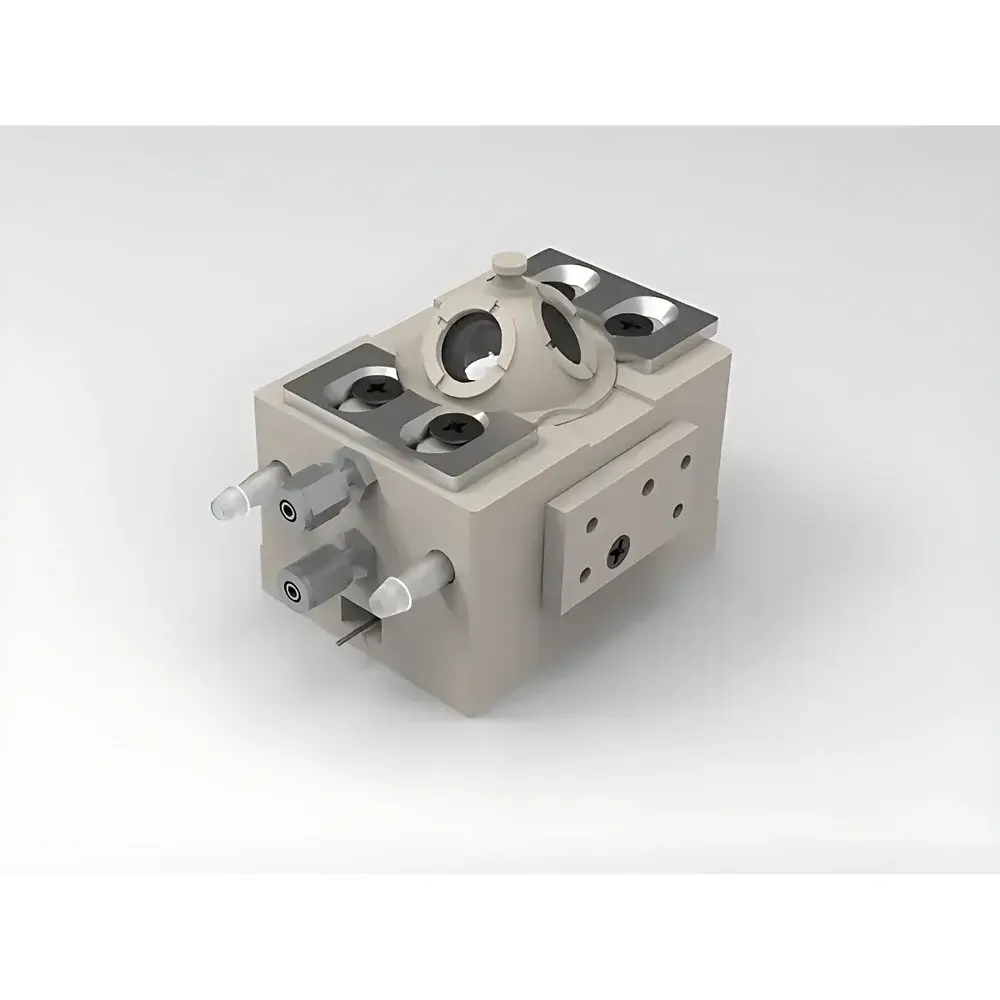
CEL-ISC-PLE01 In-situ Plasma-Ionic Liquid Electrode Reactor Cell
| Brand | CEL |
|---|---|
| Origin | Beijing, China |
| Manufacturer Type | Direct Manufacturer |
| Region | Domestic (China) |
| Model | CEL-ISC-PLE01 |
| Pricing | Upon Request |
| Housing Material | PEEK (−20 to 150 °C, ambient pressure) |
| Top Cap Options | IR Triple-Window Cap / Raman Single-Window Cap |
| Optical Window Materials | BaF₂, ZnSe, Fused Silica, Sapphire (custom options available) |
| Discharge Gap | 2 mm (customizable) |
| Dielectric Barrier Configuration | Single- or Dual-Quartz Barrier |
| Temperature Control Range | −20 to +80 °C (liquid bath circulation) |
| Electrode Configuration | Anode — metallic electrode |
Overview
The CEL-ISC-PLE01 is an engineered in-situ plasma–ionic liquid electrode reactor cell designed for real-time spectroscopic interrogation of heterogeneous catalytic processes under non-thermal plasma activation. It operates on the principle of dielectric barrier discharge (DBD), generating low-temperature, non-equilibrium plasma directly within the reaction zone while maintaining precise thermal control over the catalyst bed and gas–solid interface. Unlike conventional fixed-electrode reactors, the CEL-ISC-PLE01 integrates a dynamically circulated ionic liquid cathode, enabling uniform charge distribution across the discharge gap and suppressing localized arcing or filamentation—critical for reproducible plasma–catalyst coupling. The cell is purpose-built for integration with Fourier-transform infrared (FTIR) spectrometers (e.g., Thermo Fisher Nicolet, Bruker Tensor, Dongguan Hongdong) via standardized Harrick-style optical interfaces, and supports seamless adaptation for in-situ Raman spectroscopy upon cap and window substitution.
Key Features
- Modular optical top caps: Triple-window IR cap for simultaneous transmission/reflection/ATR-compatible alignment; single-window Raman cap optimized for 532/785 nm laser excitation with minimal fluorescence background.
- Selectable dielectric barrier architecture: Configurable single-quartz or dual-quartz barrier geometry to modulate electric field distribution, electron energy spectra, and reactive species yield (e.g., O•, N₂⁺, OH•).
- Thermally stabilized operation: Integrated liquid-bath temperature control (−20 to +80 °C) with external recirculation port, enabling decoupling of plasma-induced heating from intrinsic reaction thermodynamics.
- Circulating ionic liquid cathode: Eliminates electrode erosion and hot-spot formation; ensures stable discharge over extended durations (>100 h continuous operation demonstrated with [EMIM][BF₄] and [BMIM][PF₆]).
- PEEK body construction: Chemically inert, vacuum-tight (leak rate <1×10⁻⁹ mbar·L/s), and compatible with corrosive feed gases (e.g., NH₃, SO₂, Cl₂) and condensable vapors.
- Adjustable discharge gap (standard 2 mm, customizable down to 0.5 mm or up to 5 mm) for tuning reduced electric field (E/N) and mean electron energy.
Sample Compatibility & Compliance
The CEL-ISC-PLE01 accommodates powder catalysts (0.1–500 mg), monoliths (up to Ø12 mm × 5 mm), and supported thin films deposited on IR-transparent substrates (e.g., Si wafers, CaF₂ windows). It supports gas-phase feeds (N₂, O₂, Ar, He, CO, CO₂, CH₄, H₂, NH₃) at flow rates from 10–500 sccm and pressures from 10–760 Torr. All wetted components comply with ISO 8573-1 Class 4 purity standards for compressed air/gas systems. The design adheres to IEC 61000-4-3 (radiated RF immunity) and IEC 61000-4-4 (electrical fast transient robustness) for co-location with high-voltage plasma power supplies (e.g., kHz–MHz AC or pulsed DC sources). No internal electronics are present—ensuring full compatibility with GLP/GMP environments requiring electromagnetic isolation.
Software & Data Management
As a passive optical cell, the CEL-ISC-PLE01 requires no embedded firmware or proprietary software. All operational parameters—including plasma voltage/current waveforms, gas composition, temperature setpoints, and spectral acquisition triggers—are managed externally via the host spectrometer’s control suite (e.g., OPUS, OMNIC, GRAMS/AI) or third-party DAQ platforms (NI LabVIEW, MATLAB Data Acquisition Toolbox). Time-synchronized data logging is achievable using TTL-triggered acquisition modes, supporting kinetic profiling with sub-second temporal resolution. Audit trails for experimental conditions (temperature logs, flow controller outputs, plasma duty cycle) are maintained independently by the user’s laboratory information management system (LIMS), fully compliant with FDA 21 CFR Part 11 when paired with electronic signature-capable software.
Applications
- In-situ FTIR monitoring of plasma-assisted NH₃ synthesis over Ru/Fe catalysts under sub-atmospheric N₂/H₂ mixtures.
- Time-resolved Raman identification of surface-bound peroxo and superoxo intermediates during plasma-activated CO oxidation on Co₃O₄.
- Correlating electron energy distribution functions (EEDFs) with vibrational band intensities in CH₄ reforming over Ni/Al₂O₃.
- Quantifying plasma-induced surface charging effects on acid–base site dynamics in zeolite-catalyzed methanol-to-hydrocarbons reactions.
- Studying interfacial proton transfer kinetics at ionic liquid–metal oxide interfaces under sustained DBD exposure.
FAQ
Can the CEL-ISC-PLE01 be used under vacuum or elevated pressure?
No—it is rated for ambient pressure only (≤1 atm absolute); modifications for vacuum or high-pressure operation require custom engineering and void standard warranty.
Is the ionic liquid cathode compatible with all common ionic liquids?
Compatibility depends on viscosity, conductivity, and electrochemical window; recommended candidates include [EMIM][BF₄], [BMIM][PF₆], and [PYR₁₄][TFSI]; halide-based ILs (e.g., [BMIM][Cl]) are not advised due to corrosion risk.
What spectral range is supported with BaF₂ versus ZnSe windows?
BaF₂ transmits from 0.15–12 µm (667–833 cm⁻¹); ZnSe covers 0.5–20 µm (500–2000 cm⁻¹), with superior durability in humid or oxidizing atmospheres.
Does the cell support ATR-FTIR configurations?
Yes—the triple-window cap includes a recessed ZnSe ATR crystal option (1.5 mm path, 45° incidence) for direct catalyst surface probing without gas-phase interference.
How is plasma ignition synchronized with spectral acquisition?
Via external TTL trigger output from the plasma power supply (rising edge = start of pulse/burst), routed to the spectrometer’s external sync input for frame-locked averaging.



