
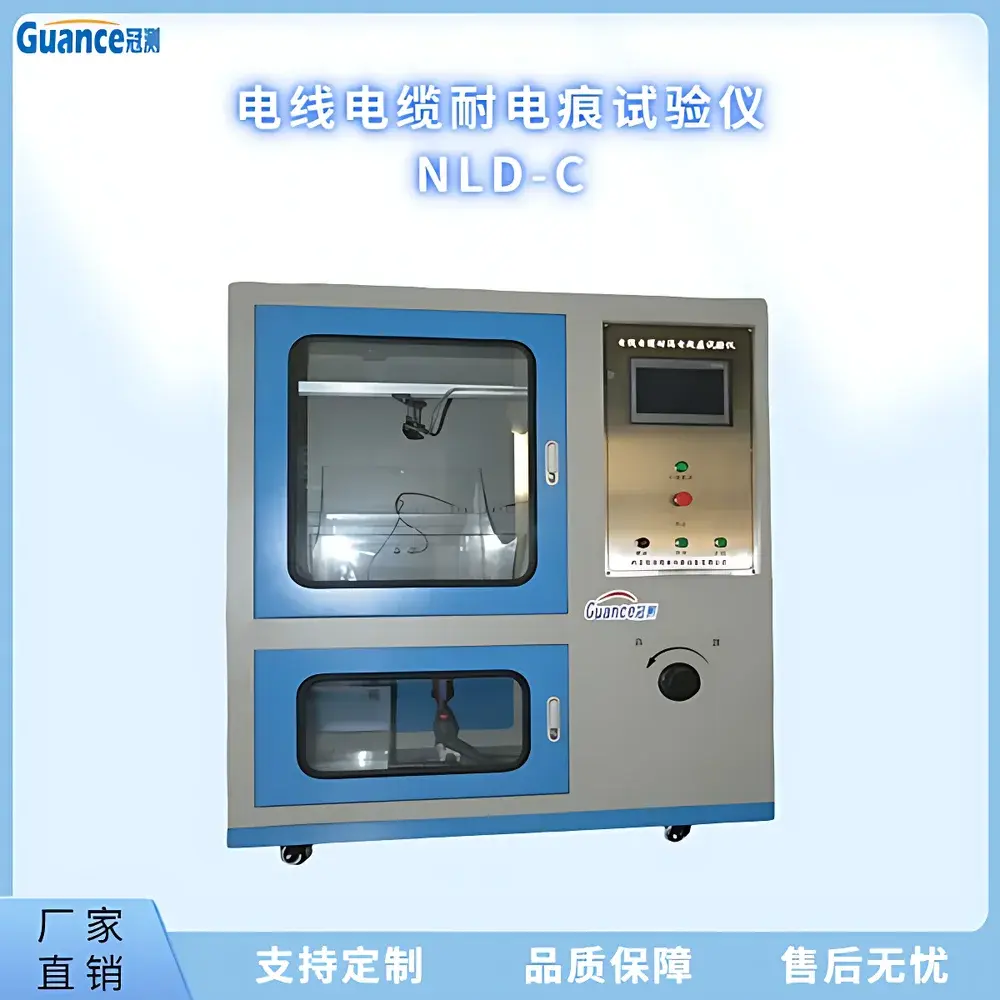
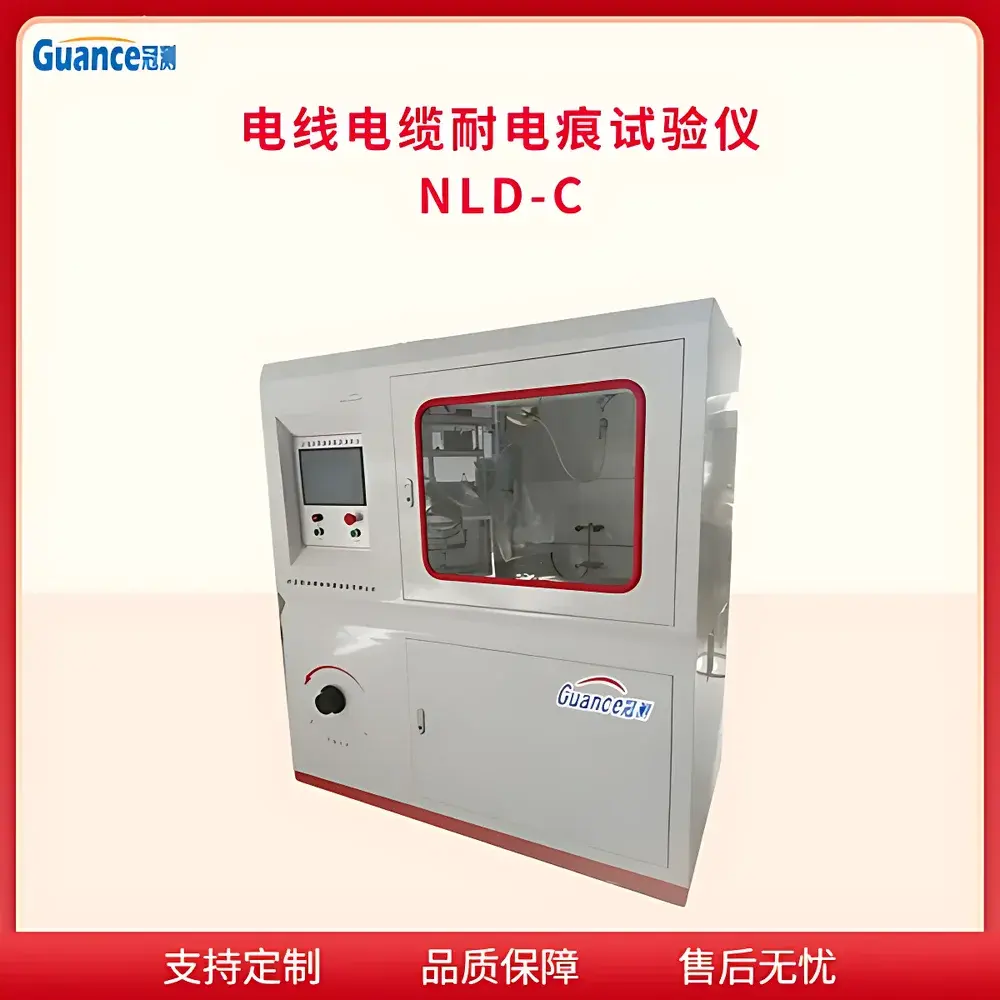
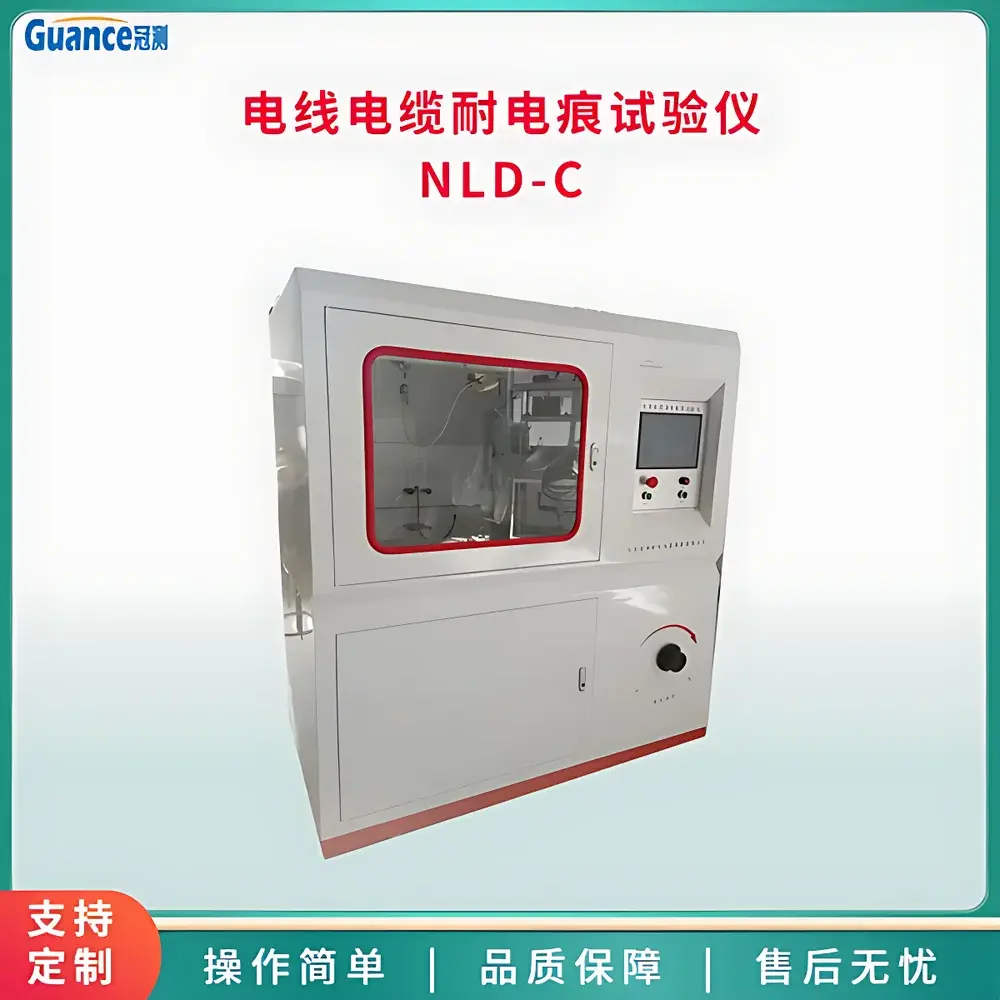
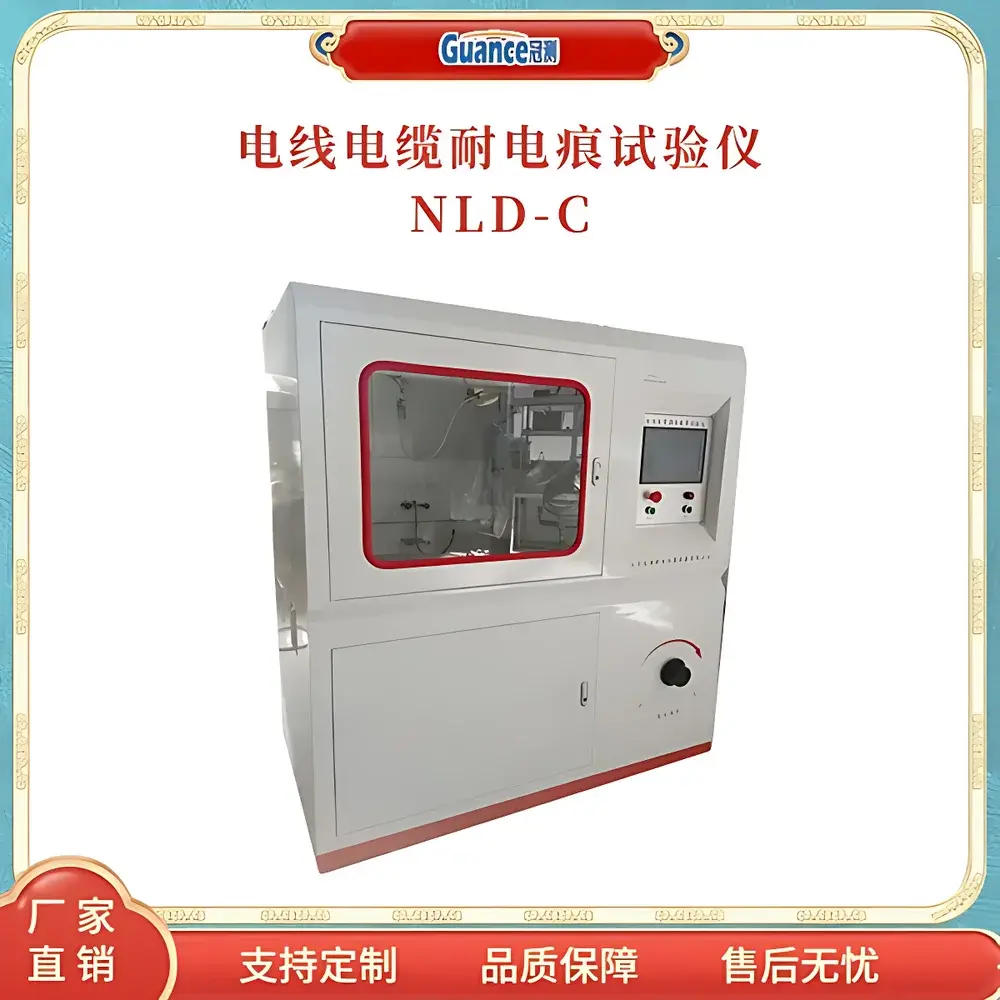
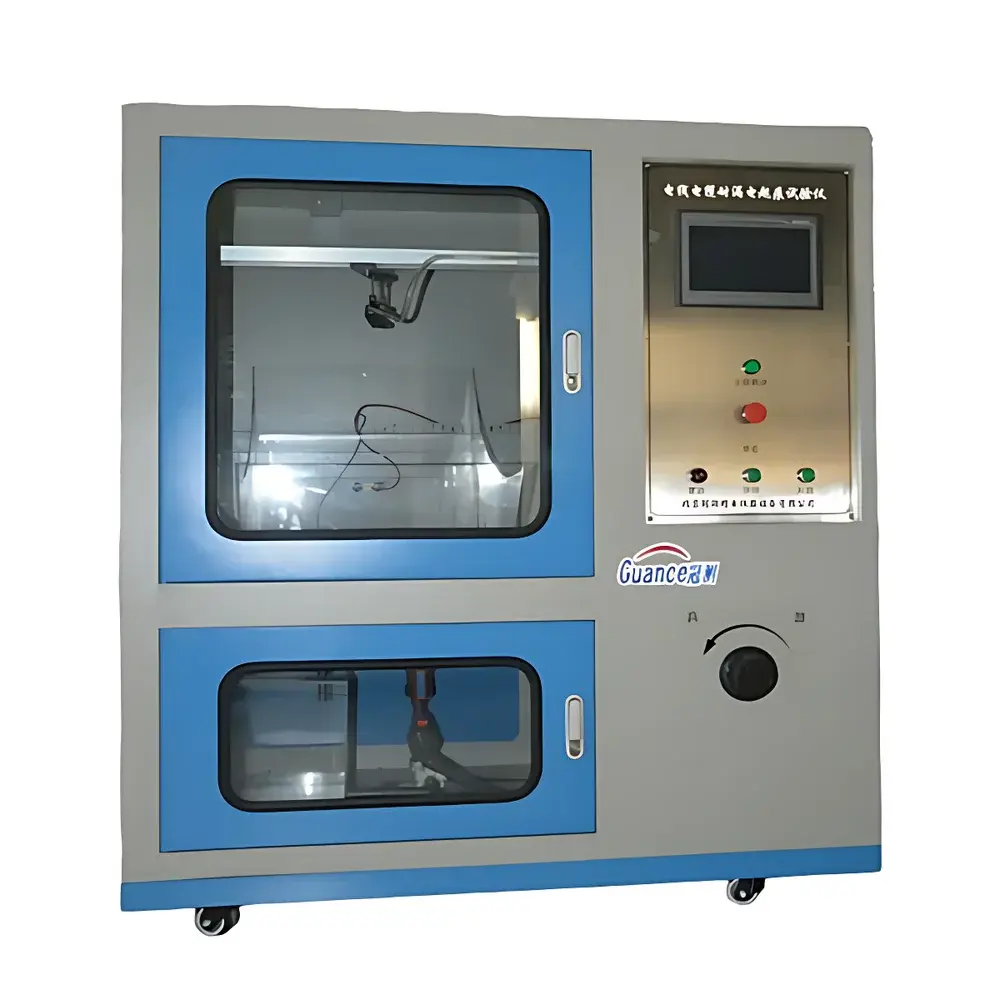
GuanCe Instruments NLD-C4 Aerospace Cable Tracking Resistance Universal Tester
| Brand | GuanCe Instruments |
|---|---|
| Origin | Beijing, China |
| Manufacturer Type | Authorized Distributor |
| Country of Origin | China |
| Model | NLD-C4 |
| Instrument Type | Electronic Universal Testing Machine |
| Input Voltage | AC 220 V |
| Output Voltage Range | AC 0–5 kV |
| Power Rating | 5 kVA |
| Voltage Accuracy | < 2% |
| High-Side Output Current | > 1 A |
| Current Measurement Accuracy | < 1% |
| Spray Velocity at Specimen | 3 m/s |
| Spray Rate | 0.5 mm/min |
| Standard Spray Cycle | 10 s spray / 20 s pause |
| Nozzle-to-Specimen Distance | ≥ 500 mm |
| Nozzle Angle Relative to Specimen Axis | 45° |
| Spray Range | > 1 m |
| Specimen Length | ≥ 150 mm |
| Compliance | GB/T 3048.7–2007 |
Overview
The GuanCe Instruments NLD-C4 Aerospace Cable Tracking Resistance Universal Tester is a purpose-built high-voltage dielectric testing system engineered for evaluating the electrical tracking resistance of solid insulating materials used in aerospace-grade wiring and cable systems. It operates on the principle of electrochemical degradation under combined electrical stress and electrolytic contamination — simulating real-world service conditions where insulating surfaces are exposed to humidity, conductive contaminants (e.g., salt mist or acidic aerosols), and sustained AC voltage gradients. The instrument applies a controllable AC high voltage (up to 5 kV) across a conditioned specimen while subjecting its surface to periodic, metered sprays of standardized corrosive solution. Tracking resistance is quantified by monitoring leakage current evolution over defined spray cycles; failure is determined when leakage exceeds 1 A, arcing occurs between electrodes, surface ignition initiates, or localized dielectric breakdown propagates. This method directly aligns with the physical mechanism of tracking — the progressive carbonization and conductive path formation along an insulator’s surface under electric field and ionic contamination.
Key Features
- 10-inch industrial-grade capacitive touchscreen interface with intuitive HMI for real-time parameter configuration, cycle control, and status monitoring.
- Siemens S7-1200 PLC-based core control architecture ensures electromagnetic compatibility (EMC), deterministic timing, and long-term operational stability in laboratory environments.
- Optically isolated voltage and current acquisition channels eliminate ground-loop interference and guarantee measurement integrity under transient high-voltage conditions.
- Manual voltage ramping with fine-resolution potentiometer control enables precise, stepwise application of test potential per GB/T 3048.7–2007 requirements.
- Adjustable spray cycle programming: users define spray duration (default 10 s), pause interval (default 20 s), and total cycle count to match material classification and qualification protocols.
- Calibrated rotameter-based flow regulation ensures consistent electrolyte delivery at 0.5 mm/min ±5%, critical for reproducible surface wetting and ion deposition.
- Dedicated drain port and sealed recirculation path allow safe, tool-free replacement or reuse of test solution without disassembly.
- Integrated axial exhaust fan with adjustable airflow rate mitigates accumulation of volatile decomposition byproducts during extended tests.
- LED-dedicated specimen illumination with independent ON/OFF control supports visual inspection of surface carbonization, charring, or dendritic growth under standardized lighting conditions.
- Programmable audible alarm triggers upon either leakage current exceeding 1 A or completion of the preset cycle count — alarm duration is user-configurable from 1 to 60 seconds.
- 45° precision-aligned nozzle mount and integrated drip containment trough prevent off-target spray dispersion and eliminate floor-level fluid leakage.
Sample Compatibility & Compliance
The NLD-C4 accommodates rigid and semi-rigid cylindrical cable specimens ≥150 mm in length, with standardized electrode termination per GB/T 3048.7–2007: one end stripped to expose conductor (20 mm), a 1–2 mm bare copper wire loop wound 2–3 turns at the 100 mm mark, and the opposite end insulated to suppress flashover. The system is validated for use with standard ammonium chloride–based electrolytes (e.g., 0.1% w/v NH₄Cl + 0.01% Triton X-100). It meets the mechanical, electrical, and procedural specifications outlined in GB/T 3048.7–2007, which references IEC 60112 principles for comparative tracking index (CTI) evaluation. While not certified to UL 746A or ASTM D3638, its operational parameters and test methodology are technically aligned with those standards for preliminary screening and internal R&D validation.
Software & Data Management
The embedded controller logs time-stamped voltage, current, spray state, and alarm events to non-volatile memory. Data export is supported via USB 2.0 to CSV format for post-test analysis in Excel or MATLAB. Audit trails include operator ID (optional login), test start/stop timestamps, parameter versioning, and calibration due dates — supporting GLP-compliant documentation workflows. Though not 21 CFR Part 11 compliant out-of-the-box, the system architecture permits integration with third-party LIMS platforms via Modbus TCP for centralized data archiving and electronic signature enforcement.
Applications
- Qualification testing of fluoropolymer (e.g., ETFE, FEP), polyimide, and silicone-insulated aerospace wiring harnesses.
- Comparative CTI screening of novel flame-retardant polymer compounds intended for avionics enclosures.
- Process validation of plasma-treated or nano-silica-coated insulation surfaces to assess tracking resistance enhancement.
- Failure analysis of field-failed cables exhibiting surface carbonization or partial discharge erosion patterns.
- Supporting compliance documentation for DO-160 Section 22 (Precipitation Static) and MIL-STD-810H Method 509.6 (Salt Fog) correlation studies.
FAQ
What safety certifications does the NLD-C4 hold?
The unit complies with GB 4793.1–2019 (equivalent to IEC 61010-1) for electrical safety in laboratory equipment, including interlocked enclosure design, emergency stop circuitry, and reinforced high-voltage insulation.
Can the instrument perform continuous DC tracking tests?
No — it is configured exclusively for AC high-voltage application per GB/T 3048.7–2007; DC tracking evaluation requires separate instrumentation.
Is remote operation or network connectivity available?
Standard configuration supports only local touchscreen and USB data retrieval; Ethernet or Wi-Fi modules are not included but may be added as a custom OEM option.
What maintenance intervals are recommended?
Voltage calibration verification every 12 months; nozzle cleaning after each test series; annual inspection of HV bushings and grounding straps per manufacturer’s maintenance log.
Does the system support automated pass/fail reporting?
Yes — the HMI displays real-time pass/fail status based on user-defined thresholds (current limit, cycle count); final reports are generated in CSV with embedded pass/fail flags.



