
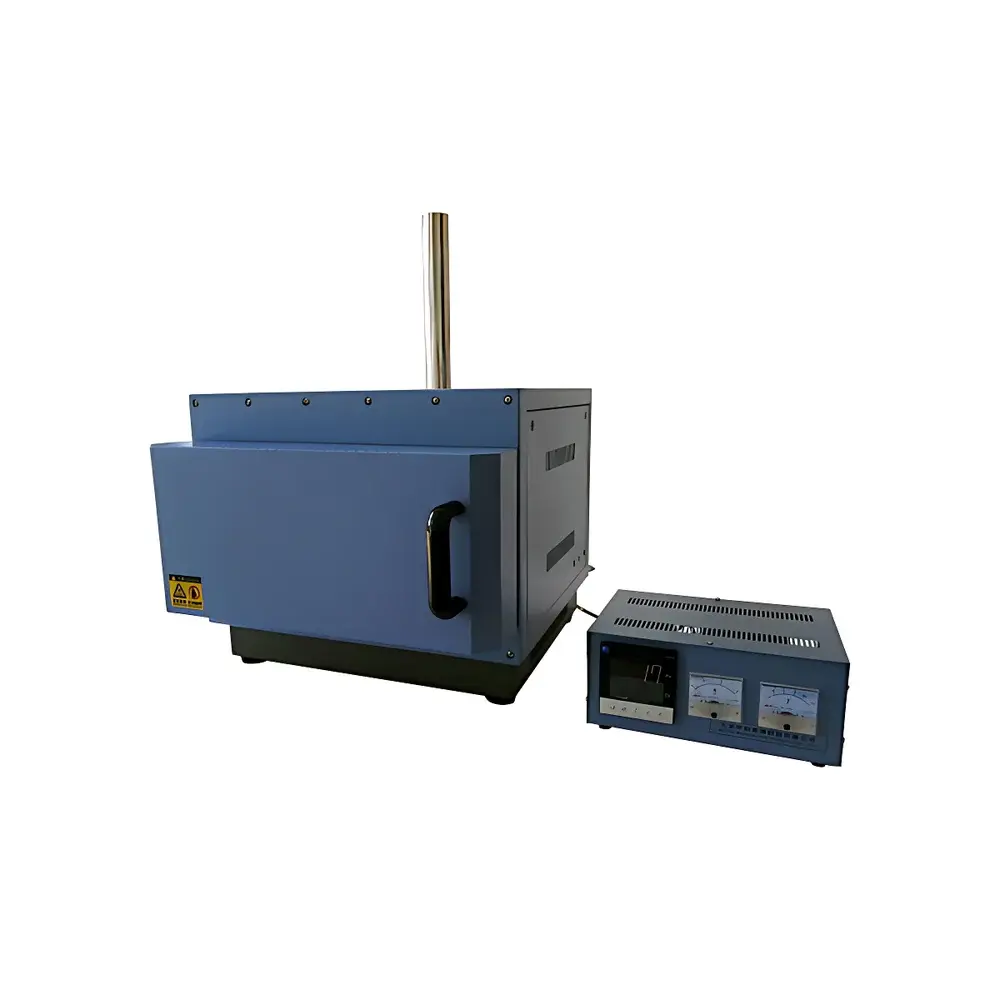
Zhongke Aobo TL-2012 Split-Type Box Muffle Furnace
| Brand | Zhongke Aobo |
|---|---|
| Origin | Beijing, China |
| Model | TL-2012 |
| Instrument Type | Box-Type Muffle Furnace |
| Max Operating Temperature | 1200 °C |
| Temperature Control Accuracy | ±1 °C |
| Rated Power | 6000 W |
| Heating Rate to Max Temperature | 30 min |
| Heating Elements | Resistance Wire / Silicon Carbide Rods / Molybdenum Disilicide (MoSi₂) Rods |
| Internal Chamber Dimensions | 400 × 250 × 200 mm (L × W × H) |
| Chamber Volume | 20 L |
| Construction | Ceramic Fiber Insulation with Double-Wall Steel Housing |
| Cooling Method | Natural Convection + Forced Air Ventilation (Optional) |
Overview
The Zhongke Aobo TL-2012 Split-Type Box Muffle Furnace is an industrial-grade, high-temperature thermal processing system engineered for precision annealing, ashing, calcination, sintering, and heat treatment applications in academic research laboratories, quality control facilities, and materials development centers. Its split-type architecture—comprising a thermally isolated furnace chamber and a physically separated temperature controller—enhances operational safety, simplifies maintenance access, and minimizes electromagnetic interference with sensitive instrumentation. The furnace operates on the principle of resistive heating via dual-mode heating elements (silicon carbide or molybdenum disilicide rods), enabling stable, uniform temperature distribution across the 20 L ceramic fiber-lined chamber. With a maximum rated temperature of 1200 °C and a certified control accuracy of ±1 °C, the TL-2012 meets fundamental thermal stability requirements for ASTM E1142 (Standard Practice for Calibration of High-Temperature Furnaces) and ISO/IEC 17025-compliant thermal validation protocols.
Key Features
- Split-System Design: Independent furnace body and controller unit reduce thermal coupling, improve long-term calibration stability, and facilitate modular service without full system shutdown.
- Ceramic Fiber Insulation: Low thermal mass, high emissivity lining ensures rapid heat-up (≤30 min to 1200 °C), energy efficiency, and surface temperatures <45 °C at ambient conditions per EN 61000-3-2.
- Dual-Element Compatibility: Supports interchangeable silicon carbide (SiC) rods for 1000–1350 °C operation or molybdenum disilicide (MoSi₂) rods for extended 1200–1700 °C capability—configurable per application demand.
- Precision PID Control: Digital microprocessor-based controller with programmable ramp-soak profiles, auto-tuning function, and real-time deviation monitoring.
- Safety-Engineered Construction: Dual-layer steel housing with over-temperature cut-off (OTC), door interlock switch, and grounded chassis compliant with IEC 61010-1:2010 for laboratory electrical safety.
- Thermal Stability Validation Ready: Equipped with dual thermocouple inputs (Type S or K), optional data logging port (RS485), and support for external validation probes per FDA 21 CFR Part 11 audit trail requirements.
Sample Compatibility & Compliance
The TL-2012 accommodates crucibles, boats, and trays up to 100 mm in height and 200 mm in diameter. It is compatible with alumina, quartz, silicon carbide, and platinum ware—subject to material-specific upper temperature limits. The furnace is not intended for direct exposure to molten metals, volatile organic solvents, halogenated compounds, or reducing atmospheres without appropriate atmosphere control accessories (e.g., gas purge ports or vacuum flanges). It complies with CE marking directives for electromagnetic compatibility (2014/30/EU) and low-voltage equipment (2014/35/EU). For GLP/GMP environments, the system supports IQ/OQ documentation templates and meets baseline criteria for USP method validation when paired with calibrated reference thermocouples.
Software & Data Management
The integrated controller provides local interface via a 4.3-inch TFT LCD with touch-sensitive navigation. All thermal profiles—including up to 30 segment ramp-soak cycles—are stored in non-volatile memory with timestamped execution logs. Optional RS485 Modbus RTU output enables integration into LabVIEW, MATLAB, or SCADA systems for centralized thermal process monitoring. Data export is supported via USB flash drive (CSV format), including setpoint, actual temperature, power output, and alarm events. Audit trail functionality—including user login history, parameter modification timestamps, and firmware version logs—meets minimum traceability requirements under ISO/IEC 17025 Clause 7.7 and FDA 21 CFR Part 11 Subpart B for electronic records.
Applications
- Ash content determination per AOAC 942.05 and ASTM D3174 for coal, biomass, and foodstuffs
- Residue-on-ignition (ROI) testing in environmental soil and wastewater sludge analysis
- Pre-sintering of ceramic green bodies and metal oxide precursors
- Thermogravimetric sample conditioning prior to XRD or SEM-EDS analysis
- Calibration standard annealing for thermocouple wire and reference materials
- Heat treatment of catalyst supports and battery electrode materials (e.g., LiCoO₂, NMC)
FAQ
What is the recommended procedure for initial furnace conditioning (“burn-in”)?
A two-stage controlled bake-out is required: 200 °C for 4 hours, followed by 600 °C for 4 hours. This removes residual binders from ceramic fiber insulation and stabilizes heating element resistance.
Can the TL-2012 operate continuously at 1200 °C?
Yes, but continuous operation above 1150 °C is not recommended for silicon carbide elements; MoSi₂ elements are required for sustained 1200 °C use. Lifetime expectancy decreases by ~30% per 50 °C increase above rated mid-range.
Is inert or reducing atmosphere operation supported?
The base model includes passive venting only. Optional gas inlet/outlet ports (NPT 1/4″) and flanged vacuum adapters are available for controlled N₂, Ar, or forming gas environments.
How often should thermocouple calibration be verified?
Per ISO/IEC 17025, verification against a traceable reference standard is required before each critical batch, or at minimum every 24 hours of cumulative operation.
What maintenance is required for the ceramic fiber chamber?
Visual inspection for cracking or delamination every 200 operating hours; light brushing of loose fibers with stainless steel brush; replacement recommended after 1,500 h at ≥1100 °C or if hot-face emissivity drops below 0.85.
Related Products



