
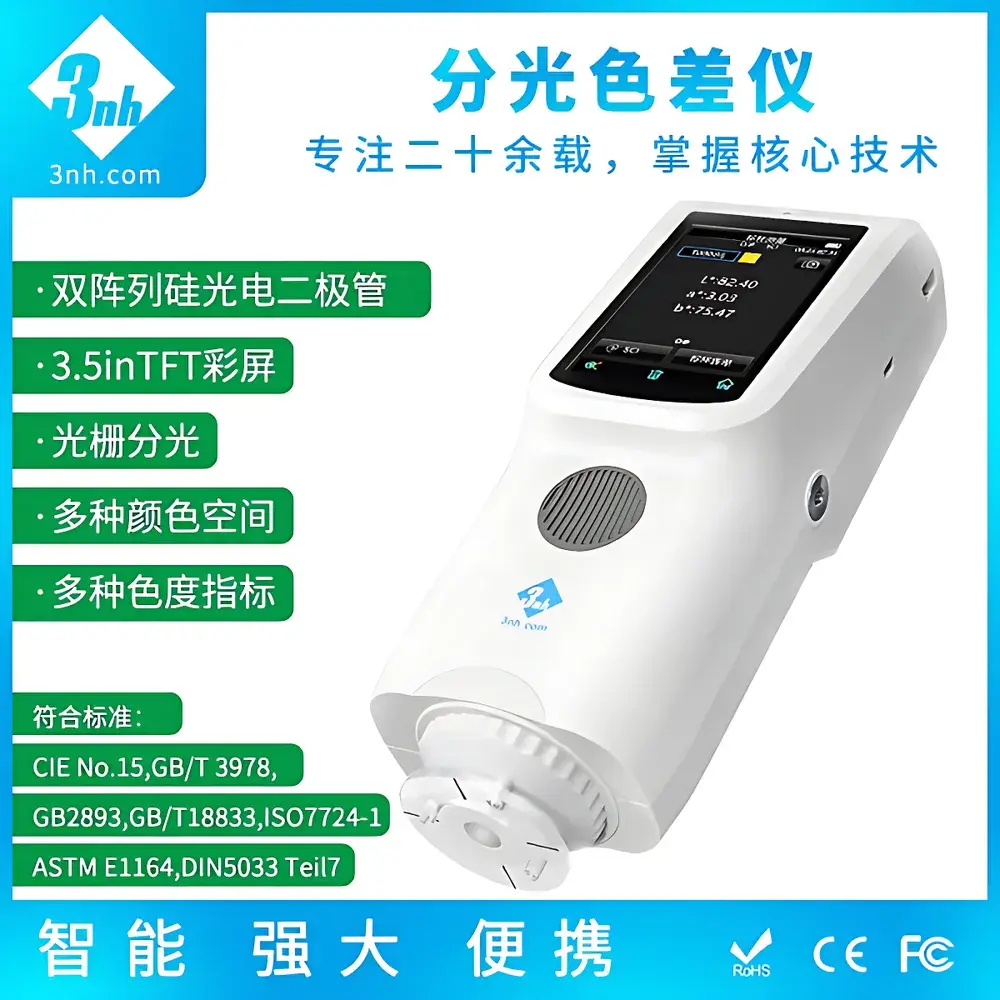
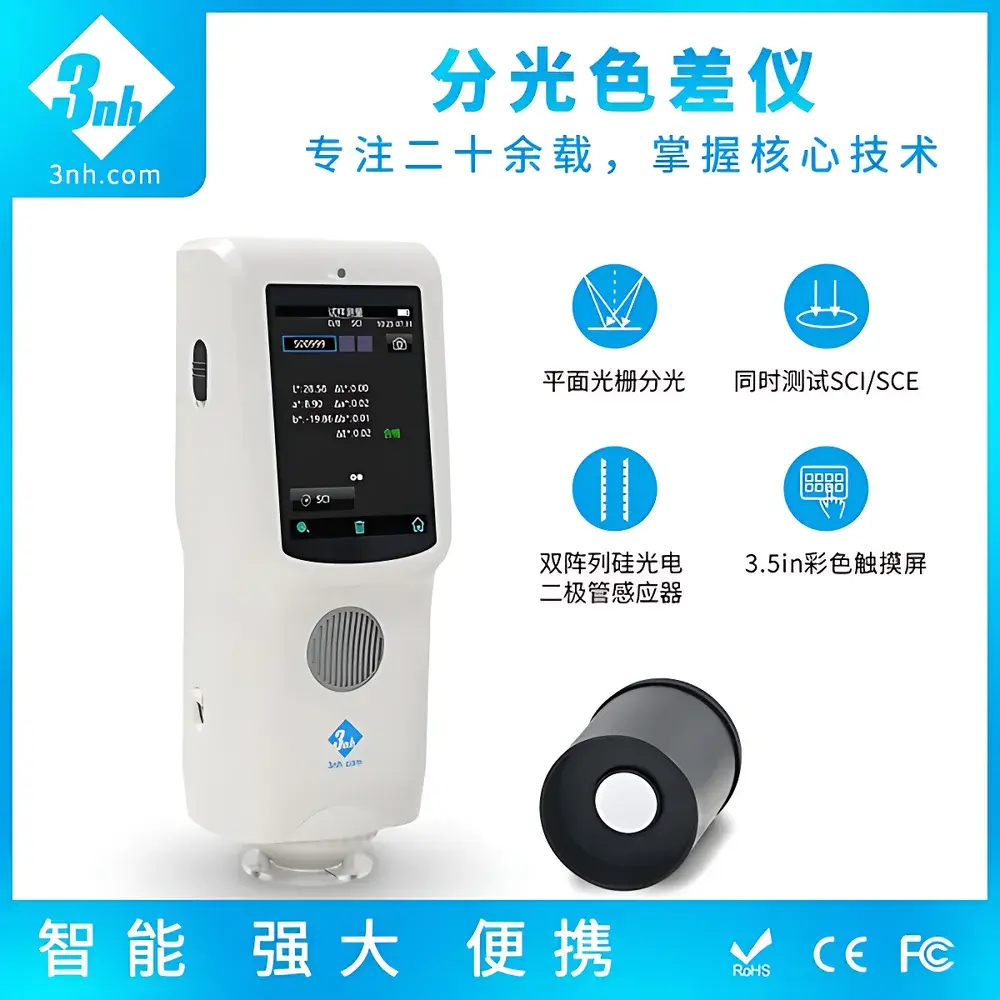
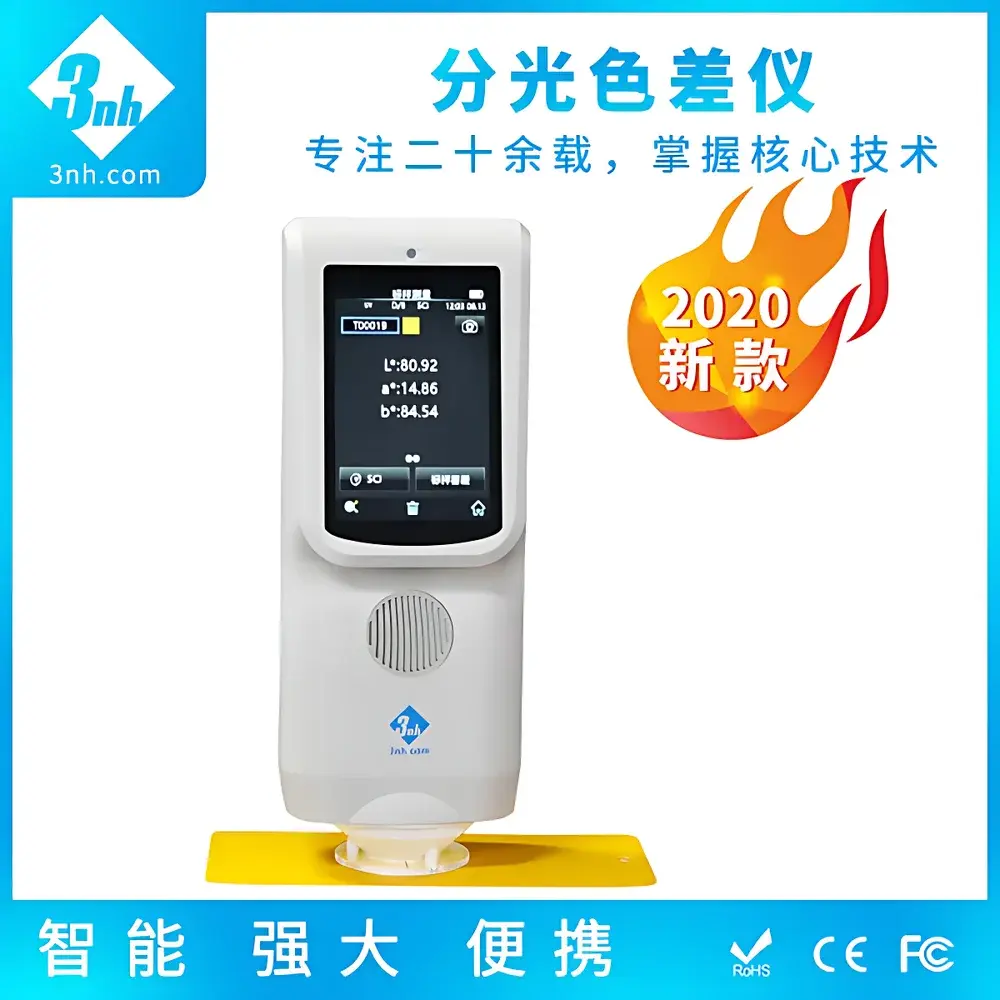
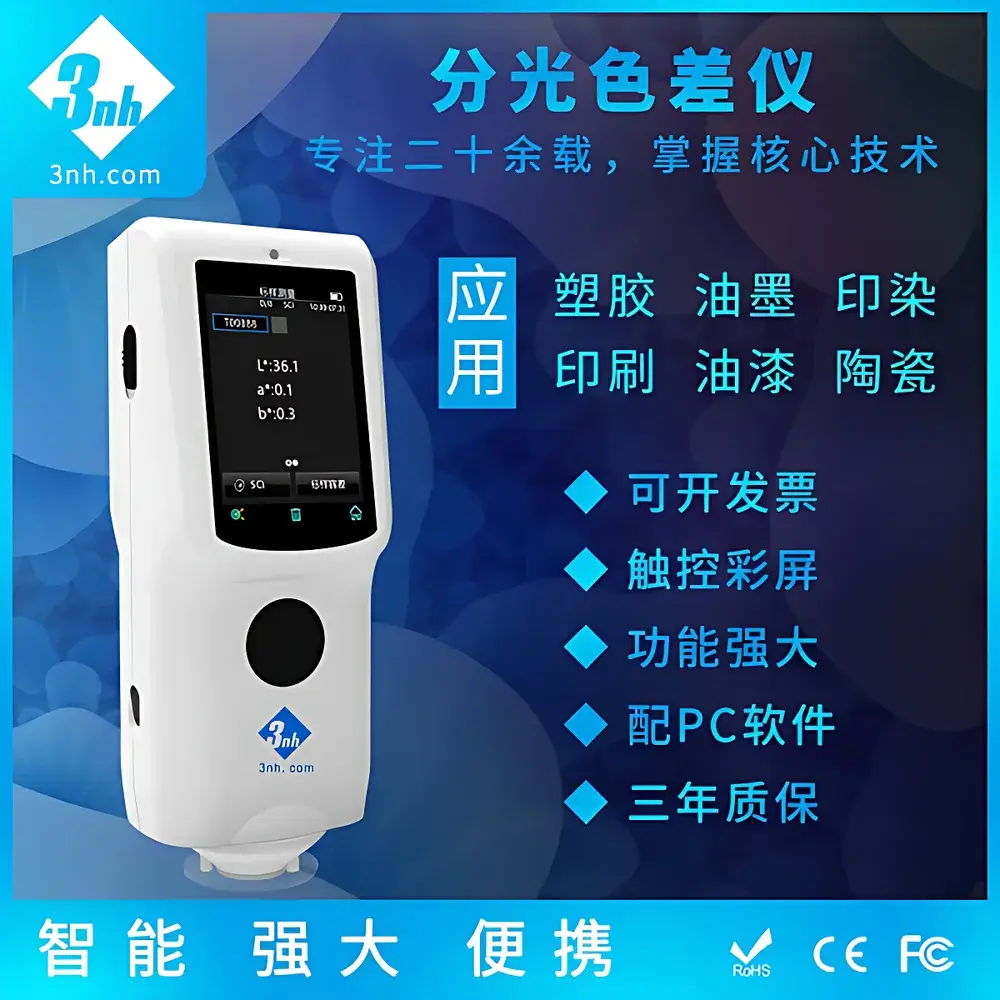
3nh TS10 Handheld Spectrophotometric Colorimeter for Ink and Plastic
| Brand | 3nh |
|---|---|
| Origin | Guangdong, China |
| Manufacturer Type | Direct Manufacturer |
| Product Category | Spectrophotometric Colorimeter |
| Instrument Type | Portable |
| Optical Geometry | d/8° Integrating Sphere |
| Illuminants | D65, A, F2 (CWF) |
| Spectral Range | 400–700 nm |
| Repeatability | ΔE*ab ≤ 0.1 (MAV/SCI, after warm-up and calibration, 30 measurements of white tile at 5 s intervals) |
Overview
The 3nh TS10 Handheld Spectrophotometric Colorimeter is an ISO-compliant, portable spectrophotometer engineered for high-precision color measurement and ΔE evaluation in industrial quality control environments. It operates on the CIE standard d/8° geometry with specular component included (SCI), enabling consistent measurement of both diffuse and mirror-reflected light—critical for evaluating textured, glossy, or semi-gloss surfaces common in ink formulation, plastic injection molding, automotive coatings, and packaging printing. Its core optical architecture integrates a planar diffraction grating and dual-row 24-element silicon photodiode array, delivering full-spectrum reflectance data from 400 nm to 700 nm at 10 nm resolution. Unlike tristimulus meters, the TS10 captures spectral reflectance curves, allowing traceable colorimetric calculations in CIE LAB, XYZ, Yxy, and LCh spaces—and supporting advanced analysis such as metamerism assessment and spectral similarity indexing. Calibration traceability aligns with national metrological standards (GB/T 3978, GB/T 18833) and international frameworks including CIE Publication No. 15, ISO 7724-1, ASTM E1164, and DIN 5033 Teil 7.
Key Features
- Φ8 mm measuring aperture optimized for small-area sampling across plastics, films, printed substrates, and molded components—compatible with industry-standard test patches and production-line fixtures.
- Dual-row 24-channel silicon photodiode array ensures high signal-to-noise ratio and stable spectral response; display resolution of 0.01 units for L*, a*, b*, and ΔE*ab supports fine-grained process tolerance verification.
- Integrated full-spectrum LED illuminants (D65, A, F2/CWF) provide stable, flicker-free, and long-life excitation (≥3 million measurements over 5 years), eliminating lamp degradation drift inherent in xenon or tungsten-halogen sources.
- Capacitive 3.5-inch TFT color touchscreen enables intuitive navigation without external software—ideal for cleanroom, shop-floor, or field use where PC connectivity is impractical or restricted.
- Onboard rechargeable lithium battery supports up to 6,000 measurements per full charge (≈8 hours continuous operation); device weight (460 g) and ergonomic form factor (81 × 71 × 214 mm) ensure fatigue-free handheld use during extended QA/QC shifts.
- Internal memory stores 500 reference standards and 10,000 sample records—including spectral data, color coordinates, pass/fail flags, and directional color difference vectors—with timestamp and operator ID tagging (where enabled via firmware update).
Sample Compatibility & Compliance
The TS10 accommodates flat, curved, and moderately textured non-transmissive samples—including solvent-based inks, UV-curable coatings, ABS/PC/PET plastics, textile dyeings, ceramic glazes, and laminated packaging films. Its SCI mode eliminates gloss-related variability, ensuring reproducible results across matte, satin, and high-gloss finishes. The instrument complies with GLP-relevant operational requirements: built-in white/black calibration verification, warm-up stabilization routines, and measurement repeatability validation protocols. While not FDA 21 CFR Part 11–certified out-of-the-box, its audit trail capabilities (via optional USB export logs) support integration into GMP-aligned color management workflows when paired with validated third-party LIMS or QMS platforms. All optical and electronic components meet RoHS Directive 2011/65/EU and IEC 61000-4 EMC immunity standards.
Software & Data Management
The TS10 operates autonomously but supports data export via USB-C interface (charging-only mode). Measurement files are saved in CSV format containing wavelength-resolved reflectance (%R), CIE tristimulus values, chromaticity coordinates, ΔE*ab/ΔE00 deviations against user-defined references, and pass/fail status per configurable tolerance (e.g., ΔE*ab ≤ 0.5). Though no proprietary desktop software is bundled, exported datasets integrate natively with Excel, MATLAB, JMP, and enterprise SPC systems. Firmware updates—delivered via microSD card—introduce new illuminant options, observer angles (10° standard), and compliance extensions (e.g., future support for ISO 12647-2 print standard reporting). Audit-ready metadata includes measurement timestamp, ambient temperature/humidity (logged internally), and serial-number-tracked calibration history.
Applications
- Ink manufacturing: batch-to-batch consistency verification of pigment dispersions and solvent-based gravure flexo inks under D65 and F2 lighting conditions.
- Plastic part production: real-time color matching of injection-molded housings (e.g., consumer electronics, automotive interiors) against master standards, minimizing scrap due to hue shift from thermal history or resin lot variation.
- Printing & packaging: press-side verification of CMYK spot color fidelity on paper, foil, and corrugated board—supporting ISO 12647-2 and GRACoL compliance checks.
- Textile dyeing: shade sorting of polyester, nylon, and cotton fabrics under multiple illuminants to assess metamerism risk prior to bulk shipment.
- Coatings R&D: spectral comparison of weathered vs. virgin panels to quantify UV-induced yellowness index (YI) and gloss retention loss.
FAQ
What is the difference between SCI and SCE measurement modes?
SCI (Specular Component Included) measures total reflectance, including both diffuse and mirror components—ideal for color formulation and standard matching. SCE (Specular Component Excluded) excludes gloss contribution and better simulates human visual perception under typical viewing conditions. The TS10 operates exclusively in SCI mode to ensure metrological consistency across instrument fleets.
Does the TS10 support color tolerance setting and pass/fail judgment?
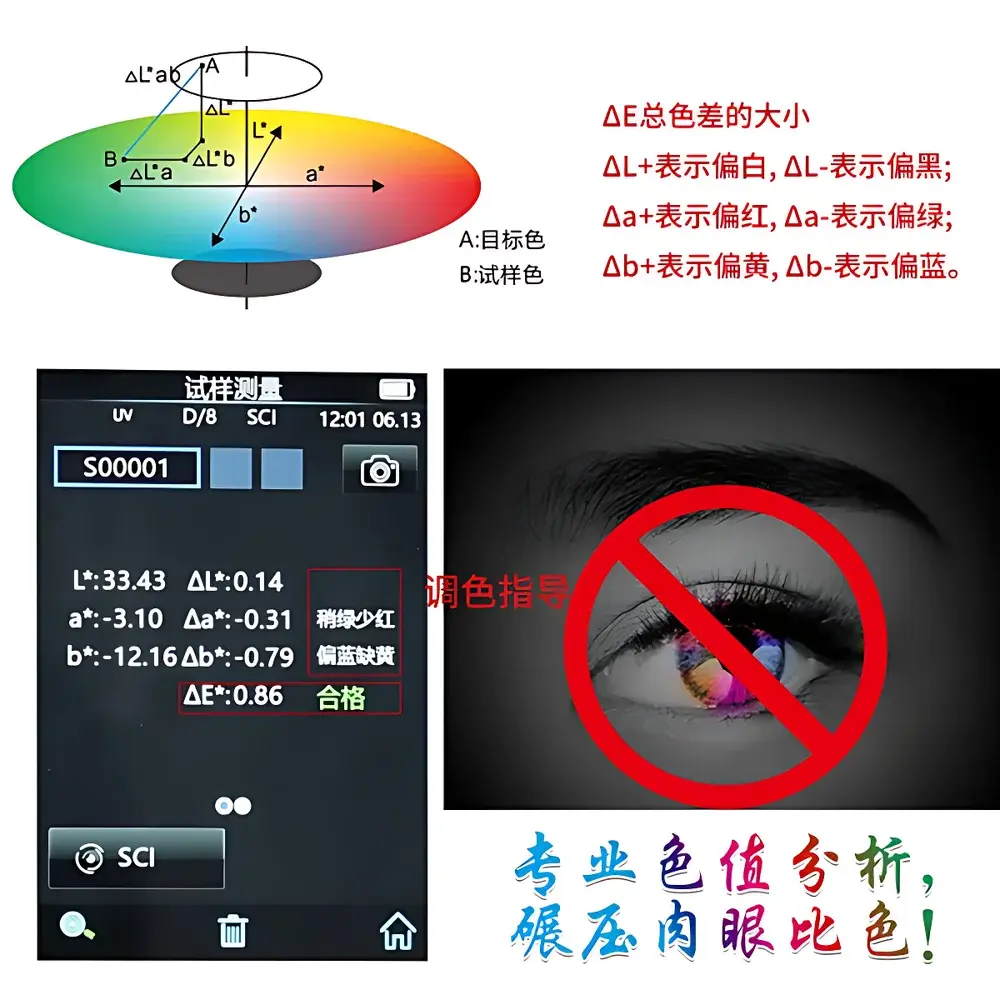
Yes. Users can define multi-axis tolerances (e.g., ΔL*, Δa*, Δb*, or composite ΔE*ab) for each stored standard. Results display “PASS” or “FAIL” directly on the touchscreen, with directional color deviation arrows indicating correction direction (e.g., “+a* → more red”).
How often does the instrument require recalibration?
Daily white/black calibration is recommended before first use and after significant ambient temperature shifts (>5°C). Factory calibration remains valid for 12 months under normal operating conditions (0–40°C, <85% RH), subject to annual verification using BCRA Series II tiles or NIST-traceable standards.
Can the TS10 measure translucent or textured samples?
It is designed for opaque, non-fluorescent, solid-color surfaces. Translucent films or heavily textured parts (e.g., brushed metal, sandblasted plastic) may yield elevated inter-instrument variability; such applications require empirical validation using representative reference materials.
Is spectral data export available for third-party analysis?
Yes. Each measurement exports full 400–700 nm reflectance data at 10 nm intervals in CSV format, enabling spectral derivative analysis, PCA clustering, and custom color difference metric computation in external analytical environments.




