
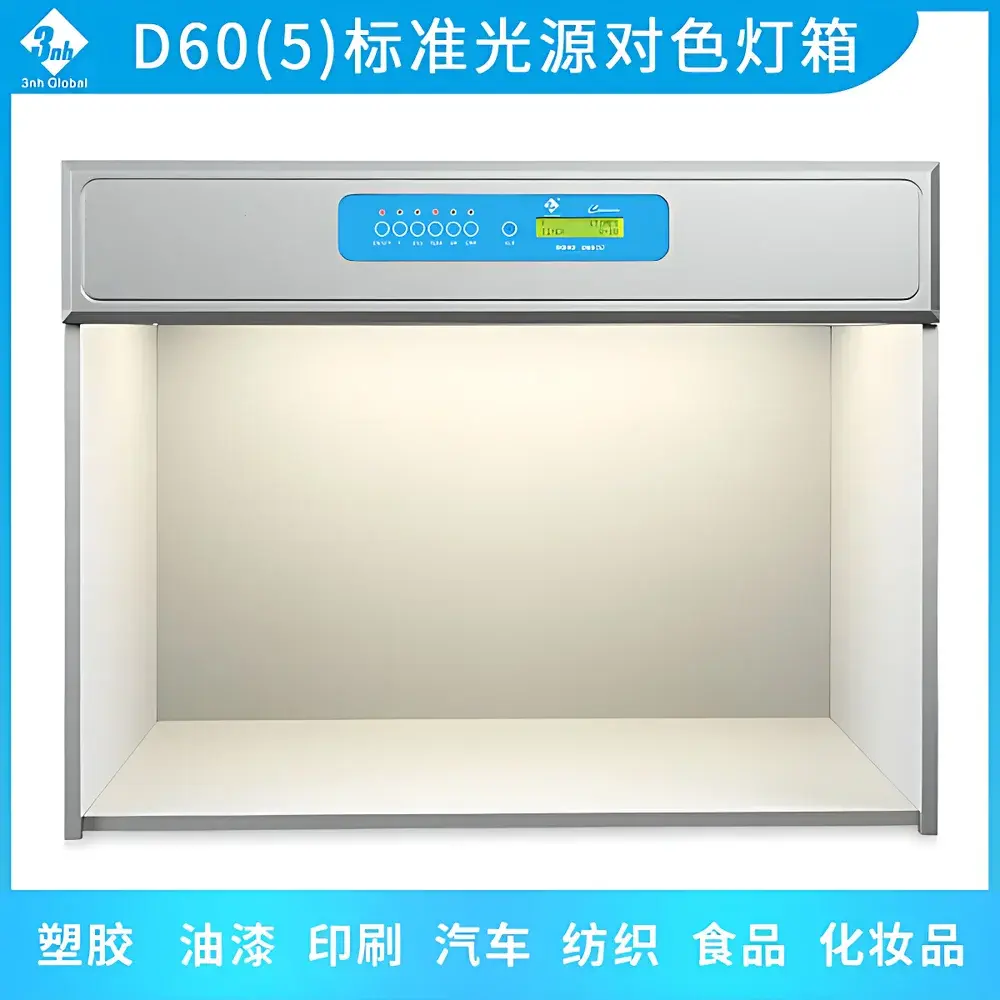
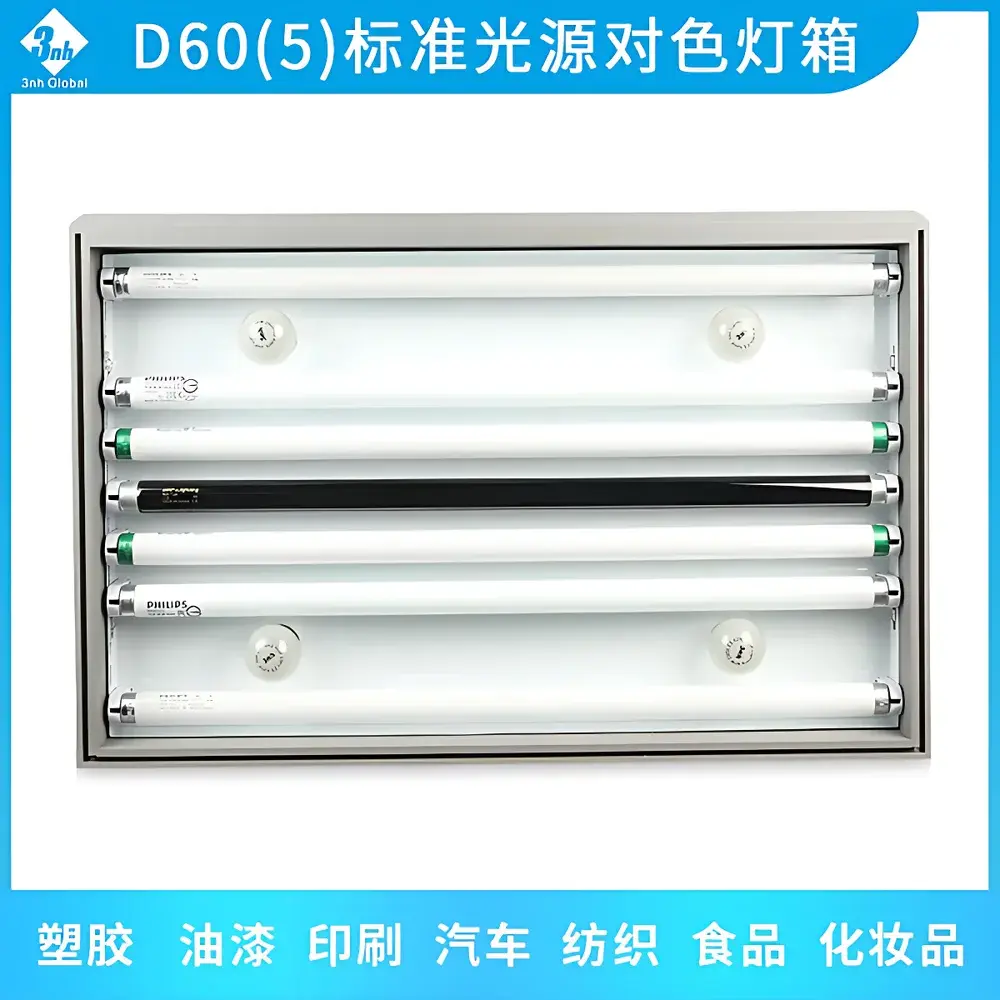
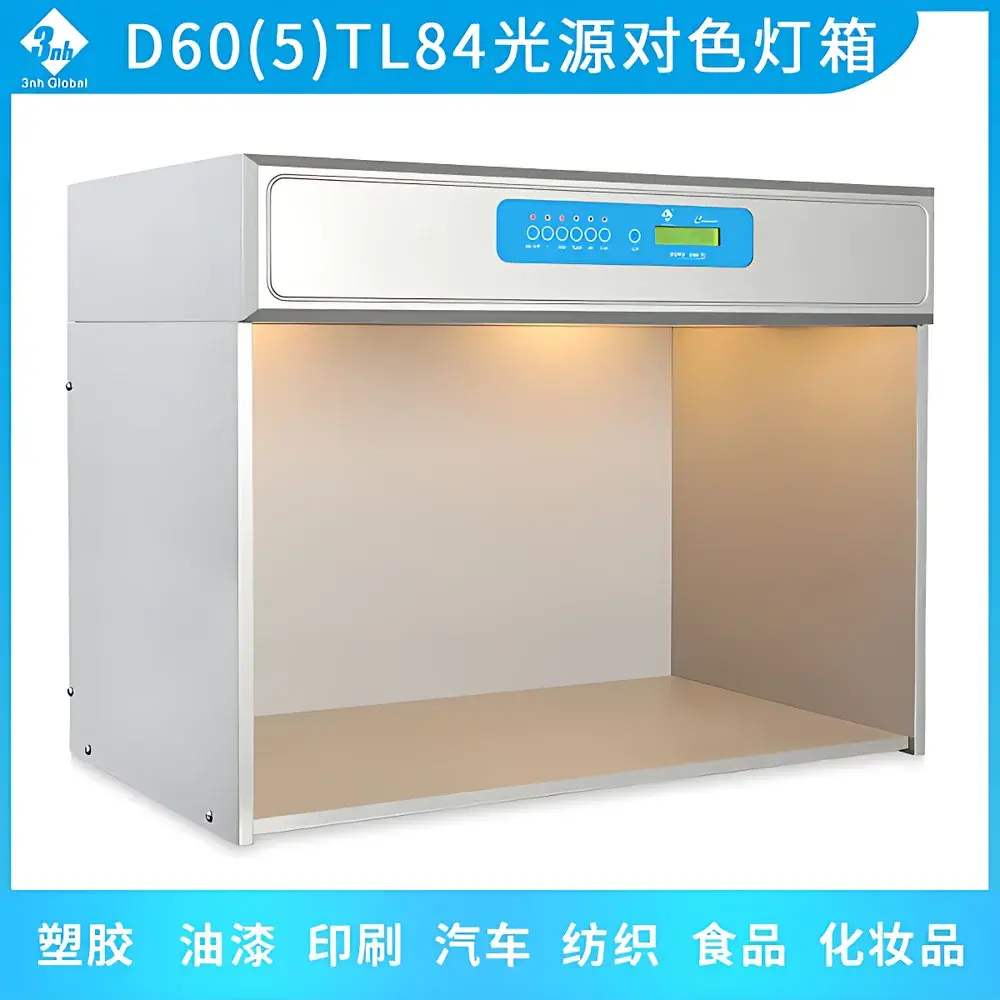
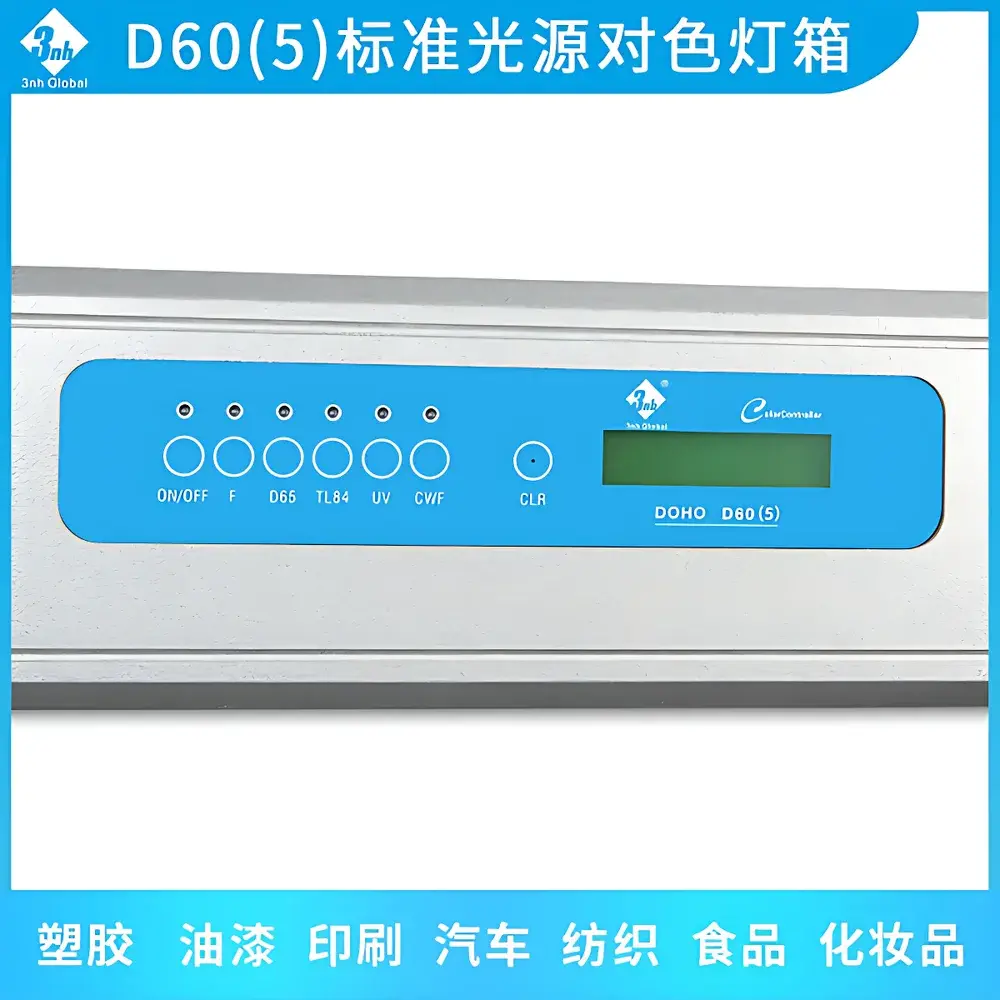
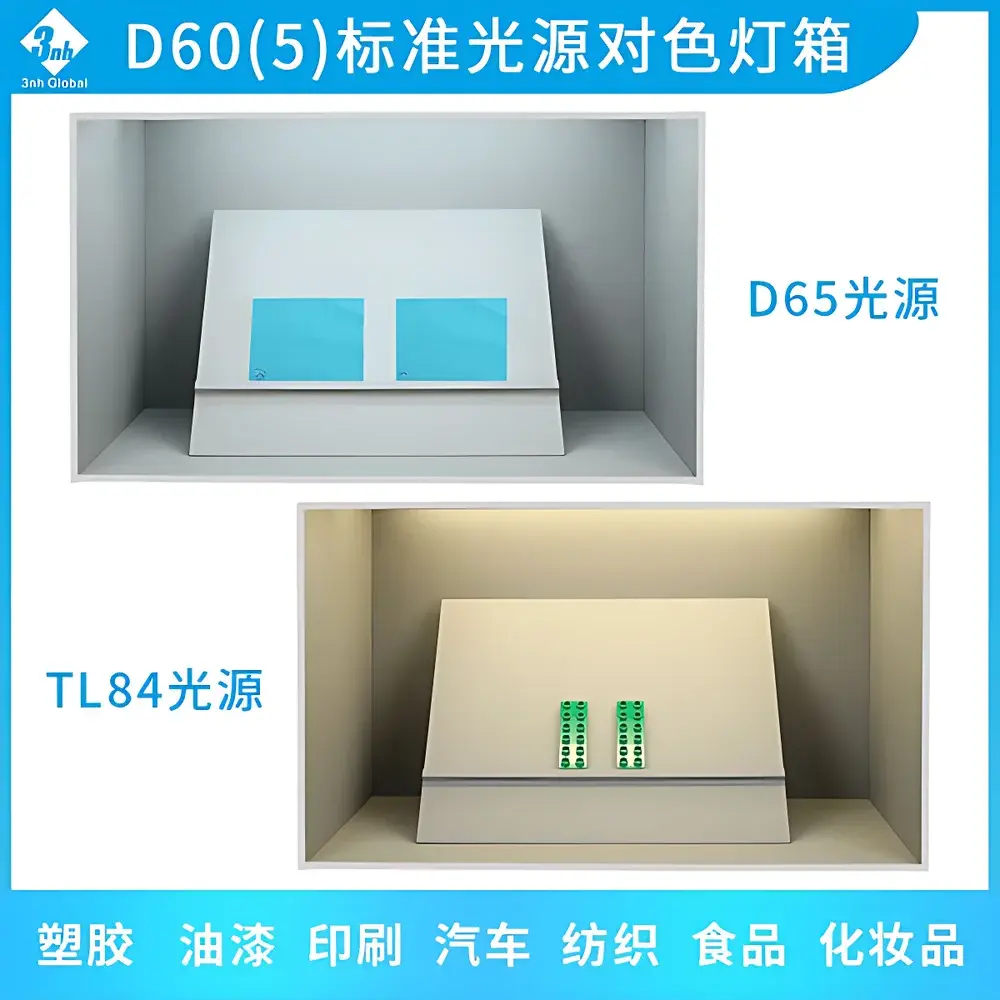
3nh DOHO D60(5) Standard Light Booth with Five Illuminants
| Brand | 3nh |
|---|---|
| Origin | Guangdong, China |
| Manufacturer Type | Direct Manufacturer |
| Model | D60(5) |
| Light Sources | D65 (6500K, 18W), TL84 (4000K, 18W), CWF (4150K, 18W), F (2700K, 40W), UV (365 nm, 18W) |
| Display | Individual & cumulative usage time per lamp |
| Switching | Fully automated, no warm-up required |
| Thermal Management | Passive cooling (no fan, zero heat buildup) |
| Power Efficiency | High luminous efficacy, low energy consumption |
| Compliance | Meets ISO 3664:2009, ASTM D1729, DIN 6173-2, and GB/T 3979–2008 requirements for color evaluation environments |
Overview
The 3nh DOHO D60(5) Standard Light Booth is an engineered solution for consistent, repeatable, and metrologically traceable color assessment under controlled illumination conditions. Designed in strict accordance with international standards—including ISO 3664:2009 for graphic technology and photography, ASTM D1729 for visual evaluation of color, and DIN 6173-2 for color matching in industrial applications—the D60(5) provides five precisely calibrated illuminants to simulate real-world viewing environments. Its optical architecture eliminates spectral discontinuities and temporal instability common in legacy fluorescent-based booths, delivering stable, flicker-free output from cold-cathode fluorescent lamps (CCFL) with certified spectral power distributions (SPDs). Unlike incandescent or halogen-based systems, the D60(5) requires zero warm-up time and maintains photometric stability within ±2% over 3,000 hours of operation—critical for QC labs conducting high-volume comparative evaluations across shifts or locations.
Key Features
- Fully automated illuminant switching via front-panel controls or optional foot switch—enabling rapid side-by-side comparison without manual lamp replacement or repositioning.
- Real-time digital display showing individual lamp operating hours and total system runtime—supporting preventive maintenance scheduling and GLP-compliant instrument logkeeping.
- No thermal drift: Passive thermal design eliminates forced-air cooling; surface temperature rise remains below 5°C above ambient during continuous operation—preserving sample integrity and operator comfort.
- High-efficiency CCFL technology delivers >85 lm/W luminous efficacy at rated wattage, reducing energy consumption by up to 40% compared to conventional tungsten-halogen booths of equivalent illuminance.
- Integrated anti-glare matte-black interior (Munsell N2.0) with diffuse reflectance <2%, minimizing stray light and ensuring uniform illumination across the 500 × 500 mm viewing area (IEC 61228 compliance).
- Compliant with CIE Publication 15:2018 for photometric measurement geometry and meets spectral irradiance tolerances specified in ISO/TR 16066:2016 for critical color judgment tasks.
Sample Compatibility & Compliance
The D60(5) accommodates rigid and flexible substrates up to 30 mm thick—including textiles, plastics, coatings, printed materials, ceramics, and automotive trim—with unobstructed access through a top-hinged, gas-spring-assisted lid. Its standardized 2° observer angle and 1000 lux ±50 lux D65 reference illuminance (measured at center of viewing plane) align with ISO 3664:2009 Class 1 requirements. All five illuminants are factory-calibrated against NIST-traceable spectroradiometric references and validated annually per ISO/IEC 17025 procedures when used in accredited laboratories. The booth supports audit-ready documentation for FDA 21 CFR Part 11 (when integrated with compliant LIMS), EU GMP Annex 11, and ICH Q5E color consistency protocols.
Software & Data Management
While the D60(5) operates as a standalone hardware platform, its usage logs (lamp hours, switch cycles, date/time stamps) are exportable via USB-C interface to CSV format for integration into laboratory information management systems (LIMS) or electronic lab notebooks (ELN). Optional firmware upgrade enables RS-232 or Ethernet connectivity for remote status monitoring and scheduled lamp lifecycle alerts. All calibration certificates include uncertainty budgets per ISO/IEC 17025:2017 Annex A.3, and raw spectral data (380–780 nm at 1 nm intervals) is available upon request for spectral metamerism analysis.
Applications
- Textile and apparel quality control: Detecting metamerism between dye lots under D65, TL84, and CWF—essential for global brand compliance (e.g., ZDHC MRSL, Higg Index).
- Printing and packaging: Verifying spot-color fidelity and process-color gamut rendering across substrate types under standardized lighting per ISO 12647-2.
- Automotive OEM supply chain: Evaluating paint and interior trim under F (2700K) for cabin ambiance simulation and UV for fluorescence detection in sealants or adhesives.
- Pharmaceutical packaging: Confirming label legibility and tamper-evident feature visibility under D65 and UV (365 nm) per USP and EU Annex 8 guidelines.
- R&D color formulation: Quantifying observer metamerism indices (MI) using paired illuminants to guide pigment selection and minimize batch-to-batch variation.
FAQ
Does the D60(5) require annual recalibration?
Yes—recommended annually or after 3,000 hours of cumulative use, per ISO/IEC 17025 and manufacturer specifications. Calibration includes spectral irradiance verification, illuminance uniformity mapping, and timer accuracy validation.
Can the UV lamp be used for fluorescence excitation quantification?
The 365 nm UV source meets CIE-defined UVA band requirements and is suitable for qualitative fluorescence assessment (e.g., optical brighteners, security inks); quantitative intensity measurement requires external spectroradiometric validation.
Is the D60(5) compatible with spectrophotometers from other manufacturers?
Yes—it provides standardized viewing geometry and illumination matching industry-grade spectrophotometers (e.g., X-Rite Ci7800, Konica Minolta CM-3700A) for correlative visual-instrumental color evaluation workflows.
What safety certifications does the unit hold?
CE marked per EN 61000-6-3 (EMC) and EN 61000-6-1 (immunity); RoHS 2011/65/EU compliant; electrical safety certified to IEC 61010-1:2010.
How is lamp aging compensated over time?
Each lamp’s operational history is logged independently; recommended replacement interval is 3,000 hours. Post-replacement, the system resets usage counters and retains historical logs for trend analysis and regulatory review.





