
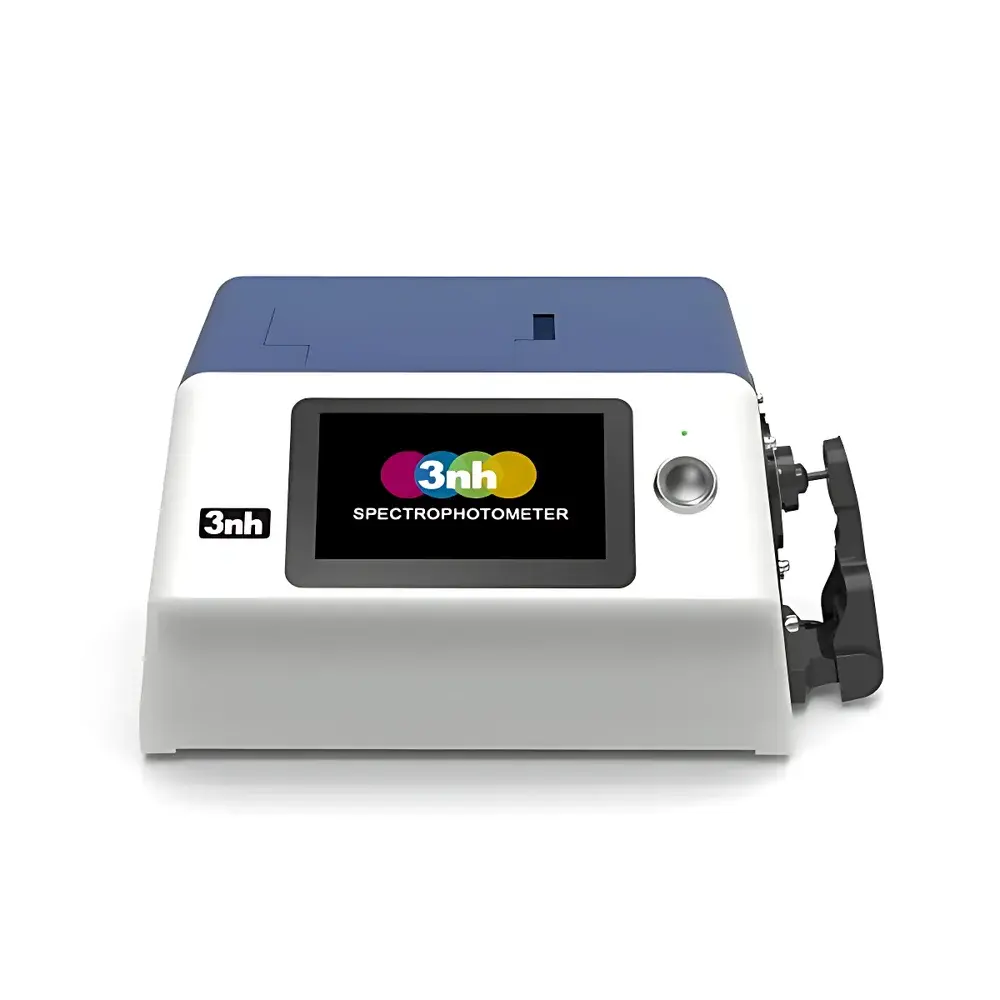
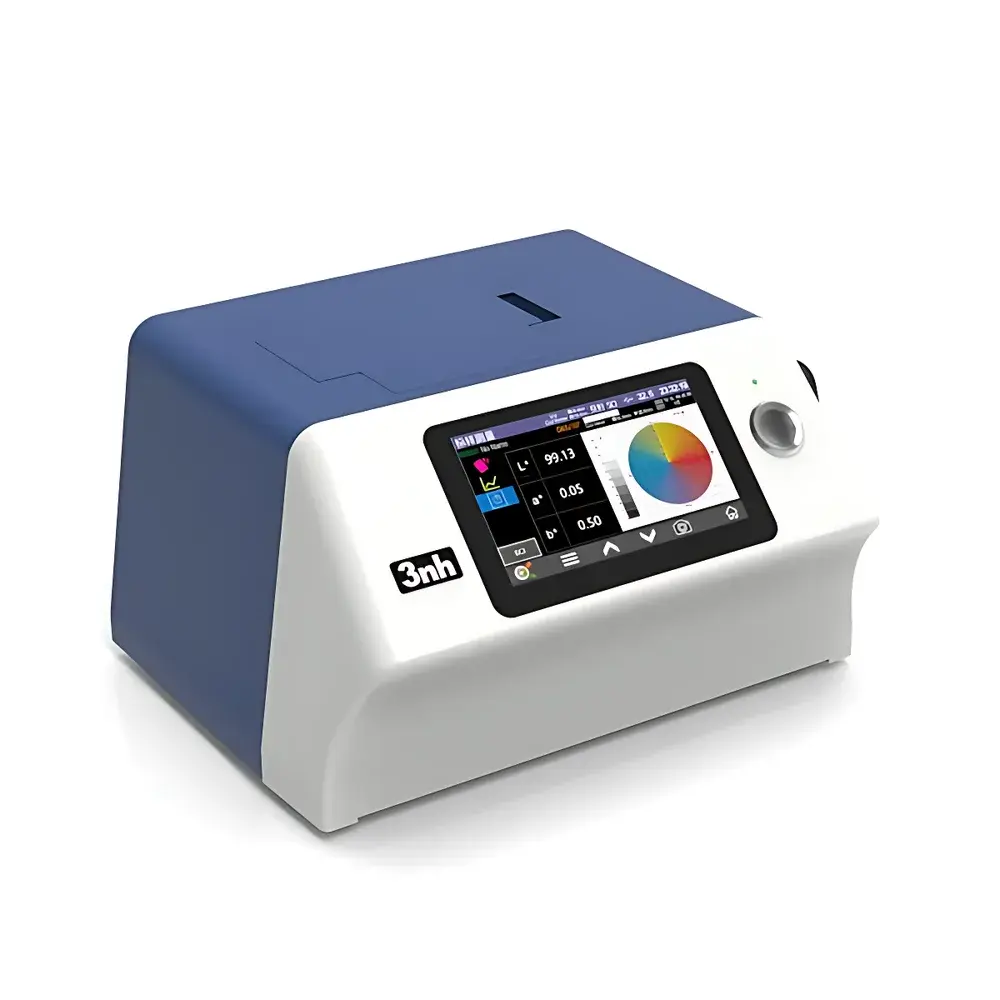
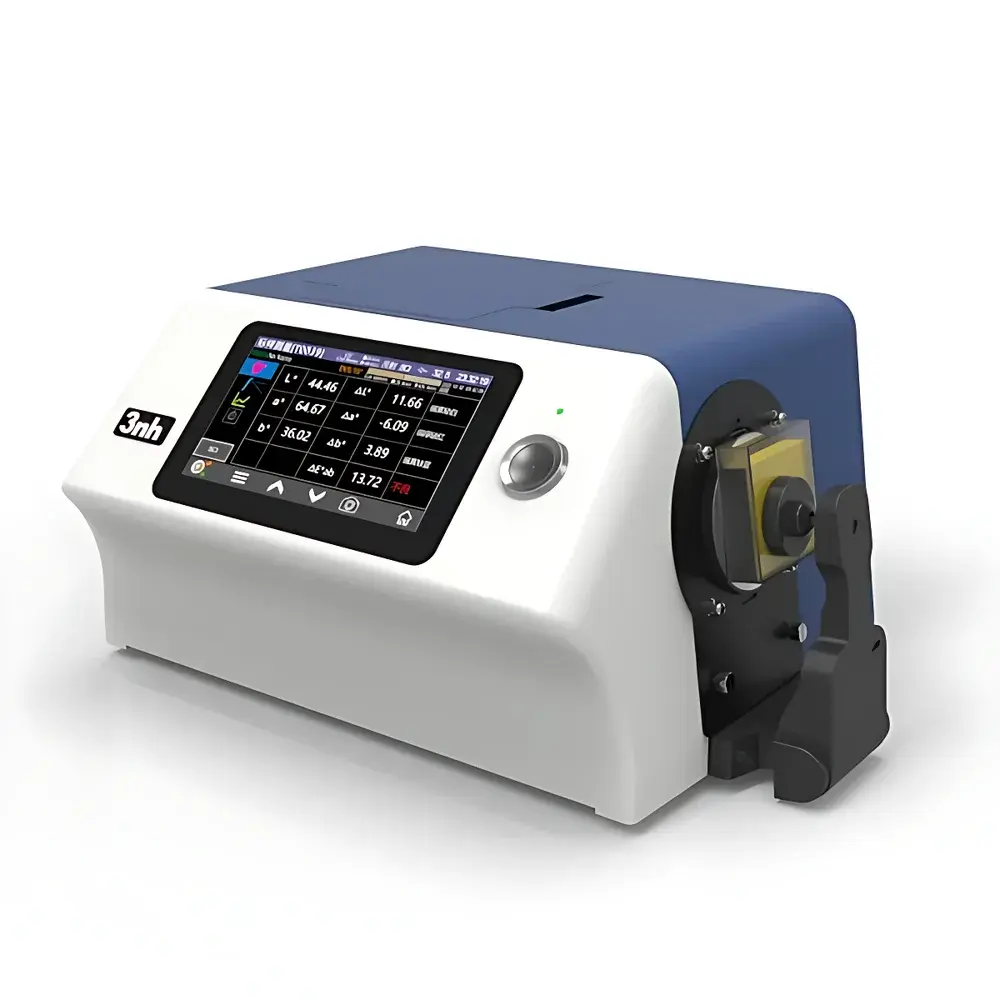
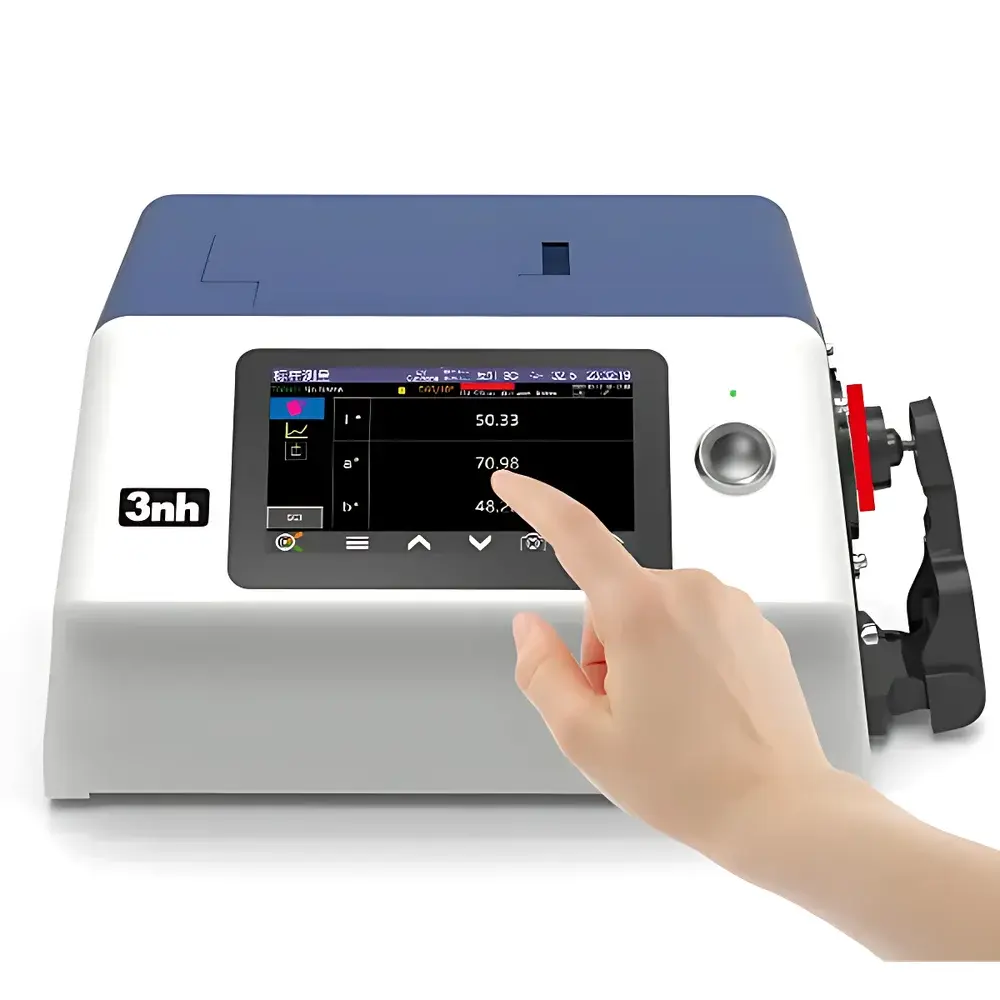
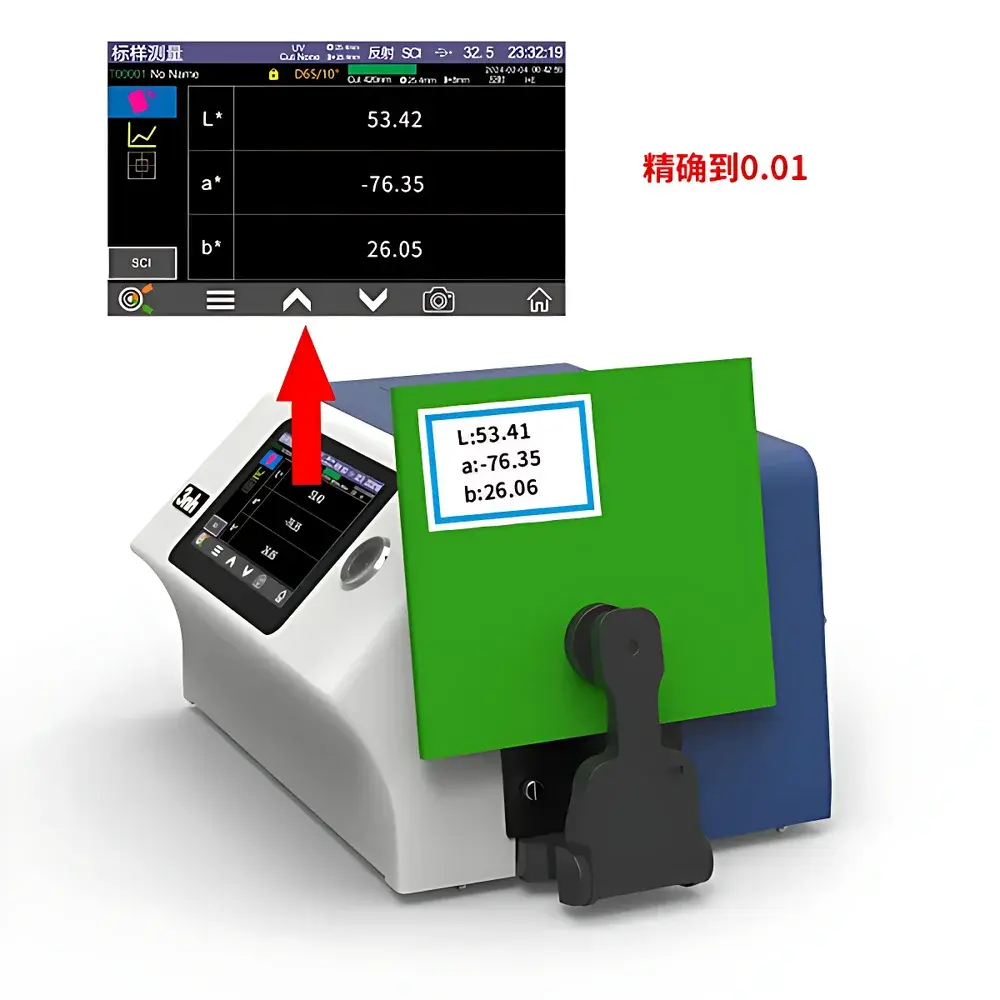
3nh TS8298 Desktop Spectrophotometer
| Brand | 3nh |
|---|---|
| Origin | Guangdong, China |
| Manufacturer Type | Direct Manufacturer |
| Product Category | Spectrophotometer |
| Instrument Type | Benchtop |
| Optical Geometry | d/8° integrating sphere |
| Light Source | Combined LED array (360–780 nm), UV-cut filter (400 nm cutoff) |
| Spectral Range | 360–780 nm |
| Repeatability | ΔE*ab ≤ 0.014 (Φ25.4 mm aperture, SCI mode, after warm-up and calibration, 30 measurements of white tile at 5 s intervals) |
Overview
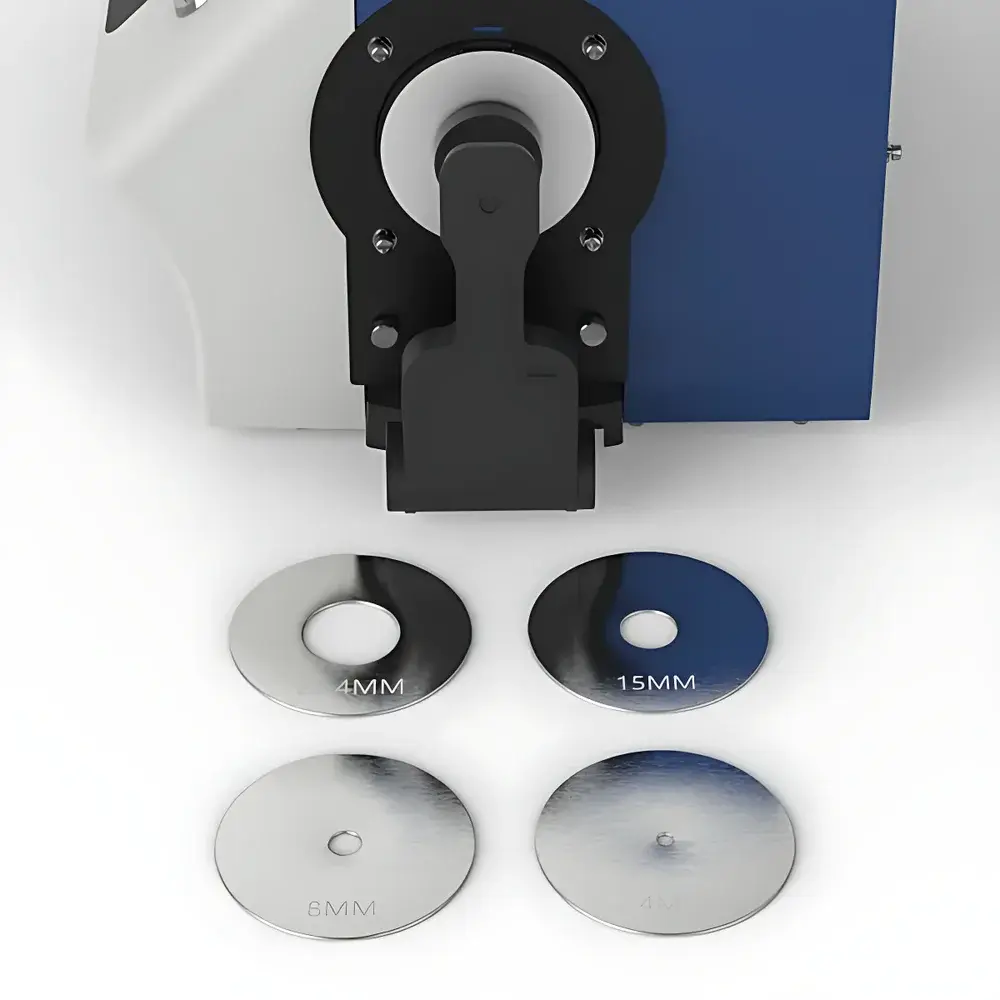
The 3nh TS8298 Desktop Spectrophotometer is a CIE-compliant benchtop color measurement system engineered for high-precision spectral analysis of reflective, transmissive, and semi-transparent materials. It operates on the fundamental principle of diffuse illumination with 8° viewing geometry (d/8°) in both specular component included (SCI) and excluded (SCE) modes—enabling separation of surface gloss effects from inherent color properties. For transmission measurements, it employs d/0° geometry per ASTM E308 and ISO 13655, supporting quantitative assessment of optical density, haze (per ASTM D1003), and spectral transmittance. The instrument integrates a dual-array 256-pixel CMOS detector with a concave holographic grating, delivering 10 nm spectral resolution and 5 nm FWHM bandwidth across the full 360–780 nm range—including near-UV extension critical for fluorescent and UV-reactive material evaluation. Its Φ154 mm integrating sphere ensures uniform illumination and high signal-to-noise ratio, while the motorized, auto-recognized aperture system (Φ25.4 mm, Φ15 mm, Φ8 mm, Φ4 mm) allows traceable, geometry-consistent measurements across diverse sample formats—from large painted panels to micro-textile swatches or liquid cuvettes.
Key Features
- Double optical path architecture supporting simultaneous d/8° reflectance and d/0° transmittance measurement—enabling comprehensive characterization of opaque, translucent, transparent, and fluorescent samples within a single platform.
- UV-controllable LED illumination: Full-spectrum (360–780 nm) source with integrated 400 nm cut-off filter for selective UV inclusion/exclusion—essential for evaluating optical brighteners and photostability compliance.
- Auto-recognizing multi-aperture system: Four interchangeable apertures (Φ25.4 mm, Φ15 mm, Φ8 mm, Φ4 mm) with mechanical lens positioning—ensuring NIST-traceable measurement geometry without manual recalibration.
- High-fidelity spectral acquisition: 10 nm data interval, ≤0.1% repeatability in spectral reflectance/transmittance, and ΔE*ab ≤ 0.014 (Φ25.4 mm, SCI) under controlled lab conditions—meeting ISO 17992 and ASTM D2244 repeatability benchmarks.
- Comprehensive colorimetric engine: Supports 12 color spaces (CIE LAB, XYZ, Yxy, LCh, CIE LUV, sRGB, HunterLab, βxy, DIN Lab99, etc.) and 9 industry-standard color difference formulas including CIEDE2000 (ΔE₀₀), CMC (1:1 & 2:1), DIN99, and ASTM D2244-compliant metrics.
- Extended chromaticity indices: Calculates whiteness (ASTM E313, CIE/ISO, AATCC), yellowness (ASTM D1925, D313), APHA/Pt-Co, Gardner, haze, gloss (8°), metamerism index (Mt), and textile-specific metrics (staining/colour change fastness, coverage power).
Sample Compatibility & Compliance
The TS8298 accommodates solid, liquid, powder, and film specimens via standardized fixtures—including transmission cell holders, petri dish adapters, and inverted sample mounts. Its optical design complies with CIE Publication No. 15:2018, ISO 7724-1:2019, ASTM E1164-22, DIN 5033-7, GB/T 3978–2008, and GB/T 18833–2019. For regulated industries, the system supports audit-ready workflows: measurement timestamps, operator ID logging, and calibration history tracking align with GLP and GMP documentation requirements. While not FDA 21 CFR Part 11–certified out-of-the-box, its raw spectral data export (ASCII .csv, .spc) enables integration into validated LIMS or ELN environments where electronic signatures and audit trails are managed externally.
Software & Data Management
The TS8298 operates with 3nh’s SQCX Quality Control Software—a Windows-based application designed for cross-functional color data governance. It provides statistical process control (SPC) charts, batch deviation analysis, pass/fail thresholding against master standards, and automated report generation (PDF, Excel). All spectral and tristimulus data are stored with full metadata: aperture used, illuminant/observer condition, measurement date/time, instrument serial number, and calibration status. The software supports multi-user role permissions, version-controlled standard libraries, and bidirectional sync with enterprise ERP/MES systems via ODBC or REST API. Raw spectral files retain full wavelength-by-wavelength intensity values—enabling post-acquisition re-evaluation under alternate illuminants or observers without remeasurement.
Applications
This spectrophotometer serves as a primary reference instrument in QC laboratories across sectors requiring metrological-grade color consistency: automotive OEMs validating interior trim pigments; pharmaceutical manufacturers assessing capsule shell hue per USP ; paint formulators optimizing TiO₂ dispersion; textile mills certifying dye lot conformance to AATCC Evaluation Procedure 1; and packaging converters verifying Pantone® spot color fidelity on flexible films. Its transmittance + haze capability is routinely applied in optical film certification (e.g., anti-glare coatings, OLED substrates), while UV-inclusive measurements support regulatory testing for UV stabilizers in agricultural plastics and medical device polymers.
FAQ
What standards does the TS8298 comply with for color measurement accuracy?
It adheres to CIE No. 15:2018, ISO 7724-1:2019, ASTM E1164-22, DIN 5033-7, and GB/T 3978–2008 for geometric and photometric performance validation.
Can the TS8298 measure fluorescent or optically brightened samples?
Yes—its 360–780 nm LED source includes near-UV output, and the UV-cut filter (400 nm cutoff) allows controlled excitation and exclusion of fluorescence contributions per ISO 13655:2017 Annex B.
Is inter-instrument agreement (IIA) supported for multi-site deployments?
Yes—inter-instrument agreement is specified at ΔE*ab ≤ 0.14 (Φ25.4 mm, SCI, BCRA Series II 12-tile average), enabling consistent color transfer across production facilities.
Does the system support Good Manufacturing Practice (GMP) documentation requirements?
While not Part 11–validated, its timestamped, operator-logged, calibration-audited data export meets foundational ALCOA+ principles (Attributable, Legible, Contemporaneous, Original, Accurate) for regulated environments.
How is aperture selection handled during operation?
Apertures are mechanically encoded and auto-detected upon insertion; no software configuration or recalibration is required—ensuring geometry integrity across measurement sessions.




