
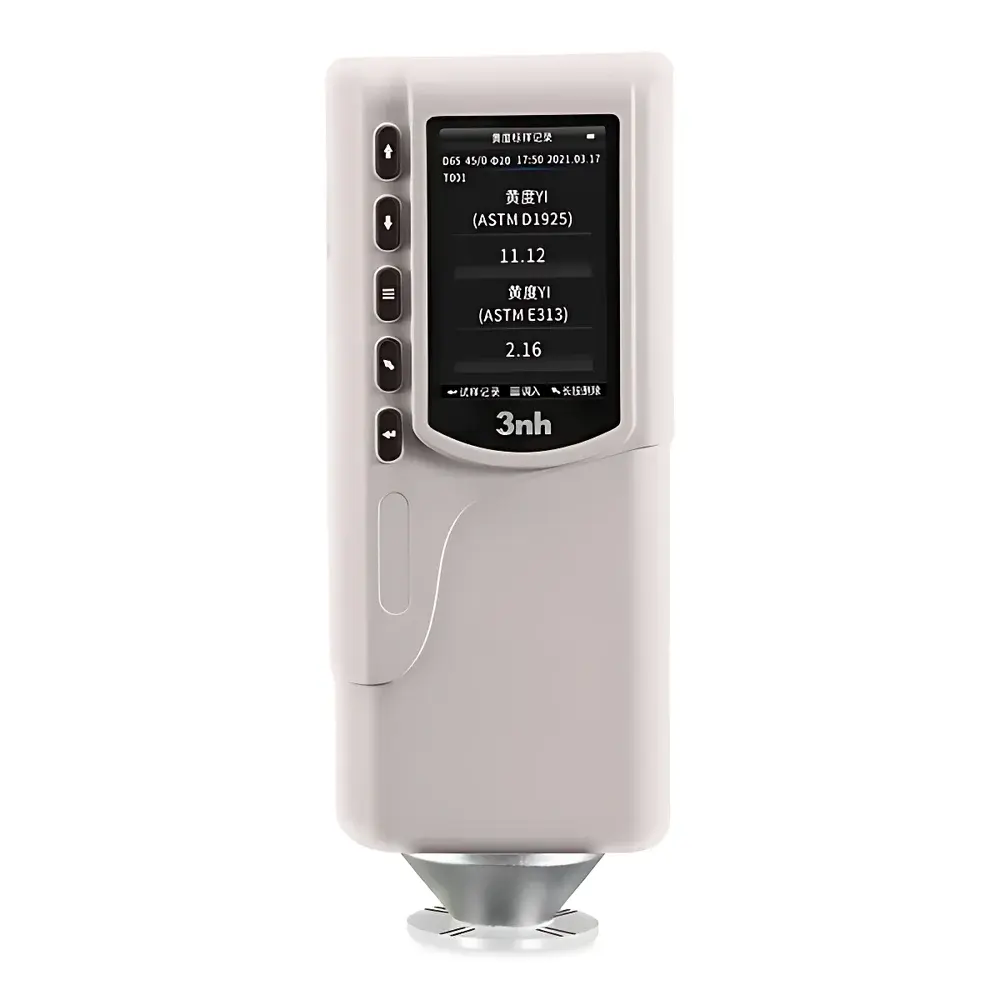
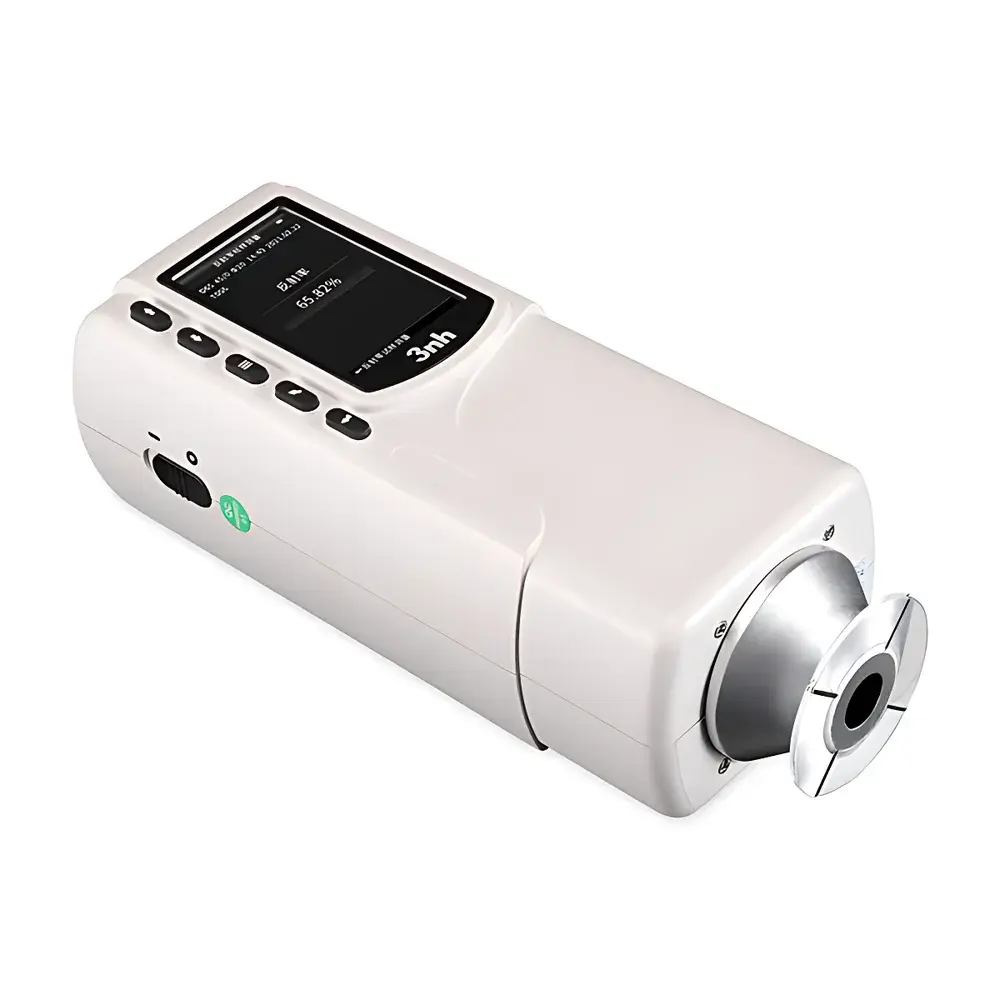
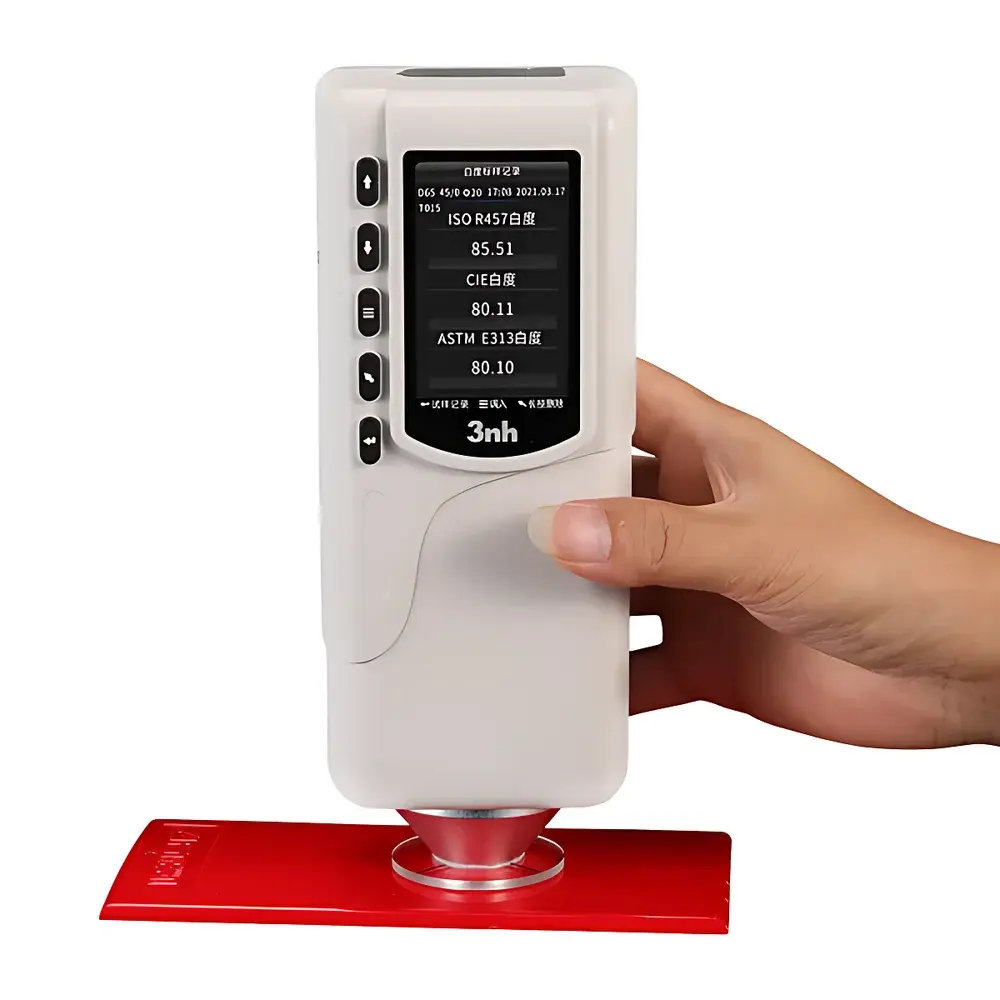
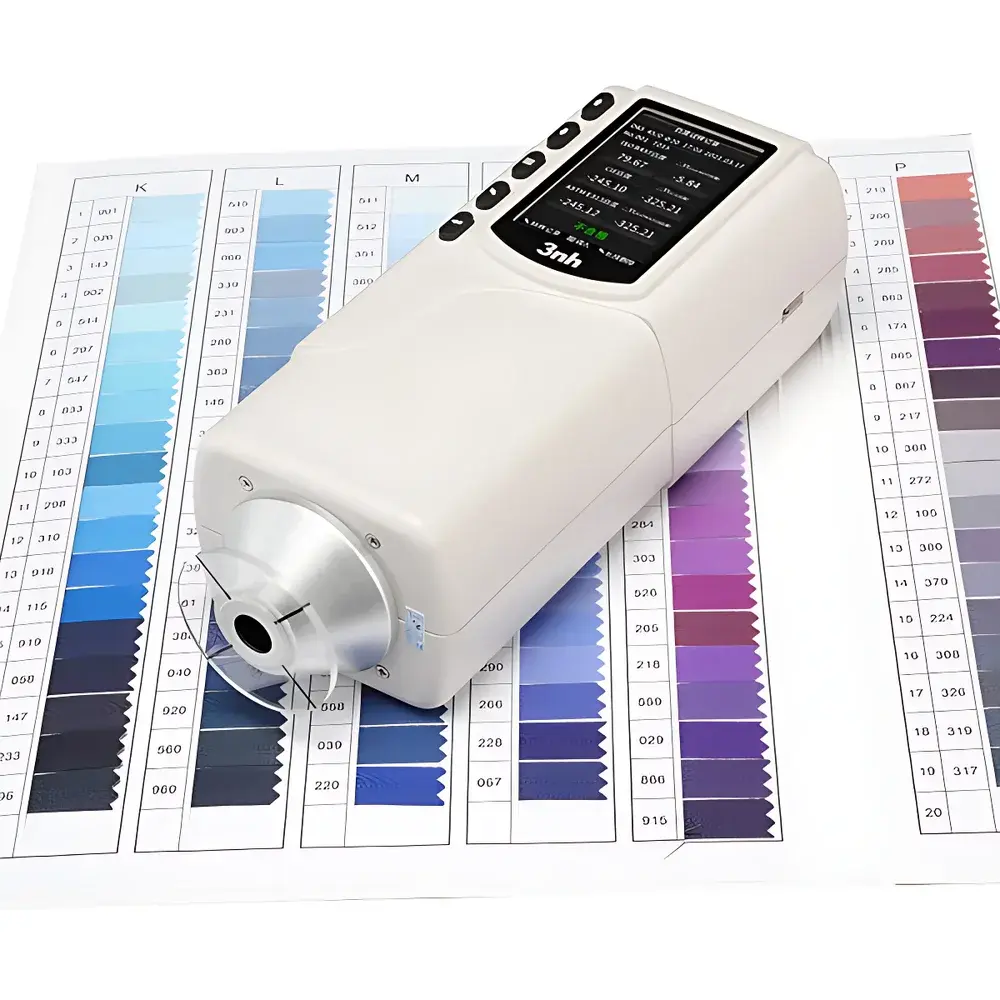
3nh NR4520 Powder Whiteness Meter (ISO R457, CIE & ASTM E313 Compliant)
| Brand | 3nh |
|---|---|
| Origin | Guangdong, China |
| Manufacturer Type | Direct Manufacturer |
| Country of Origin | China |
| Model | NR4520 |
| Illumination Geometry | 45/0 (45° incident / 0° viewing) |
| Compliance | CIE No. 15, GB/T 3978, ISO 2470-1, ASTM E313, CIE 1964 10° Standard Observer |
| Light Source | D65-simulating LED |
| Detector | Silicon photodiode with D65-weighted spectral response |
| Measurement Aperture | Φ20 mm (optional Φ10 mm) |
| Repeatability | ΔR ≤ 0.1 (after warm-up & calibration, 30 measurements on white tile at 5 s intervals) |
| Inter-instrument Agreement | ΔR ≤ 0.5 (BCRA Series II 12-tile average) |
| Measurement Time | 1.5 s |
| Display | 2.8″ TFT true-color LCD (16:9) |
| Data Storage | 100 standards + 5,000 samples |
| Power | Rechargeable Li-ion 3.7 V @ 3200 mAh |
| Operating Temperature | 0–40 °C |
| Storage Temperature | −20–50 °C |
| Dimensions | 205 × 67 × 80 mm |
| Weight | 400 g |
| LED Lifetime | >1.6 million measurements or ≥5 years |
Overview
The 3nh NR4520 Powder Whiteness Meter is a portable, high-stability optical instrument engineered for precise whiteness and colorimetric evaluation of powdered, granular, and flat solid specimens under standardized illumination and geometric conditions. It operates on the 45/0 illumination/viewing geometry—where light is directed at the sample surface from 45° relative to the normal, and reflected radiation is collected at 0° (normal incidence)—fully conforming to CIE Publication No. 15, GB/T 3978, and ISO 2470-1 for paper and board brightness testing. The device integrates a D65-illuminant–simulating LED source paired with a silicon photodiode detector whose spectral responsivity is weighted to match the CIE 1964 10° standard observer function. This configuration ensures metrological traceability in quantifying ISO R457 whiteness (commonly referenced as “ISO Brightness”), CIE whiteness (W10, TW10), ASTM E313 whiteness index, yellowness index (YI E313), and diffuse reflectance (%R) across the visible spectrum (approx. 400–700 nm). Designed specifically for routine quality control in production and inspection environments, the NR4520 delivers rapid, operator-independent results without requiring darkroom conditions or external PC connectivity.
Key Features
- Multi-standard whiteness calculation: Simultaneous computation of ISO R457, CIE W10/TW10, ASTM E313 WI/YI, and absolute reflectance (%)—all traceable to national and international reference standards.
- Fluorescence compensation capability: Enables accurate assessment of fluorescent whitening agent (FWA)-treated materials by isolating fluorescence contribution through spectral simulation and dual-mode calibration protocols.
- High repeatability and inter-instrument agreement: Achieves ΔR ≤ 0.1 (intra-unit repeatability) and ΔR ≤ 0.5 (inter-unit agreement per BCRA Series II 12-tile set), meeting requirements for comparative QC across distributed manufacturing sites.
- Robust 45/0 optical architecture: Eliminates directional bias associated with 0/45 or d/8 geometries, ensuring consistent measurement of textured, matte, or low-gloss powders—including talc, titanium dioxide, kaolin, starch, and pharmaceutical excipients.
- Onboard statistical processing: Supports up to 32 sequential readings per sample, automatically calculating mean, standard deviation, and pass/fail judgment against user-defined tolerance limits.
- Long-life D65 LED source: Rated for >1.6 million measurements or ≥5 years of continuous operation—significantly reducing recalibration frequency and maintenance downtime versus tungsten-halogen or xenon alternatives.
Sample Compatibility & Compliance
The NR4520 accommodates loose powders, pressed pellets, tablets, ceramic glazes, plastic granules, and flat-surface solids via its fixed Φ20 mm aperture (with optional Φ10 mm variant for small-area analysis). Its 45/0 geometry minimizes errors caused by surface texture, gloss variation, or particle scattering—an advantage over integrating sphere-based instruments when evaluating non-Lambertian materials. Regulatory alignment includes full compliance with ISO 2470-1 (paper brightness), ASTM E313 (whiteness/yellowness indices), CIE 15:2018 (colorimetry fundamentals), and GB/T 3978–2008 (standard illuminants and observers). While not FDA 21 CFR Part 11–enabled out-of-the-box, raw measurement data (including timestamps, operator IDs, and calibration logs) are exportable in CSV format for integration into validated LIMS or ELN systems supporting GLP/GMP audit trails.
Software & Data Management
Data capture and reporting are handled entirely onboard via a 2.8″ TFT color display with intuitive icon-driven navigation. The instrument stores 100 reference standards and up to 5,000 sample records—including spectral reflectance values, computed indices, pass/fail flags, and measurement metadata (date/time, ambient temperature). Although no proprietary PC software is bundled, exported CSV files contain structured columns compatible with Excel, MATLAB, JMP, and industry-standard SPC platforms. All calibration routines—including white tile verification, zero adjustment, and FWA mode activation—are password-protected and logged with timestamps to support internal QA documentation and external audits.
Applications
The NR4520 serves as a primary QC tool across regulated and industrial sectors where whiteness consistency directly correlates with product performance or regulatory acceptance. Key use cases include: monitoring TiO2 pigment batch uniformity in paint and coating manufacturing; verifying ISO R457 brightness of bleached pulp and paper grades; assessing FWA efficacy in detergent formulations; evaluating whiteness drift in ceramic frits and glazes during kiln firing; validating excipient whiteness in solid-dose pharmaceutical production (per USP <905> content uniformity guidance); and certifying salt, flour, sugar, and dairy powder whiteness for food-grade compliance. Its portability and battery operation make it suitable for line-side verification, warehouse inspection, and third-party lab cross-checking.
FAQ
Does the NR4520 require annual factory recalibration?
No—its LED-based optical system exhibits negligible drift over time. Users perform daily zero/white calibration using supplied tiles; full recalibration is recommended only after physical impact, extreme thermal cycling, or if inter-instrument agreement exceeds ΔR 0.5.
Can the NR4520 measure wet or oily powders?
It is designed for dry, free-flowing or compacted powders. Surface moisture or oil films will scatter incident light and invalidate R457 readings; samples must be conditioned to equilibrium humidity prior to measurement.
Is the Φ10 mm aperture available as a field-installable option?
Yes—the smaller aperture is offered as a factory-installed accessory; retrofitting requires mechanical replacement of the front baffle and firmware update to maintain geometric accuracy.
How does the instrument handle fluorescent brighteners in textile fibers?
While optimized for powders and planar surfaces, the NR4520 can quantify FWA contribution in homogeneous fiber mats when compressed into uniform thickness—provided the mat fills the measurement area completely and exhibits minimal translucency.
Are measurement uncertainties documented per ISO/IEC 17025?
Uncertainty budgets (k=2) are provided in the technical manual for each index (e.g., ±0.15 units for ISO R457, ±0.3 units for YI E313), derived from repeatability studies, reference tile certification, and detector linearity characterization.




