
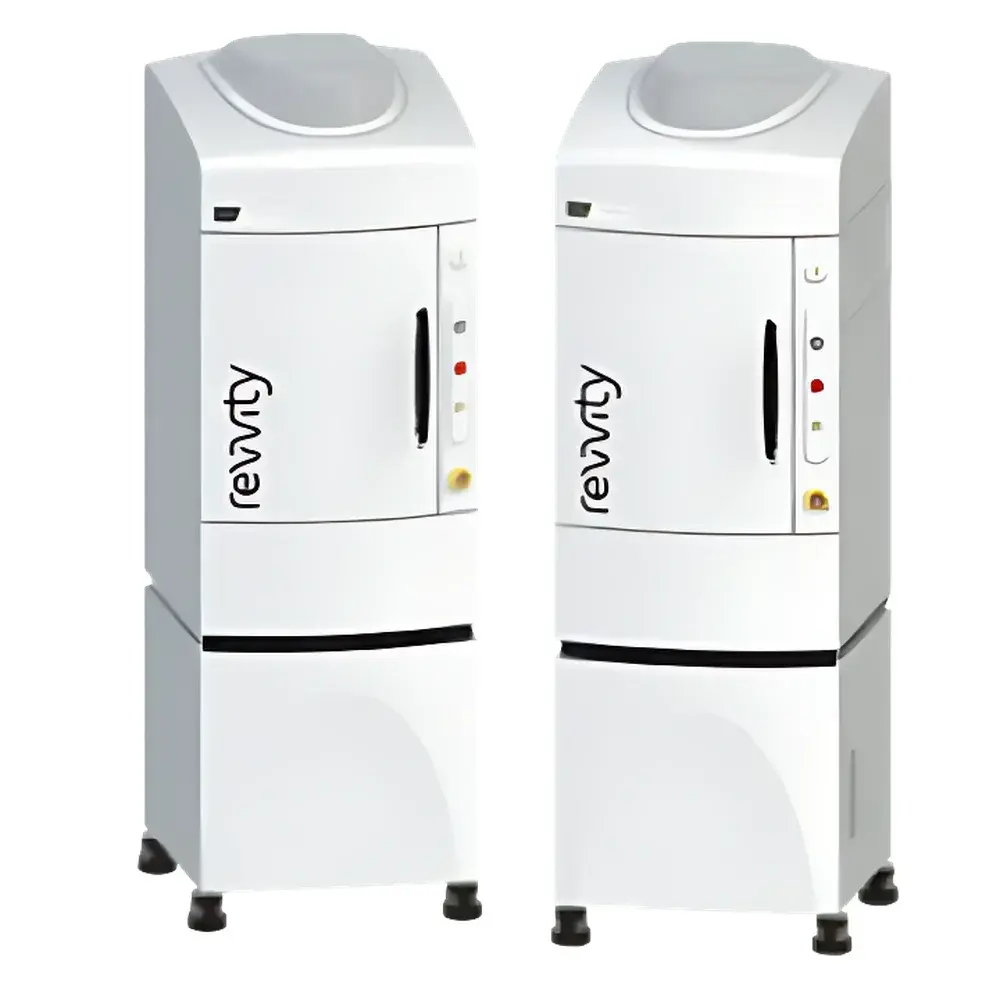
Revvity SpectrumBL High-Throughput Small Animal In Vivo Optical Imaging System
| Brand | Revvity |
|---|---|
| Origin | USA |
| Manufacturer | Revvity, Inc. |
| Product Type | Imported |
| Model | SpectrumBL |
| Imaging Modality | Bioluminescence, Chemiluminescence, Cerenkov Luminescence |
| Animal Model | Mouse (up to 10 simultaneously) |
| Spatial Resolution | ≤20 µm |
| 3D Tomographic Reconstruction | Yes |
| NIST-Traceable Absolute Radiometric Calibration | Yes |
| Software Platform | Living Image® v8.x |
| CT/MRI/PET/SPECT Data Fusion Capability | Yes |
| Upgrade Path | Compatible with IVIS® Spectrum fluorescence module |
Overview
The Revvity SpectrumBL High-Throughput Small Animal In Vivo Optical Imaging System is an engineered platform for quantitative, non-invasive, longitudinal optical imaging in murine models. It operates on the principle of photon detection from bioluminescent, chemiluminescent, and Cerenkov luminescent sources within living animals, leveraging cryogenically cooled (-90°C), back-illuminated CCD technology with high quantum efficiency (>95% at 600 nm) and a large-aperture f/0.95 lens assembly. Unlike conventional 2D planar imaging systems, SpectrumBL integrates proprietary 3D bioluminescent tomography (BLT) algorithms that reconstruct photon emission distributions in three dimensions by solving the forward model of light propagation in heterogeneous tissue—using anatomical priors derived from co-registered microCT or MRI data. This enables absolute quantification of source depth, volume, total flux (photons/sec), and estimated cell burden—critical for preclinical oncology, immunology, infectious disease, and regenerative medicine studies requiring rigorous spatial and temporal fidelity.
Key Features
- High-throughput imaging capacity: Simultaneous acquisition from up to 10 anesthetized mice using integrated isoflurane delivery and 10-position nose-cone array—reducing per-study acquisition time by ≥50% compared to single-animal workflows.
- Ultra-sensitive detection: Capable of resolving bioluminescent signals equivalent to <100 luciferase-expressing cells in vivo, validated using Firefly, Renilla, and bacterial luciferases under standardized NIST-traceable radiometric calibration.
- Multi-modal optical detection: Native support for bioluminescence, chemiluminescence, and Cerenkov luminescence without hardware modification; optimized spectral filtering and exposure control for each modality.
- Dynamic Cerenkov-enhanced tomography (DyCE™): Integrated software-guided acquisition protocol for time-resolved Cerenkov imaging of radiotracers (e.g., 18F-FDG, 64Cu, 89Zr), enabling pharmacokinetic mapping of radiopharmaceutical biodistribution across major organs within minutes post-injection.
- 3D bioluminescent tomography (BLT): Fully automated reconstruction pipeline incorporating mouse digital atlas segmentation, tissue optical property modeling (absorption/scattering coefficients), and iterative regularization to resolve deep-tissue sources with sub-millimeter localization accuracy.
- Multi-modality data fusion: Native export of reconstructed 3D optical volumes in DICOM format compatible with Quantitative Imaging Biomarkers Alliance (QIBA)-compliant microCT (e.g., Quantum FX), PET, SPECT, and MRI platforms for correlative structural-functional analysis.
Sample Compatibility & Compliance
SpectrumBL is validated for use with standard laboratory mouse strains (C57BL/6, BALB/c, nude, NSG) and supports both subcutaneous and orthotopic tumor models, intracardiac/intravenous/intraperitoneal cell injections, and pathogen challenge models (e.g., uropathogenic E. coli, S. pneumoniae, S. aureus). All optical measurements adhere to ASTM E2594–21 standards for bioluminescence assay validation and ISO/IEC 17025:2017 requirements for measurement traceability. The system’s NIST-traceable absolute radiometric calibration ensures inter-laboratory reproducibility and regulatory acceptability in GLP-compliant toxicology and IND-enabling efficacy studies. Data integrity is maintained through FDA 21 CFR Part 11–compliant audit trails, electronic signatures, and role-based access control within Living Image® software.
Software & Data Management
Living Image® v8.x serves as the unified acquisition, processing, and reporting environment. It includes automated acquisition wizards for BL/CL/Cerenkov modalities, batch-processing pipelines for multi-animal datasets, and QIBA-aligned quantification templates. The software supports DICOM-SR structured reporting, export to HDF5/NIFTI for machine learning preprocessing, and integration with LIMS via RESTful API. Audit logs record all parameter changes, ROI definitions, and reconstruction settings with timestamps and user IDs. Raw image data are stored in vendor-neutral TIFF format with embedded EXIF metadata (exposure time, binning, lens aperture, temperature), ensuring long-term archival compliance per NIH Data Management and Sharing Policy (NOT-OD-21-013).
Applications
- Oncology: Longitudinal monitoring of orthotopic glioblastoma (GL261-luc2), metastatic breast cancer (MDA-MB-231-luc-D3H2Ln), and lung carcinoma (NCI-H460-luc2) with 3D quantification of tumor burden and micrometastatic dissemination.
- Infectious disease: Real-time tracking of bacterial load dynamics in urinary tract infection, pneumococcal pneumonia, and meningitis models using luxCDABE-expressing pathogens.
- Cell therapy & regenerative medicine: Quantitative engraftment assessment of luciferase-labeled stem cells in myocardial infarction or spinal cord injury models.
- Radiopharmaceutical development: Dynamic Cerenkov imaging of 18F-, 64Cu-, and 89Zr-labeled antibodies and small molecules to validate target engagement and off-target accumulation.
- Toxicology: Detection of hepatic or renal stress responses via inducible luciferase reporters (e.g., HSP70-luc, NF-κB-luc) following compound administration.
FAQ
What animal models are supported?
The SpectrumBL system is optimized for mice (up to 30 g); compatibility with juvenile rats (≤150 g) is achievable with optional positioning fixtures and software-defined ROI scaling.
Is the system compliant with FDA 21 CFR Part 11?
Yes—Living Image® v8.x implements full electronic signature functionality, audit trail generation, and secure user authentication meeting Part 11 requirements for regulated preclinical studies.
Can I perform longitudinal studies across multiple time points?
Absolutely—the system supports automated registration of serial 3D reconstructions using anatomical landmarks, enabling voxel-wise change analysis of signal intensity, volume, and spatial distribution over weeks or months.
How does 3D tomographic reconstruction differ from standard 2D imaging?
2D imaging provides relative signal intensity and approximate location; 3D BLT solves the inverse problem of light transport to localize and quantify photon sources in 3D space—including depth, volume, and absolute flux—using co-registered anatomical priors.
Is microCT fusion mandatory for 3D reconstruction?
No—while microCT significantly improves reconstruction accuracy by defining tissue boundaries and optical properties, the system can perform atlas-based BLT using the built-in Digimouse model when CT data are unavailable.




