
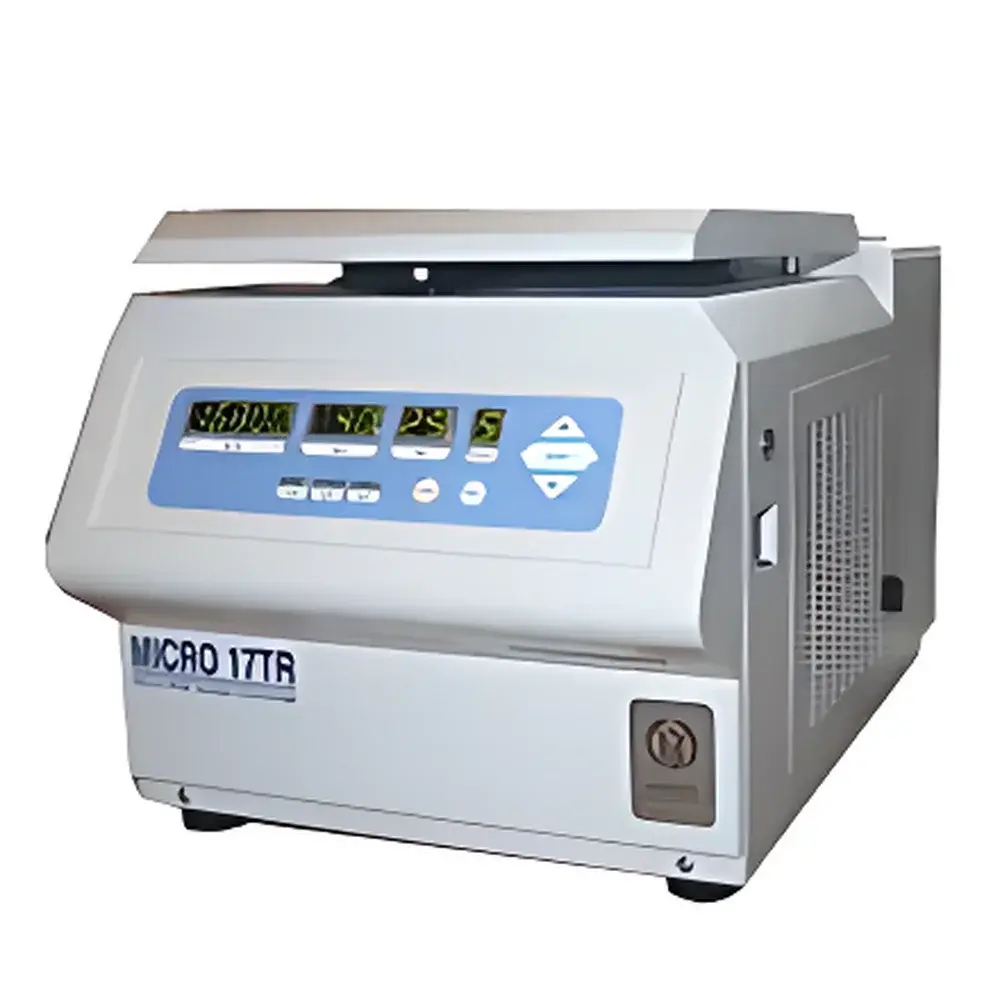
Hanil Micro17TR High-Speed Benchtop Centrifuge
| Brand | Hanil |
|---|---|
| Origin | South Korea |
| Model | Micro 17TR |
| Max Speed | 17,000 rpm |
| Max RCF | 25,525 × g |
| Max Capacity | 24 × 1.5/2.0 mL tubes |
| Temperature Range | −20 °C to +40 °C |
| Timer Range | 1–99 min |
| Control Interface | Digital display for speed, RCF, time, program, and temperature |
| Power Supply | 220 V, 60 Hz, single-phase, 0.8 kW |
| Dimensions (W×D×H) | 335 × 522 × 216 mm |
| Weight | 52 kg |
Overview
The Hanil Micro17TR High-Speed Benchtop Centrifuge is a precision-engineered refrigerated centrifuge designed for routine and demanding laboratory separation tasks requiring high rotational speeds and precise thermal control. Based on Couette-flow rotor dynamics and optimized aerodynamic chamber design, the Micro17TR delivers consistent sedimentation performance across diverse sample types—including cell lysates, nucleic acid preparations, plasma fractions, and microvolume biological suspensions. Its compact footprint and robust mechanical architecture make it suitable for shared core facilities, QC laboratories, and academic research environments where space efficiency, operational reliability, and regulatory traceability are essential. Engineered for continuous duty cycles under GLP-compliant workflows, the unit integrates real-time thermal stabilization with dynamic imbalance compensation—ensuring reproducible pelleting efficiency even during extended runs at maximum rated speed.
Key Features
- Microprocessor-based control system with full digital interface displaying real-time RPM, RCF, elapsed time, programmed run parameters, and chamber temperature
- Brushless AC motor delivering maintenance-free operation, low acoustic emission (<58 dB(A) at 17,000 rpm), and extended service life without carbon brush replacement
- Active refrigeration system with dual-stage Peltier cooling and insulated chamber wall design, enabling stable temperature maintenance from −20 °C to +40 °C across all speed ranges
- Three-step acceleration/deceleration profile selection (Slow/Normal/Fast) for sensitive sample integrity preservation and rotor longevity optimization
- Integrated safety interlock mechanism preventing lid opening during operation and automatically halting rotation upon door detection failure
- Comprehensive fault diagnostics: visual and audible alerts for imbalance detection, lid-open events, temperature deviation beyond setpoint ±2 °C, overspeed conditions, and timer expiration
- Thermal limit input function allowing user-defined upper/lower bounds to prevent unintended thermal excursions during unattended operation
Sample Compatibility & Compliance
The Micro17TR accommodates standard microcentrifuge tubes (1.5 mL and 2.0 mL) in fixed-angle rotors, supporting common polypropylene and PCR-grade tube formats. It complies with IEC 61010-1:2010 for laboratory electrical equipment safety and meets electromagnetic compatibility requirements per EN 61326-1:2013. While not certified for biosafety containment (e.g., BSL-2+), its sealed rotor chamber and condensation management system minimize aerosol generation risks during routine use. The instrument supports audit-ready operation in regulated environments through timestamped event logging of start/stop times, temperature deviations, and error codes—aligning with basic data integrity expectations under FDA 21 CFR Part 11 Annex 11 principles when paired with external LIMS integration.
Software & Data Management
The Micro17TR operates as a standalone instrument with no proprietary PC software dependency. All operational parameters—including up to 10 user-programmable protocols—are stored in non-volatile memory with power-loss retention. Event logs (including error timestamps, temperature drift history, and cycle count) are accessible via front-panel navigation and persist across power cycles. For laboratories requiring electronic record archiving, optional RS-232 or USB-to-serial adapters enable ASCII-formatted output of run metadata to external data loggers or validated CSV export tools compatible with ELN platforms. No cloud connectivity or remote access functionality is embedded—ensuring full data sovereignty and simplifying IT validation pathways.
Applications
- Routine nucleic acid purification workflows requiring rapid pelleting of silica-membrane spin columns or ethanol-precipitated DNA/RNA
- Preparative isolation of extracellular vesicles and exosomes from conditioned media using sequential ultracentrifugation-compatible protocols
- Clarification of bacterial and yeast lysates prior to protein electrophoresis or affinity chromatography
- Plasma and serum fractionation in clinical research labs performing biomarker discovery assays
- Quality control testing of nanoparticle dispersions and colloidal stability assessments under controlled thermal conditions
- Small-volume solvent extraction procedures in analytical chemistry labs preparing samples for HPLC or GC-MS analysis
FAQ
Does the Micro17TR support rotor autoclaving?
No—the aluminum rotor is not autoclavable; cleaning must be performed with 70% ethanol or isopropanol and lint-free wipes. Chemical sterilization agents such as sodium hypochlorite are not recommended.
Can this centrifuge be used with PCR strip tubes or 0.2 mL tubes?
It is optimized for individual 1.5/2.0 mL tubes only; adapter accessories for strips or low-volume tubes are not supplied or validated by Hanil.
Is there a built-in calibration certificate included?
The unit ships with a factory verification report confirming speed accuracy (±50 rpm at 17,000 rpm) and temperature uniformity (±1.5 °C across chamber volume), but formal ISO/IEC 17025 calibration is performed externally upon request.
What is the expected service interval for preventive maintenance?
Under normal usage (≤4 hrs/day, ≤5 days/week), annual inspection of refrigeration performance, rotor seat wear, and brake response time is recommended—no scheduled lubrication is required due to brushless motor design.
How does the imbalance detection system respond during operation?
Upon detecting ≥5 g mass asymmetry, the system initiates immediate deceleration, displays “UNBAL” on screen, disables restart until lid is opened/closed, and logs the event with timestamp in internal memory.
Related Products



