
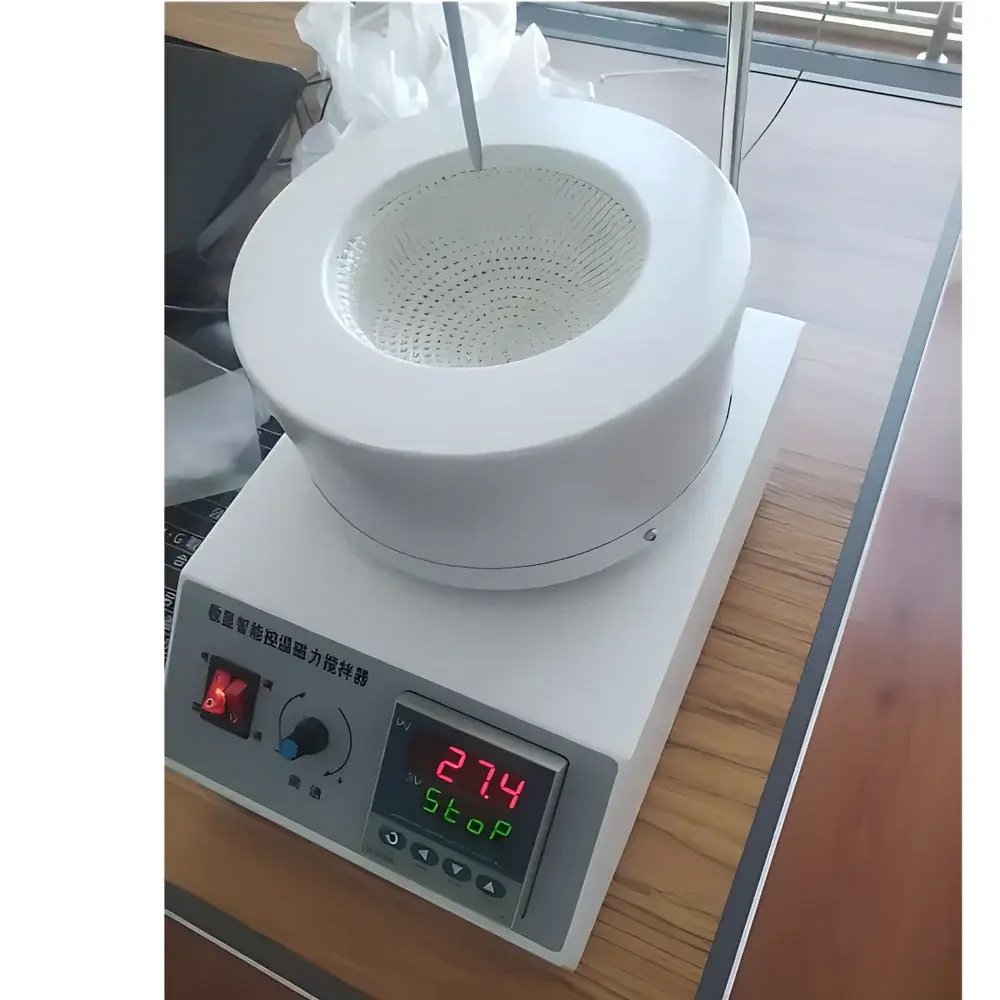
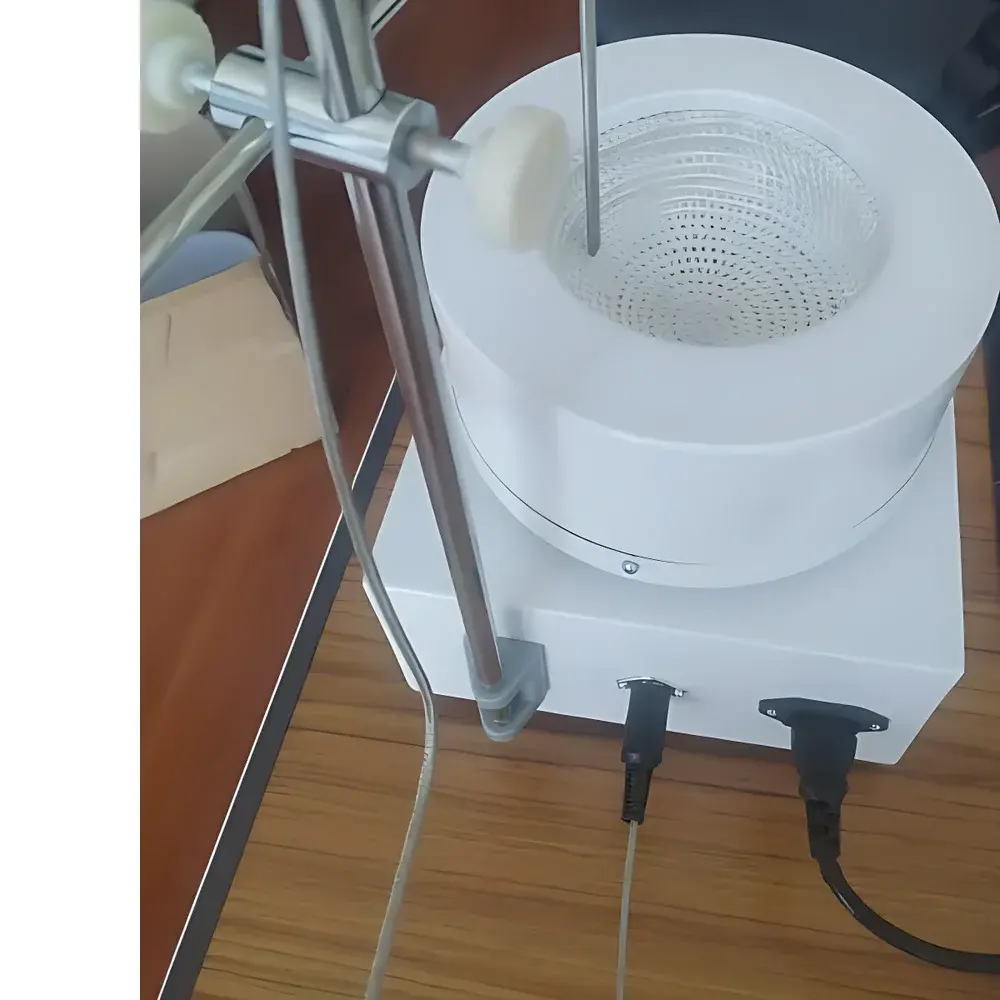
Zhongke Aobo HJS Intelligent Programmable Temperature-Controlled Magnetic Stirring Heating Mantle
| Brand | Zhongke Aobo |
|---|---|
| Origin | Beijing, China |
| Model | HJS Intelligent Programmable Temperature-Controlled Magnetic Stirring Heating Mantle |
| Capacity Options | 100 mL, 250 mL, 500 mL, 1000 mL, 2000 mL, 3000 mL |
| Power Rating | 100 W – 600 W (model-dependent) |
| Max Operating Temperature | 380 °C |
| Temperature Control Accuracy | ±1 °C |
| Stirring Speed Range | 100 – 1500 rpm |
| Dual Temperature Sensing | Internal mantle core + external liquid probe |
| Display | Dual digital LCD (temperature & speed) |
| Heating Element | Sealed Ni-Cr resistance wire embedded in high-temp alkali-free glass fiber insulation |
| Drive Motor | Imported brushless DC motor |
| Housing | Cold-rolled steel with epoxy powder coating |
| Compliance | Designed for laboratory use under general GLP conditions |
Overview
The Zhongke Aobo HJS Intelligent Programmable Temperature-Controlled Magnetic Stirring Heating Mantle integrates precise resistive heating and contactless magnetic agitation into a single compact platform engineered for reproducible thermal and mixing control in analytical, synthetic, and quality control laboratories. Unlike conventional hotplates or standalone stirrers, the HJS series employs a hemispherical, internally wound Ni-Cr heating element encapsulated within alkali-free glass fiber insulation—ensuring uniform radial heat distribution across the mantle surface while eliminating open coils or exposed heating elements. This design minimizes thermal gradients, reduces risk of glassware fracture, and supports stable temperature maintenance during extended reaction periods. The system operates on the principle of electromagnetic coupling: a brushless DC motor beneath the mantle base rotates a permanent magnet assembly, inducing synchronous rotation of a PTFE-coated magnetic stir bar inside the vessel. Temperature regulation is achieved via PID-controlled feedback from dual independent sensors—one embedded in the mantle’s core to monitor heater thermal mass, and another immersed directly in the process liquid to provide real-time solution-phase measurement. This dual-sensing architecture enables accurate compensation for heat loss, solvent evaporation, and exothermic/endothermic events.
Key Features
- Programmable temperature ramping and soaking profiles via intuitive digital controller with dual-line LCD display (setpoint & actual values for both temperature and speed)
- Brushless DC motor drive delivering consistent torque up to 1500 rpm with zero carbon dust generation, low acoustic emission (10,000 hours MTBF)
- Hemispherical heating geometry optimized for volumetric compatibility across six standard capacities (100–3000 mL), ensuring >92% surface contact with round-bottom flasks and jacketed reactors
- Thermal insulation layer composed of high-purity, alkali-free fiberglass rated to 600 °C, providing Class H electrical insulation and minimizing ambient heat radiation
- Cold-rolled steel housing with electrostatic epoxy powder coating (thickness ≥60 µm) for corrosion resistance and mechanical durability in multi-user lab environments
- Over-temperature cut-off and motor stall protection circuits compliant with IEC 61010-1:2010 safety requirements for laboratory electrical equipment
Sample Compatibility & Compliance
The HJS mantles accommodate standard borosilicate glassware (e.g., Pyrex®, Kimax®) including 24/40, 29/32, and 34/22 ground joints. Vessel geometry must conform to ASTM E2739-21 specifications for round-bottom flask dimensional tolerances to ensure optimal thermal transfer. While not certified to UL or CE for standalone medical device use, the unit meets essential safety and EMC criteria per GB 4793.1–2019 (Chinese national equivalent of IEC 61010-1). Its dual-sensor architecture supports data integrity requirements in GLP-regulated environments where contemporaneous recording of both mantle and bulk-phase temperatures is necessary for audit trails. When paired with validated data logging software (see Software & Data Management), the system satisfies documentation expectations aligned with FDA 21 CFR Part 11 for electronic records in pharmaceutical QC labs.
Software & Data Management
The HJS series does not include proprietary PC software but features an RS-232 serial interface (optional USB-to-serial adapter) enabling integration with third-party laboratory information management systems (LIMS) or custom SCADA platforms. Users may configure automated data capture of time-stamped temperature and speed values at user-defined intervals (1 s to 600 s). All controller firmware supports timestamped event logging—including power-on, setpoint changes, alarm triggers, and sensor fault detection—for retrospective analysis. For regulated applications, validation packages—including IQ/OQ protocols, sensor calibration certificates (NIST-traceable Pt100 probes), and firmware version verification—are available upon request to support GMP-compliant installation and operation.
Applications
- Synthesis of metal-organic frameworks (MOFs) requiring simultaneous precise heating (≤380 °C) and homogeneous mixing under inert atmosphere
- Viscosity monitoring of polymer solutions during thermal curing, where constant shear rate and temperature stability are critical to Arrhenius modeling
- Extraction protocols in environmental testing (e.g., EPA Method 3540C), where controlled reflux and agitation improve analyte recovery from solid matrices
- Standardization of reference standards in pharmaceutical assay development, per USP and guidelines for equipment qualification
- Pretreatment of catalyst slurries prior to fixed-bed reactor loading, ensuring particle dispersion uniformity and thermal equilibration
- Calibration of thermocouples and RTDs using stirred oil baths traceable to ITS-90 via dual-sensor cross-validation
FAQ
What is the maximum recommended flask size for the HJS-1000 model?
The HJS-1000 is optimized for 1000 mL round-bottom flasks with 29/32 or 34/22 joints; use with larger vessels may reduce thermal efficiency and stirring uniformity.
Can the external temperature probe be used in corrosive solvents such as concentrated HNO₃?
The standard stainless-steel-sheathed probe is not chemically resistant to strong oxidizers; optional Hastelloy C-276 or PFA-coated probes are available for aggressive media.
Is firmware update capability supported?
Yes—field-upgradable firmware is provided via UART interface; updates include enhanced PID tuning parameters and expanded alarm logging depth.
Does the unit support external analog input for cascade control?
No analog input is built-in, but the RS-232 port allows integration with external PLCs or controllers via Modbus RTU protocol for master-slave thermal management.
What calibration documentation is supplied with shipment?
Each unit ships with a factory calibration report covering temperature accuracy (±1 °C at 100 °C, 200 °C, and 300 °C) and speed linearity (±2 rpm across full range), traceable to CNAS-accredited metrology labs.



